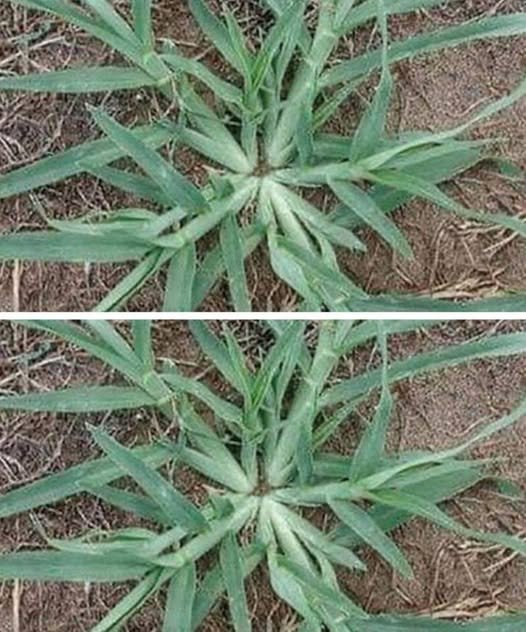
Have you ever noticed a grass-like plant spreading through your garden and immediately thought it was a weed that needed to be pulled out? Think twice before removing it. The plant shown in the image appears to be Bermuda grass (Cynodon dactylon), a vigorous grass that is sometimes treated as a troublesome weed but also has several useful qualities.
Rather than automatically uprooting it, it’s worth understanding what this plant is, why it spreads so quickly, and whether it has a useful place in your garden.
What Is This Plant?
The plant appears to be Bermuda grass, also known in some regions as couch grass or doob grass.
It is a warm-season perennial grass that spreads through above-ground runners (stolons) and underground rhizomes. This ability allows it to establish itself rapidly and recover after mowing, drought, or other disturbances.
Its leaves are usually narrow and green, while the stems can spread horizontally across the soil.
Why Do Gardeners Consider It a Weed?
Bermuda grass can become difficult to control when it grows where you don’t want it.
Its extensive root and runner system allows even small pieces of the plant to establish again under favorable conditions. It can compete with vegetables, flowers, and other plants for water, nutrients, sunlight, and growing space.
This is why the same plant can be desirable in one location and unwanted in another.
For example, Bermuda grass can be useful as a lawn or ground cover, but it may become a nuisance when it spreads into a carefully maintained vegetable or flower bed.
Why You Shouldn’t Automatically Uproot It
Despite its reputation as an aggressive grass, Bermuda grass has legitimate uses.
1. It Can Make a Durable Lawn
Bermuda grass is widely valued for its ability to tolerate heat, sunlight, drought, and foot traffic. In suitable climates, it can form a dense lawn that recovers relatively quickly from wear.
2. It Helps Cover Bare Soil
Dense grass coverage can help reduce exposed soil and may help limit erosion, particularly where suitable growing conditions allow it to establish effectively.
3. It Can Be Used as Forage
Bermuda grass is also cultivated as a forage grass in appropriate agricultural settings. Its usefulness depends on the variety, climate, management, and intended livestock use.
4. It Is Extremely Resilient
One reason Bermuda grass is so successful is its ability to survive difficult conditions. Its underground rhizomes and surface runners help it recover and spread.
That resilience can be an advantage when you actually want a durable grass—but a disadvantage when it invades your flower beds.
Is Bermuda Grass Safe to Have in a Garden?
For most gardeners, the question isn’t whether Bermuda grass is inherently “bad.” The real question is where it is growing.
If it is growing as an intentional lawn or ground cover, it may be perfectly useful.
If it is spreading through a vegetable garden, around ornamental plants, or into areas where you don’t want grass, controlling it may be necessary.
So the statement “never uproot this plant” should not be taken literally for every garden. Gardeners should identify the plant and consider its location and purpose before deciding what to do.
Why Is It So Difficult to Remove?
Bermuda grass can be frustrating because pulling out the visible leaves doesn’t necessarily remove the entire plant.
Its rhizomes and stolons can remain in the soil and produce new growth.
If you decide to remove it from a garden bed, try to remove as much of the underground material as practical and avoid leaving pieces behind. Repeated monitoring is important because surviving fragments can regrow.
What Should You Do If It Appears in Your Garden?
First, identify the plant correctly.
If it is Bermuda grass and you want it as lawn or ground cover, maintain it within its intended area and prevent it from spreading into places where it isn’t wanted.
If it has invaded your vegetable or flower beds, don’t simply leave it because an internet post says it should never be removed. Instead, control it carefully using methods appropriate for your garden and local conditions.
A simple approach includes:
- Remove unwanted runners before they spread further.
- Dig carefully to remove persistent roots and rhizomes.
- Avoid repeatedly breaking the plant into small pieces.
- Monitor the area for new shoots.
- Use suitable mulch to reduce opportunities for regrowth.
- Keep lawn edges and garden beds clearly separated.
Don’t Confuse Identification With Internet Gardening Myths
Many viral gardening posts describe ordinary plants as either “miracle plants” or “dangerous weeds.” Both descriptions can be misleading.
A plant’s value depends on its species, growing environment, and how you’re using your garden.
Bermuda grass is a good example: it’s valuable as a turf and forage grass, but its aggressive spreading habit can make it undesirable in other parts of the garden.
Final Takeaway
If the plant in your photo is indeed Bermuda grass (Cynodon dactylon), don’t automatically label it as either a miracle plant or a useless weed.
It can be an excellent, hardy grass where it is wanted—but its aggressive spreading habit means it should be managed carefully where it competes with other garden plants.