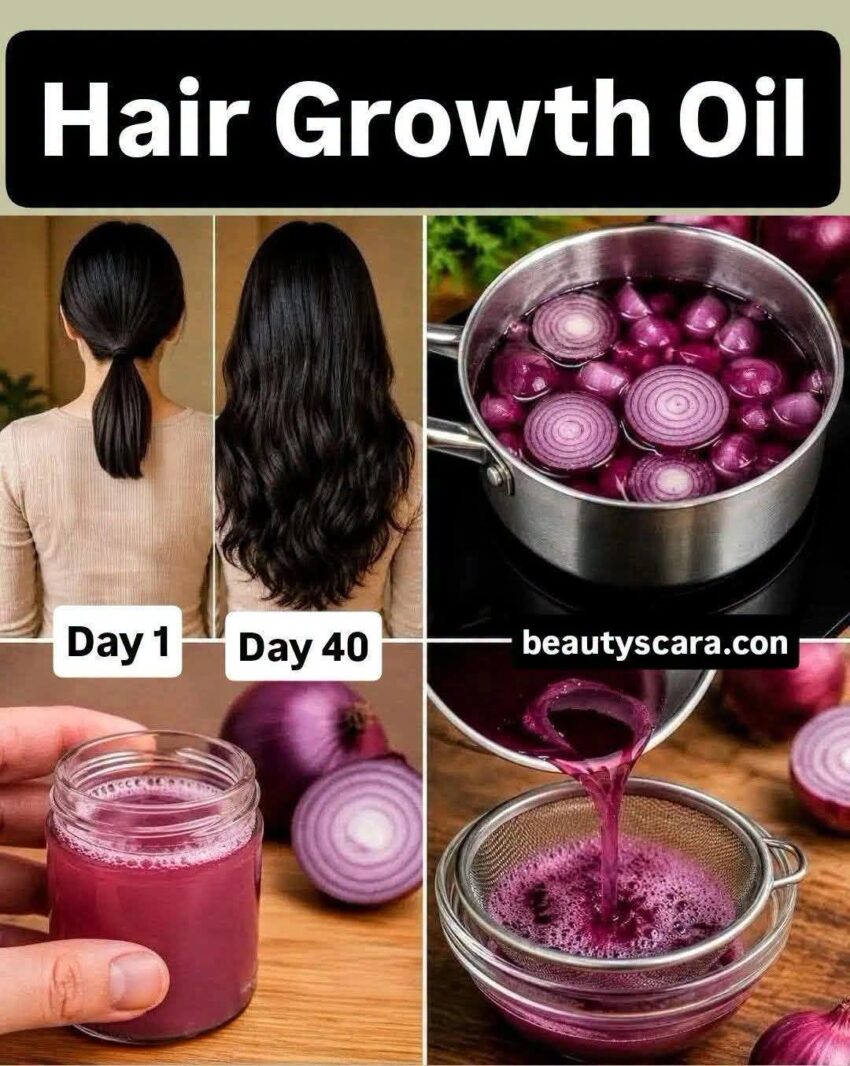
Learn how to use onion juice and onion hair oil for hair care, their potential benefits, DIY recipes, possible side effects, and what research says about hair growth.
Onion juice has become a popular natural hair-care remedy, especially among people looking for ways to support hair growth and reduce the appearance of thinning hair. Onion hair oil is another popular option that combines onion with a carrier oil for scalp massage and conditioning.
But does onion really help your hair grow?
There is some limited research, particularly involving onion juice and certain types of patchy hair loss, but the evidence isn’t strong enough to say that onion juice is a proven treatment for all types of hair loss. Still, onions contain sulfur-containing compounds and antioxidants that make them an interesting ingredient for a simple scalp-care routine.
Let’s look at how to use onion juice and onion oil safely—and what you can realistically expect.
What Are the Potential Benefits of Onion for Hair?
Onions contain sulfur compounds and antioxidant plant compounds. Sulfur is also naturally present in keratin, the protein that makes up much of the hair shaft.
Potential benefits of onion-based hair care include:
- Supporting a healthy scalp environment
- Conditioning dry-feeling hair when used with a suitable carrier oil
- Providing antioxidant compounds
- Helping hair feel softer and more manageable
- Potentially supporting hair regrowth in certain types of patchy hair loss
However, it’s important to distinguish potential benefits from proven medical treatments. Onion juice isn’t a guaranteed solution for genetic hair loss, nutritional deficiencies, hormonal hair loss, or scalp diseases.
How to Make Onion Juice for Hair
Making onion juice at home is relatively simple.
Ingredients
- 1 medium onion
- 2–3 tablespoons of clean water, if needed
- A clean blender or grater
- A fine strainer or clean cheesecloth
Method
- Peel and wash the onion.
- Chop it into small pieces.
- Blend or grate the onion into a paste.
- Squeeze the mixture through a clean strainer or cheesecloth.
- Collect the juice in a clean container.
For best hygiene, prepare a small amount rather than storing homemade onion juice for a long time.
How to Apply Onion Juice to Your Scalp
Before applying onion juice all over your scalp, perform a small patch test.
Apply a tiny amount to an inconspicuous area of skin and wait to see whether irritation develops.
If your skin tolerates it:
- Part your hair into sections.
- Apply a small amount of onion juice directly to the scalp.
- Gently massage with your fingertips.
- Leave it on for approximately 15–30 minutes.
- Wash your scalp thoroughly with a mild shampoo.
- Follow with conditioner if needed.
Avoid getting onion juice into your eyes.
You don’t need to soak your entire head. Applying a modest amount directly to the scalp is enough for a home experiment.
How Often Should You Use Onion Juice?
There’s no well-established ideal frequency for cosmetic onion-juice use.
If your scalp tolerates it, you could start with once or twice a week rather than applying it every day.
If you experience burning, itching, redness, swelling, or worsening irritation, stop using it.
More isn’t necessarily better—irritating the scalp can make your hair-care routine less helpful.
How to Make Onion Hair Oil
Onion hair oil can be a gentler alternative for people who find fresh onion juice too irritating or inconvenient.
Ingredients
- 1 small onion
- ½ cup coconut, olive, or another suitable carrier oil
Method
- Chop the onion into small pieces.
- Add the onion and oil to a clean pan.
- Warm the mixture over low heat.
- Allow the onion to infuse gently without burning it.
- Turn off the heat and let the mixture cool completely.
- Strain out the onion pieces.
- Store the oil in a clean, airtight container.
Because homemade infused oils can spoil or become contaminated if prepared or stored improperly, make small batches and keep them stored appropriately.
How to Use Onion Hair Oil
Using onion oil is straightforward:
- Apply a small amount to your scalp.
- Massage gently with your fingertips for a few minutes.
- Leave it on for around 30–60 minutes.
- Shampoo thoroughly.
- Condition your hair if necessary.
Avoid aggressive scalp massage, especially if your scalp is already irritated or inflamed.
Onion Juice vs. Onion Hair Oil
Which one should you choose?
Onion Juice
Best for: People who want to try a simple, direct scalp application.
Advantages:
- Easy to prepare
- No additional carrier oil required
- Direct application to the scalp
Potential downside: The smell can be strong, and some people may experience irritation.
Onion Hair Oil
Best for: People who prefer an oil-based scalp treatment.
Advantages:
- Can help condition dry-feeling hair
- Easy to massage into the scalp
- Carrier oils can improve the feel of the treatment
Potential downside: It can leave the hair greasy and may not be suitable for every scalp type.
Can Onion Juice Actually Make Hair Grow?
This is where it’s important to keep expectations realistic.
A small clinical study published in the Journal of Dermatology investigated topical crude onion juice for patchy hair loss associated with alopecia areata and reported hair regrowth in participants who used the treatment.
However, this was a small study, and the findings shouldn’t be interpreted as proof that onion juice can treat every type of hair loss.
Hair loss can have many causes, including genetics, hormonal changes, nutritional deficiencies, medications, autoimmune conditions, stress, and scalp disorders.
Treating the cause is much more important than simply applying a home remedy.
Tips for Getting Better Results From Your Hair-Care Routine
If you’re trying onion juice or onion oil, combine it with habits that support overall hair health.
Eat Enough Protein
Hair is largely made from keratin, a protein. A balanced diet containing adequate protein and essential nutrients supports normal hair growth.
Avoid Excessive Heat
Frequent high-heat styling can damage the hair shaft and contribute to breakage.
Be Gentle With Wet Hair
Wet hair can be more vulnerable to stretching and breakage. Avoid aggressive brushing immediately after washing.
Don’t Tighten Hairstyles Too Much
Repeated tension from tight ponytails, braids, buns, or extensions can contribute to traction-related hair loss.
Keep Your Scalp Clean
Regular washing appropriate for your scalp type can help remove excess oil, buildup, and styling products.
Possible Side Effects of Onion Juice
Natural doesn’t automatically mean irritation-free.
Onion juice may cause:
- Burning or stinging
- Redness
- Itching
- Dryness
- Contact dermatitis
- Eye irritation
If you have sensitive skin, eczema, an irritated scalp, or open wounds, be particularly cautious.
Never continue using onion juice simply because you believe irritation means the treatment is “working.” Burning or inflammation is a reason to stop.
When Should You See a Dermatologist?
Consider professional evaluation if you’re experiencing:
- Sudden or severe hair loss
- Noticeable bald patches
- A widening part
- Significant scalp itching or scaling
- Pain, redness, or inflammation
- Hair loss accompanied by other unexplained symptoms
- Continued shedding despite improving your hair-care routine
A dermatologist can help determine whether the problem is related to androgenetic alopecia, alopecia areata, scalp inflammation, nutritional issues, or another condition.
Final Thoughts
Onion juice and onion hair oil are inexpensive home remedies that some people enjoy incorporating into their scalp-care routine. Onion contains potentially useful plant compounds, and limited research has investigated topical onion juice for certain forms of patchy hair loss.
However, onion isn’t a miracle hair-growth treatment.
If you decide to try it, start slowly, perform a patch test, avoid irritated skin, and stop if you develop a reaction. Most importantly, don’t let a home remedy delay professional evaluation when hair loss is persistent, sudden, or significant.
Healthy hair usually depends on more than one ingredient—it’s influenced by genetics, nutrition, hormones, scalp health, hair-care habits, and overall health.