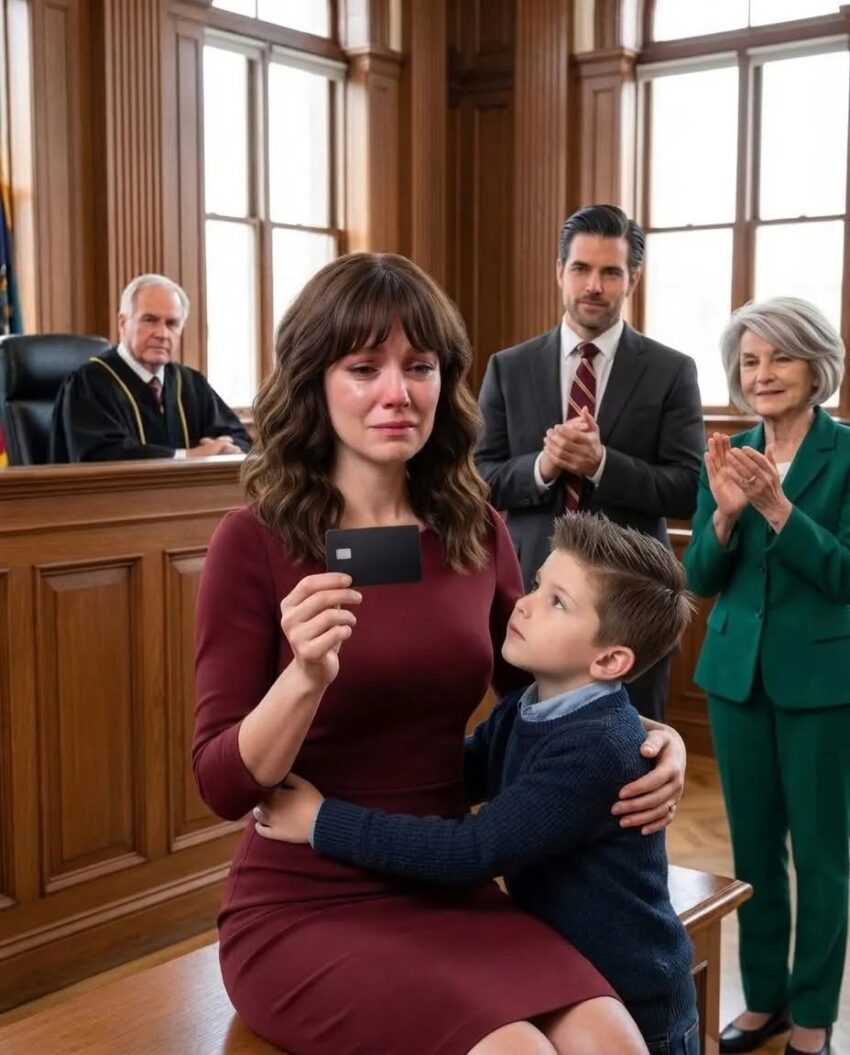
After a painful custody hearing, a twelve-year-old boy chooses his father and tells the judge that his mother cannot give him the future he needs. But what happens afterward changes everything.
After Our Custody Hearing, My Twelve-Year-Old Son Chose His Father
I had rehearsed what I wanted to say to the judge at least a hundred times.
I wanted to explain that I had been there for every fever, every parent-teacher meeting, every late-night homework assignment and every nightmare that sent my son running into my bedroom.
I wanted the judge to know that I wasn’t a perfect mother.
But I was his mother.
And I loved him more than anything in the world.
What I hadn’t rehearsed was hearing my twelve-year-old son say he wanted to live with his father.
The courtroom was quiet when the judge leaned forward and asked him gently,
“Daniel, you’ve heard both sides. Where would you prefer to live?”
My son looked down at his hands.
Then he looked at his father.
Finally, he looked at me.
I smiled at him, even though my heart was already breaking.
“It’s okay,” I whispered. “Tell the truth.”
Daniel swallowed.
“I want to live with Dad.”
The words seemed to echo around the courtroom.
I felt my fingers go cold.
Then he added something that hurt even more.
“Mom can’t give me the kind of future I need.”
I don’t remember breathing.
For twelve years, I had believed I was building that future for him.
Apparently, somewhere along the way, he had stopped seeing it that way.
The Life We Had Built
Daniel’s father, Mark, and I had divorced three years earlier.
There had been no dramatic betrayal or scandal.
We simply became two people who could no longer live peacefully under the same roof.
After the divorce, Daniel lived primarily with me.
Mark had a comfortable job, a larger house and far more financial freedom than I did.
I worked two jobs to keep our small apartment and make sure Daniel had everything he needed.
We didn’t have expensive vacations.
We didn’t have a new car.
Sometimes I had to calculate whether I could afford new shoes that month.
But Daniel always had food on the table.
His school fees were paid.
His birthday cake was homemade.
And whenever he needed me, I was there.
At least, I thought I was.
Then, over the previous year, something changed.
Daniel became quieter.
He started talking constantly about his father’s house.
“Dad is getting a pool.”
“Dad says he’ll help me get a better computer.”
“Dad’s taking me skiing next winter.”
“Dad says I could go to a better school.”
I tried not to react.
“That’s nice,” I’d say.
But inside, I worried.
I knew what was happening.
His father could give him things I couldn’t.
And I was terrified that one day Daniel would confuse having more with being loved more.
The Conversation That Broke Me
The night before the hearing, I sat beside Daniel on his bed.
His room was small, but it was filled with things he had chosen himself.
A soccer poster hung above his desk.
His favorite books were stacked beside the bed.
A photograph of the two of us at the beach sat on his nightstand.
I reached over and brushed his hair away from his forehead.
“Are you scared about tomorrow?”
“A little.”
“Whatever you tell the judge,” I said, “I want you to be honest.”
He looked at me.
“Even if I don’t choose you?”
My heart stopped for a second.
I forced myself to smile.
“Even then.”
He stared at the floor.
“I just want a better future.”
I nodded slowly.
“I know.”
“Dad says I could have more opportunities with him.”
I wanted to tell him that opportunities weren’t just about money.
I wanted to tell him that his father had been away for most of his childhood.
I wanted to tell him about all the nights I’d stayed awake worrying about bills.
But I didn’t.
Instead, I said,
“Whatever happens tomorrow, I’ll always be your mom.”
He hugged me.
For a few seconds, I thought everything would be okay.
I was wrong.
The Judge’s Decision
After Daniel spoke, the judge asked him several questions.
Did anyone pressure him?
Had his father promised him anything?
Was he afraid of me?
Daniel answered no.
The judge then asked him why he preferred his father.
Daniel took a deep breath.
“Dad can give me more opportunities. A better school. More activities. A bigger house. I think I’ll have a better future there.”
Then he looked at me.
“Mom works all the time. She’s always tired.”
That sentence hurt more than anything else.
Because it was true.
I was tired.
I had been tired for years.
But I had thought my exhaustion was invisible to him.
Apparently, it wasn’t.
The judge ultimately decided that Daniel would live primarily with his father, with scheduled time with me.
I nodded.
I didn’t cry in the courtroom.
I didn’t want Daniel to think I was angry at him.
But when I walked into the parking lot, I sat inside my car and finally broke down.
The First Week Without Him
The first morning was unbearable.
There was no cereal bowl on the counter.
No backpack by the door.
No voice yelling,
“Mom! Where are my socks?”
The apartment was silent.
I walked past his bedroom and stopped.
His bed was made.
His favorite stuffed animal was still on the pillow.
I sat down and cried.
Then I noticed something on his desk.
It was an old notebook.
I opened it.
Most of the pages contained schoolwork.
But near the back was a list Daniel had written months earlier.
Things I Want When I’m Older
- Own a house.
- Travel.
- Have a good job.
- Make Mom proud.
- Take care of Mom.
I stared at the fifth line until the words blurred.
“Take care of Mom.”
That was the future he wanted.
I wondered when he’d forgotten it.
Three Months Later
Daniel began spending weekends with me.
At first, he was distant.
He talked about his father’s house constantly.
The new television.
The swimming pool.
The computer.
His new school.
I listened.
I never criticized his father.
Then one Saturday, Daniel arrived carrying a cardboard box.
“What’s that?” I asked.
“My old things.”
He put the box down.
“I want to keep them here.”
I smiled.
“Of course.”
He looked around the apartment.
“Mom?”
“Yeah?”
“Can we talk?”
I sat beside him.
He took a long breath.
“I thought Dad’s house would make me happier.”
I didn’t answer.
He continued.
“Everything is bigger. I have more stuff. But Dad is always working.”
My heart tightened.
“Daniel…”
“I don’t want you to say anything bad about Dad.”
“I won’t.”
He looked down.
“I just miss you.”
I reached for his hand.
“I miss you too.”
What He Finally Understood
Over the next few months, Daniel began noticing things he hadn’t understood before.
He realized that his father’s money could provide opportunities, but it couldn’t automatically provide time.
He realized that a bigger bedroom didn’t make loneliness disappear.
And he realized that my small apartment had never meant I loved him less.
One evening, while we were making pancakes, he suddenly said,
“Mom?”
“Hmm?”
“I’m sorry.”
“For what?”
“For what I said in court.”
I put down the spatula.
“You don’t have to apologize for telling the truth.”
“But I hurt you.”
“Yes,” I admitted. “You did.”
His eyes filled with tears.
“I thought you couldn’t give me a future.”
I hugged him.
“And now?”
He smiled through his tears.
“I think I was looking at the wrong thing.”
A Different Kind of Future
A year after the custody hearing, Daniel’s circumstances had changed.
He continued living primarily with his father, but our relationship became stronger.
We had dinner together several nights a week.
I attended his soccer games.
He came to my apartment on weekends.
And, most importantly, we started talking honestly.
One evening, he handed me a school assignment.
The title was:
“The Person Who Has Influenced My Future the Most.”
I read the first few lines.
“My mom doesn’t have the most money. She doesn’t have the biggest house. But she taught me that having a future isn’t just about what you own. It’s about who you become.”
I couldn’t continue reading.
I looked at him.
“Did you really write this?”
He nodded.
Then he smiled.
“You’re still going to be proud of me, right?”
I pulled him into my arms.
“Always.”
Because I’d finally learned something too.
Being a good parent isn’t about winning a custody battle.
It isn’t about having the biggest house or buying the most expensive gifts.
And sometimes, children need years to understand sacrifices that adults make quietly.
That day in court, my son believed I couldn’t give him the future he needed.
I thought I’d lost him.
But I hadn’t.
He was simply growing up.
And perhaps the greatest gift I could give him was the freedom to discover the truth for himself.