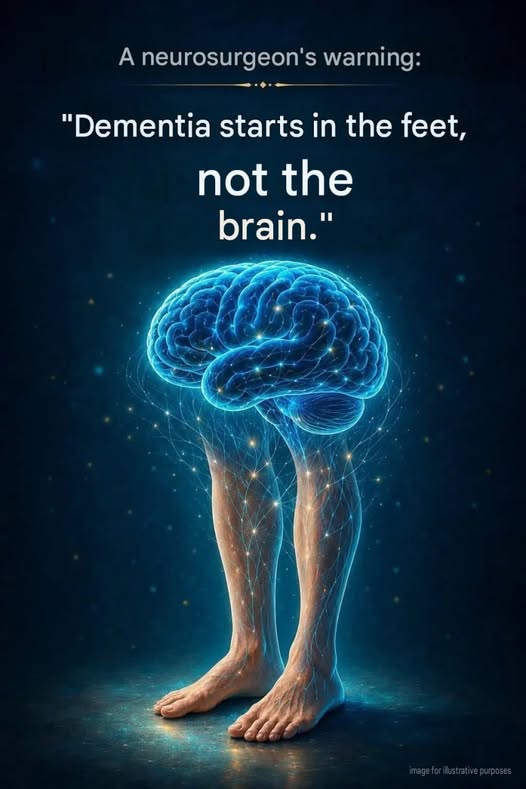
Could changes in walking reveal early problems with cognitive health? Learn what research says about gait, balance, brain health and dementia, and why changes in mobility should not be ignored.
Dementia May Start in the Feet, Not the Brain? What Walking Can Reveal About Cognitive Health
What if changes in the way you walk could provide clues about what is happening in your brain?
The idea that dementia might “start in the feet” is attention-grabbing, but it is not medically accurate to say that dementia literally begins in the feet. Dementia results from diseases and conditions that affect the brain. However, changes in walking, balance and coordination can sometimes occur alongside cognitive problems and may provide useful clues about neurological health.
The surprising connection between walking and the brain
Walking may look automatic, but it requires several brain systems to work together.
Your brain needs to:
- Maintain balance
- Coordinate muscles
- Process information from your eyes and inner ear
- Judge distances and obstacles
- Control the timing of each step
- Adjust your movement to your surroundings
Because of this, changes in gait can sometimes reflect problems involving brain function.
Research has found associations between certain gait abnormalities and cognitive impairment, particularly in older adults. However, a change in walking pattern by itself does not mean someone has dementia.
What changes might be worth noticing?
Some people with neurological or cognitive problems may develop changes such as:
1. Walking more slowly
A noticeable reduction in walking speed can have many causes, including aging, arthritis, muscle weakness, medication effects and cardiovascular problems.
But persistent slowing—especially when accompanied by memory or thinking difficulties—may deserve medical evaluation.
2. Shorter or shuffling steps
Taking unusually small steps or appearing to shuffle can occur in several neurological conditions. Parkinson’s disease, for example, can affect gait and movement.
It is not, however, a specific sign of dementia.
3. Problems with balance
Frequent stumbling, difficulty turning, or feeling increasingly unsteady can have many possible causes.
Vision problems, inner-ear disorders, medication side effects, muscle weakness and neurological conditions can all affect balance.
4. Difficulty performing two things at once
Walking while talking or carrying something requires the brain to divide attention between tasks.
Some people with cognitive impairment may have greater difficulty managing these simultaneous tasks.
Again, this is not a diagnostic test for dementia.
Why walking changes shouldn’t automatically be blamed on dementia
Aging itself can change walking speed and balance. Joint pain, previous injuries, poor vision, neuropathy, vitamin deficiencies, medication side effects and lack of physical activity can also affect mobility.
That’s why a new walking problem should be assessed in context rather than interpreted as proof of dementia.
When should you speak with a doctor?
Consider talking with a healthcare professional if you or a family member develops a persistent or unexplained change in walking, particularly if it occurs alongside:
- Increasing forgetfulness
- Difficulty finding familiar words
- Problems managing familiar tasks
- Changes in judgment
- Getting lost in familiar places
- Personality or behavior changes
- Repeated falls
- New problems with coordination or balance
A doctor can look for reversible causes and determine whether further neurological or cognitive assessment is appropriate.
Keep your brain and body active
Regular physical activity is one of the habits associated with better overall brain and cardiovascular health. Walking, strength exercises and balance activities can also help maintain mobility and independence as we age.
Good sleep, managing blood pressure and diabetes, avoiding smoking, maintaining social connections and eating a balanced diet are also important components of healthy aging.
The bottom line
Dementia does not begin in the feet. But your walking pattern is influenced by the brain, muscles, nerves, vision and balance systems, so meaningful changes in gait can sometimes provide an early clue that something deserves attention.
If walking changes are new, worsening or accompanied by memory or thinking problems, don’t simply dismiss them as normal aging. A medical evaluation can help identify the actual cause.