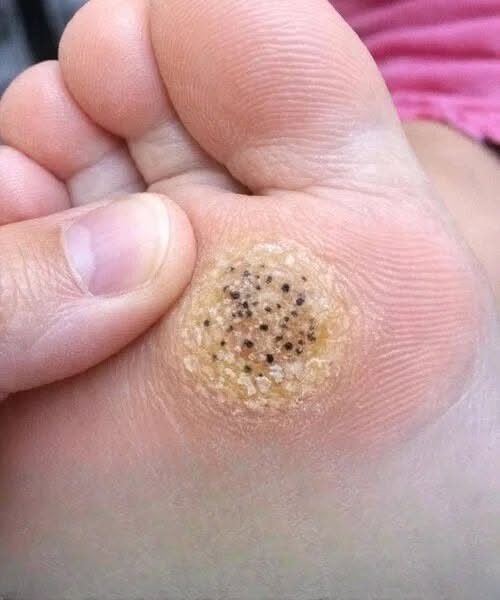
From the photo, this looks most consistent with a plantar wart—a wart that develops on the sole of the foot. The rough, thickened skin and especially the tiny black dots are typical of plantar warts. Those black dots are usually small blood vessels, not “roots” of the wart.
What Is This on the Foot? Likely a Plantar Wart (Verruca)
However, a photo alone cannot confirm the diagnosis. A corn, callus, or another skin condition can sometimes look similar.
Why does it happen?
Plantar warts are caused by certain types of human papillomavirus (HPV). The virus can enter through tiny cuts or breaks in the skin. Because the sole experiences pressure from walking, the wart may grow inward and become surrounded by thick, hard skin.
Best home treatment: Salicylic acid
For a small plantar wart, the most evidence-supported home treatment is an over-the-counter wart remover containing salicylic acid. Dermatologists recommend this approach because salicylic acid gradually removes the layers of the wart.
How to use it:
- Soak the foot in warm water for about 5 minutes.
- Dry the area thoroughly.
- Gently remove some of the dead, thickened skin using a disposable emery board or pumice stone used only for this wart. Don’t make it bleed.
- Apply the salicylic-acid wart treatment exactly according to its package directions.
- Cover it with a bandage if directed by the product instructions.
- Repeat the treatment regularly—usually daily, while gently filing away dead skin every few days.
- Be patient. Plantar warts can take weeks to several months to disappear.
Important: Don’t use the same pumice stone, nail file, or emery board on healthy skin, because the virus can potentially spread. Wash your hands after touching the wart. Avoid picking, scratching, or shaving it.
What about duct tape?
Covering a wart with duct tape is sometimes used as a home treatment. Evidence is mixed, but dermatologists note that it may help some people. It can be used alone or, when appropriate, over a salicylic-acid treatment.
What NOT to do
Don’t try to cut the wart out with a blade, needle, scissors, or nail cutter. This can cause bleeding, infection and potentially spread the wart.
I also wouldn’t recommend putting strong household acids such as concentrated vinegar on it. They can burn healthy skin and don’t provide the controlled treatment you get from a properly formulated wart-removal product.
When you should NOT treat it yourself
Don’t self-treat with salicylic acid if you have diabetes, poor circulation, or numbness/neuropathy in the foot unless a healthcare professional has advised you to do so. (AAD)
You should also see a doctor/dermatologist if it:
- Becomes very painful
- Bleeds or develops an open sore
- Changes rapidly
- Keeps getting larger or spreads
- Doesn’t improve after a reasonable period of treatment
- Is not clearly a wart
- Keeps coming back
A dermatologist can confirm whether it is actually a wart and, if necessary, use treatments such as professional freezing (cryotherapy).
Bottom line: The picture strongly resembles a plantar wart, and the black dots are a classic clue. For an otherwise healthy person, a pharmacy salicylic-acid wart treatment + warm soaking + gentle removal of dead skin is the most reasonable home approach. Don’t cut it yourself, and don’t expect it to disappear overnight.