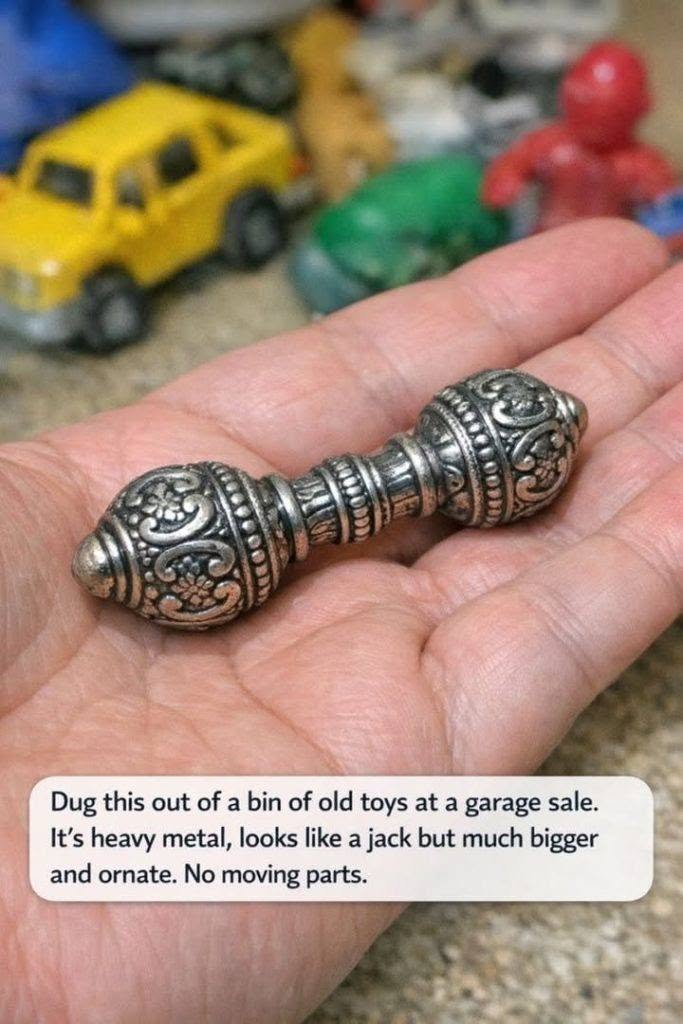
Found a heavy, ornate metal object that looks like an oversized jack but has no moving parts? Here are the most likely possibilities and the clues that can help identify it.
Finding an unusual old object at a garage sale can be surprisingly fascinating. This particular piece sounds especially interesting: heavy metal, shaped somewhat like a jack, considerably larger than a normal toy jack, decorated or ornate, and with no visible moving parts.
At first glance, it might look like a mechanical tool, but the lack of moving components raises an important question: Was it actually designed to function as a jack, or was it made for another purpose?
Could It Be an Old Tool?
One possibility is that the object is related to an old workshop or mechanical tool.
Traditional jacks come in many forms, including bottle jacks, screw jacks, lifting jacks, and specialized industrial jacks. However, a functional lifting jack normally has some type of moving mechanism, such as a screw, lever, ratchet, or hydraulic component.
If your object has absolutely no moving parts, that makes a conventional working jack less likely.
Could It Be a Decorative or Display Piece?
The word “ornate” is an important clue.
Older cast-iron and cast-metal objects were sometimes manufactured with decorative details, elaborate bases, embossed designs, or unusual shapes. Some were intended as decorative objects, paperweights, bookends, shop displays, or novelty pieces rather than practical tools.
If the object is unusually heavy for its size and has decorative features, it may have been designed partly for appearance and stability.
Could It Be a Toy?
Because you found it in a bin of old toys, another possibility is that it could be an old metal toy or miniature replica.
Vintage toys were sometimes made from cast iron or other heavy metals and could look surprisingly realistic. Toy manufacturers produced miniature versions of cars, farm equipment, tools, machinery, and household objects.
However, if it’s significantly larger than a typical toy and extremely heavy, it may have simply ended up in the toy bin because nobody knew what it was.
Could It Be a Paperweight or Shop Advertisement?
Another interesting possibility is that it was produced as a promotional or novelty object.
Businesses sometimes used miniature or stylized versions of their products as advertising pieces. A manufacturer of mechanical equipment, for example, might have produced a small metal representation of one of its machines.
Look carefully for:
- Company names
- Initials
- Numbers
- Logos
- Embossed lettering
- Patent information
- Country of manufacture
- Manufacturer’s marks
Even a few letters can completely change the identification.
The Material Could Tell Us Something
“Heavy metal” is useful information, but identifying the exact material would be even better.
For example, cast iron tends to be very heavy and often has a rougher surface. Older cast-metal objects can also show seams where the mold pieces joined.
Look for:
Casting seams: These can indicate that the object was made using a mold.
Rust: Brown-orange corrosion can suggest iron or steel.
Patina: A dark gray, brown, or aged surface can be characteristic of older metal objects.
Machining marks: Smooth, precisely cut surfaces may indicate that part of the object was mechanically finished.
The Absence of Moving Parts Is a Major Clue
If it genuinely resembles a jack but cannot move, ask whether it ever needed to move.
A decorative replica doesn’t need moving parts.
A toy might have been intentionally manufactured as a solid piece.
A display model might imitate a machine without actually functioning.
An old industrial component might also resemble a jack without actually being one.
That’s why identifying the shape and purpose together is more useful than simply calling it a jack.
What to Photograph
If you’re trying to identify the object, photographs can provide much more information than a description.
Take clear pictures of:
- The entire object from the front
- Both sides
- The top
- The bottom
- Any unusual openings or holes
- Any lettering or numbers
- Any manufacturer’s mark
- Close-ups of decorative details
- A photo next to a ruler or common object for scale
The bottom is particularly important because manufacturers often placed stamps, casting numbers, logos, or other identification marks there.
Don’t Clean It Aggressively Yet
If you suspect the object may be genuinely old or collectible, avoid aggressively sanding, polishing, painting, or using strong chemicals on it before identification.
Original surface patina can sometimes provide useful clues about age and manufacture. Heavy cleaning can also remove markings that could help identify the piece.
For now, gentle dusting and careful photography are safer.
Could It Be Valuable?
Possibly, but the description alone isn’t enough to estimate its value.
The value of an old metal object can depend on:
- Manufacturer
- Age
- Rarity
- Original finish
- Condition
- Size
- Historical use
- Whether it’s a toy, tool, ornament, or advertising piece
- Demand among collectors
A seemingly ordinary cast-metal object can occasionally turn out to be a collectible, while an impressive-looking piece may have little monetary value.
The Most Interesting Clue
The combination of heavy metal + oversized jack-like shape + ornate construction + no moving parts makes me especially hesitant to call it an ordinary jack.
It could be a decorative cast-metal object, miniature industrial replica, novelty item, old toy, or an unusual non-functional mechanical object.
A photo would be the next step. With clear pictures of the object from several angles and especially the underside, it should be possible to narrow down what you’re looking at much more accurately.