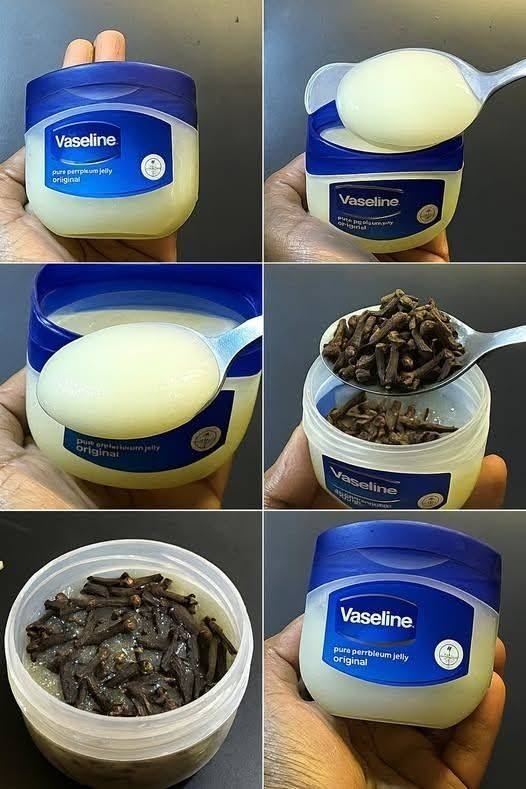
Clove and petroleum jelly are often promoted online as a homemade remedy for skin and beauty concerns. Learn what the mixture may do, how to use it safely, and what to avoid.
Cloves and petroleum jelly are two inexpensive ingredients found in many homes. Recently, a mixture of ground cloves and petroleum jelly has been circulating online as a “secret” remedy for everything from dry skin to unwanted skin problems.
But before putting the mixture on your skin, it is important to separate traditional beauty uses from medically proven claims.
Why Do People Mix Cloves With Petroleum Jelly?
Cloves contain aromatic compounds, particularly eugenol, which has antimicrobial and antioxidant properties in laboratory studies. Petroleum jelly, meanwhile, is an occlusive moisturizer that forms a protective layer over the skin and helps reduce water loss.
That makes the combination potentially useful as a simple moisturizing balm with a warming fragrance—but it does not mean that the mixture can treat infections, parasites, wrinkles, or other medical conditions.
Potential Benefits
1. Helps Seal in Moisture
Petroleum jelly is particularly useful for very dry areas such as:
- Heels
- Elbows
- Knees
- Hands
- Dry patches of skin
Applying a thin layer to slightly damp skin can help keep moisture from escaping.
2. Cloves Provide Antioxidant Compounds
Cloves contain plant compounds with antioxidant activity. However, evidence from laboratory studies does not automatically mean that rubbing ground cloves on your skin will provide the same benefits.
So it is better to view cloves as an optional traditional ingredient, rather than a proven treatment.
3. May Feel Warming
Clove’s aromatic compounds can create a warming or tingling sensation.
Some people like this sensation in homemade body balms, but burning or significant irritation is not a sign that the remedy is working.
A Safer Way to Try It
If you still want to experiment with the mixture for a small area of dry, intact skin, keep the recipe very simple.
Ingredients
- 1 tablespoon plain petroleum jelly
- A very small pinch of finely ground clove
Mix thoroughly.
Apply a tiny amount to a small patch of skin first.
Patch Test First
Before applying it more widely, test a small amount on an inconspicuous area.
Wait 24 hours and check for:
- Redness
- Burning
- Itching
- Swelling
- Rash
If irritation develops, wash the area and discontinue use.
Don’t Put It Everywhere
This is where many viral “clove and petroleum jelly” recipes go too far.
Avoid applying homemade clove mixtures:
- Inside the nose
- Inside the mouth
- Around the eyes
- On broken skin
- On burns
- On freshly shaved or irritated skin
- On the genital area
Ground spices can irritate sensitive tissue, and concentrated clove oil can be considerably more irritating than ordinary culinary cloves.
What About Pimples?
You may see claims that clove mixtures can eliminate acne because cloves have antimicrobial properties.
That is not enough evidence to recommend clove-petroleum jelly as an acne treatment.
In fact, petroleum jelly can feel heavy on some acne-prone areas, while spices may irritate inflamed skin.
For persistent acne, proven ingredients such as benzoyl peroxide or salicylic acid are generally more appropriate.
Can It Remove Dark Spots or Wrinkles?
There is no good evidence that rubbing cloves mixed with petroleum jelly will permanently remove:
- Dark spots
- Wrinkles
- Scars
- Stretch marks
- Age spots
The moisturizing effect of petroleum jelly can temporarily make dry skin look smoother, which may make fine lines appear less noticeable.
That’s different from actually reversing wrinkles.
What About Fungal Infections?
This is another common online claim.
Although compounds found in cloves have demonstrated antimicrobial activity in laboratory research, a homemade clove-and-petroleum-jelly mixture should not be considered a treatment for a fungal infection.
If you have persistent itching, scaling, redness, or a spreading rash, proper diagnosis matters because eczema, fungal infections, allergies, and other conditions can look similar.
One Important Warning About Clove Oil
Don’t assume that clove essential oil is simply a stronger version of ground cloves.
It is highly concentrated and can irritate or damage skin when used incorrectly.
Never apply undiluted clove essential oil directly to the skin.
And because petroleum jelly is an occlusive substance, mixing it with a concentrated essential oil does not automatically make the oil safe.
The Bottom Line
The viral clove + petroleum jelly remedy isn’t a magical secret cure.
Petroleum jelly itself is a well-established moisturizer and skin protectant, while cloves contain interesting plant compounds that have been studied for antioxidant and antimicrobial activity.
But those facts don’t prove that the homemade mixture can cure infections, remove wrinkles, eliminate parasites, or dramatically transform the skin.
If you want to try it as a simple homemade moisturizing balm, use only a tiny amount of ground clove, patch-test first, and stop immediately if your skin burns or becomes irritated.
Sometimes the simplest part of a viral remedy—the petroleum jelly—is also the part with the strongest practical evidence behind it.