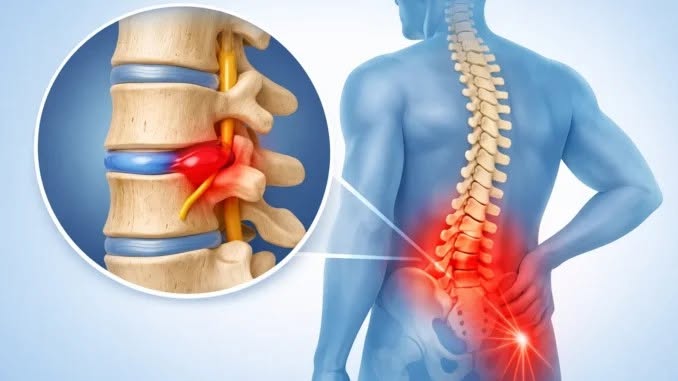
A herniated disc can cause anything from mild back pain to severe pain that travels down the leg or arm. For some people, the symptoms can be frightening—especially when pain, numbness, or weakness appears suddenly.
But a herniated disc does not automatically mean you need surgery.
In many cases, symptoms improve with time and appropriate nonsurgical treatment. Understanding what is happening inside the spine can make the condition feel much less mysterious and help you have a more informed conversation with your healthcare professional.
What Is a Herniated Disc?
Your spine is made up of individual bones called vertebrae. Between most of these bones are flexible structures called discs.
A disc has a tougher outer layer surrounding a softer inner material.
A herniated disc occurs when some of the inner material pushes through a weakened or damaged area of the outer portion.
If the displaced material irritates or compresses a nearby nerve, symptoms can develop.
Herniated discs are particularly common in the lower back, although they can also occur in the neck.
Why Does a Herniated Disc Hurt So Much?
The pain isn’t always caused simply by the disc itself.
A major reason for symptoms is nerve irritation or compression.
For example, a herniated disc in the lower back can irritate a nerve that travels into the buttock and leg. This may cause a type of pain commonly called sciatica.
People may experience:
- Sharp or burning pain
- Pain traveling down an arm or leg
- Numbness or tingling
- Muscle weakness
- Back or neck pain
- Symptoms that worsen with certain movements
Interestingly, some people have a herniated disc visible on an MRI but experience little or no pain.
That’s why imaging findings need to be interpreted together with symptoms and a physical examination.
Does Every Herniated Disc Need Surgery?
No.
Surgery is not automatically required simply because an MRI shows a herniated disc.
Many people improve with conservative treatment.
Depending on the individual situation, treatment may include:
- Staying gently active
- Avoiding activities that significantly worsen symptoms
- Physical therapy
- Pain-relieving medication when appropriate
- Gradually rebuilding strength and mobility
- Guidance from a physician or physical therapist
The exact treatment depends on the location and severity of the herniation, your symptoms, overall health, and whether nerves are being affected.
Why Staying Completely in Bed Usually Isn’t the Answer
When your back hurts badly, lying in bed may seem like the safest option.
But prolonged bed rest can lead to stiffness, muscle weakness, and reduced physical conditioning.
For many people, gentle movement and gradually returning to normal activities are preferable to extended inactivity.
That doesn’t mean you should push through severe pain.
Instead, activity should generally be modified according to your symptoms and your healthcare professional’s advice.
Physical Therapy Can Be Helpful
A physical therapist can assess how you’re moving and develop an individualized program.
Depending on your condition, exercises may focus on:
- Core strength
- Flexibility
- Posture
- Hip and leg strength
- Movement patterns
- Gradual return to normal activities
The goal isn’t simply to “stretch the disc back into place.”
Instead, rehabilitation aims to improve movement, reduce disability, and help you safely return to daily activities.
When Is Surgery Considered?
Surgery may become an option when symptoms are severe, persistent, or associated with significant neurological problems.
A specialist may consider surgery when:
- Severe symptoms don’t improve with appropriate nonsurgical treatment
- Significant or progressive muscle weakness develops
- Nerve compression causes substantial functional problems
- There is a serious emergency involving the spinal nerves
The decision is individualized.
An MRI alone generally doesn’t determine whether someone needs surgery.
Warning Signs That Require Urgent Medical Attention
Although many herniated discs can be managed without surgery, certain symptoms are emergencies.
Seek urgent medical attention if you develop:
- New loss of bladder or bowel control
- Numbness around the inner thighs, buttocks, or genital area
- Severe or rapidly worsening weakness in the legs
- Significant difficulty walking associated with neurological symptoms
These symptoms can indicate severe compression of the nerves at the bottom of the spinal canal, sometimes called cauda equina syndrome, which requires prompt evaluation.
What About Painkillers?
Medication may help some people manage symptoms while the underlying problem improves.
Depending on your health and other medications, a clinician may recommend an appropriate pain reliever or anti-inflammatory medication.
However, medications aren’t suitable for everyone.
For example, some anti-inflammatory drugs can cause stomach, kidney, cardiovascular, or other problems in certain people.
It’s important to follow professional advice and medication instructions rather than assuming that an over-the-counter medicine is automatically safe.
Can a Herniated Disc Heal on Its Own?
In many cases, symptoms improve over time.
The body can gradually reduce the size of the herniated material, and inflammation around the affected nerve can settle.
Improvement doesn’t necessarily mean the disc instantly returns to its original shape.
Instead, the combination of reduced inflammation, adaptation, and natural changes around the herniation can lead to significant symptom relief.
How Can You Protect Your Back?
There is no guaranteed way to prevent every disc problem, but several habits can support spinal health.
Stay Physically Active
Regular movement helps maintain strength and mobility.
Strengthen Supporting Muscles
A balanced exercise routine can help improve overall physical conditioning.
Lift Carefully
When lifting heavy objects, avoid twisting while carrying the load and use a technique appropriate for the object you’re lifting.
Maintain a Healthy Body Weight
Excess body weight can increase mechanical stress on the spine and is associated with back problems.
Avoid Smoking
Smoking is associated with poorer spinal health and can affect tissue healing.
The Bottom Line
A herniated disc can be painful and disruptive, but the diagnosis does not automatically mean surgery.
Many people improve with time, appropriate activity, physical therapy, and symptom management.
At the same time, severe or progressive neurological symptoms should never be ignored.
The best treatment depends on the individual—not simply on what appears on an MRI.
If you have persistent back or neck pain, numbness, tingling, or weakness, a healthcare professional can help determine whether a herniated disc is actually responsible and what treatment is appropriate.
And if you develop sudden bladder or bowel problems, numbness in the saddle area, or rapidly worsening weakness, seek urgent medical care rather than waiting for symptoms to improve on their own.