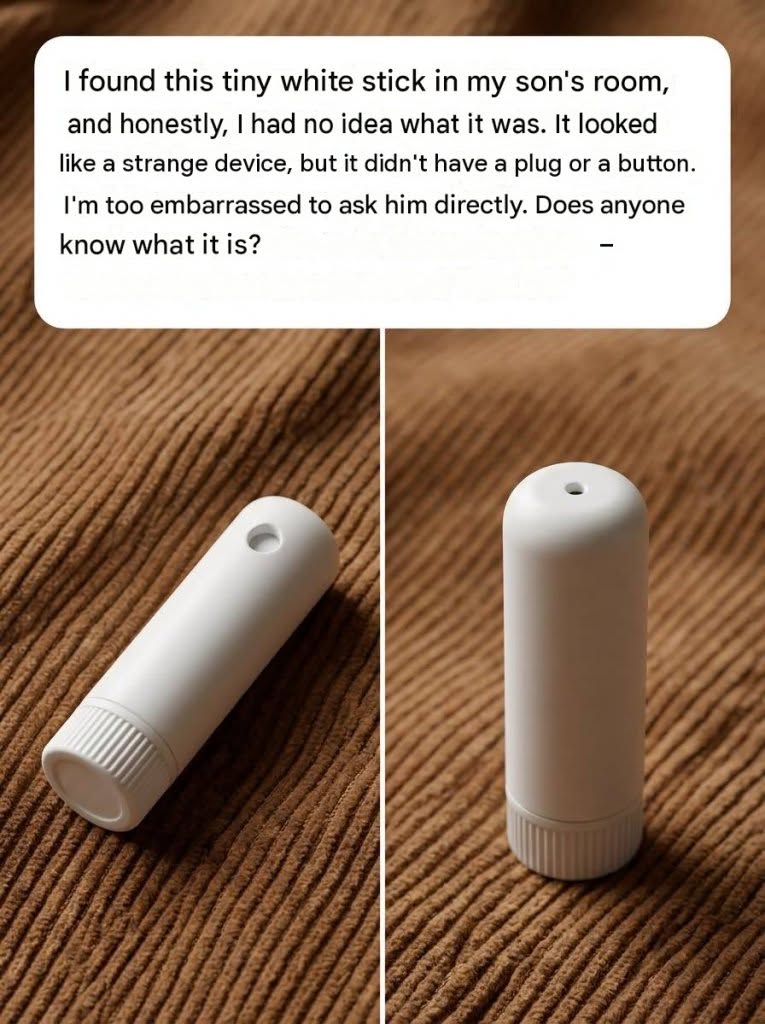
Found a tiny white stick in your son’s room and wondering what it could be? Here are common possibilities, clues to check, and when you should avoid touching an unknown object.
I Found a Tiny White Stick in My Son’s Room and Was Too Embarrassed to Ask Him — What Could It Be?
Finding an unfamiliar object in your child’s room can instantly make you curious—and sometimes a little uncomfortable. A tiny white stick may look unusual, especially if you have no idea what it is or what it is used for.
Before jumping to conclusions, though, it’s important to remember that a small white stick can have dozens of completely ordinary explanations.
It could be part of a household product, a cosmetic item, a craft supply, an electronic accessory, packaging material, or something related to a personal-care product. Without seeing the object clearly, there is no reliable way to identify it simply from the description “tiny white stick.”
First, Don’t Panic
The first thing to remember is that an unfamiliar object doesn’t automatically mean something suspicious.
Small white plastic objects are extremely common. Many everyday products contain little sticks, rods, applicators, handles, caps, or pieces of packaging that can easily become separated from the original product.
Instead of guessing what it is, look for some basic clues.
Check the size
Is it:
- About the size of a matchstick?
- Longer and thinner, like a cotton swab?
- Very short, like a small plastic applicator?
- Thick and solid?
- Hollow inside?
The size can immediately eliminate many possibilities.
Look at the material
Does it appear to be:
- Plastic?
- Paper or cardboard?
- Cotton?
- Wood?
- Silicone or rubber?
- Something waxy or chalky?
A smooth plastic stick is likely to have a very different purpose from a soft cotton or paper one.
Look for markings
Sometimes tiny objects have surprisingly useful clues.
Check whether there are:
- Letters or numbers
- A logo
- A colored end
- A small groove
- A cap
- Threads or ridges
- A hole through the middle
- A pointed or rounded end
Even a tiny marking can help identify the original product.
What Could a Tiny White Stick Be?
There are many possibilities, so it’s better to think in categories rather than immediately assuming one particular explanation.
1. A personal-care item
Some grooming and personal-care products come with small applicators or plastic sticks. These may be used with cosmetics, skincare products, nail products, or other grooming items.
If the object has a cotton-like tip, it may simply be an applicator.
2. Part of packaging
This is one of the easiest possibilities to overlook.
Packaging sometimes contains small plastic pieces that help hold products in place, protect openings, or assist with application. Once the main product has been thrown away, the little piece may be left behind.
3. An electronic accessory
Small plastic rods and pieces are also found with electronics and accessories.
For example, an object could be part of:
- A cleaning kit
- A tool for removing or adjusting a component
- A cable accessory
- A small electronic device
- A gaming accessory
If your son has recently bought electronics, check the packaging before assuming anything else.
4. A craft or hobby item
Tiny sticks are commonly used for crafts, models, art projects, repairs, and hobbies.
A small white rod could simply be a leftover piece from a project.
5. A household item
Some household products contain small disposable applicators or plastic rods.
It may even be something that accidentally ended up in the bedroom from another part of the house.
What If You’re Embarrassed to Ask?
This is probably the biggest reason someone might search online instead of simply asking.
But honestly, asking doesn’t have to be awkward.
You don’t have to say, “What is this?” in a suspicious way.
You could simply say:
“Hey, I found this little piece in your room. Do you know what it belongs to?”
That’s it.
If it is something completely ordinary, the mystery is solved in seconds.
And if your son is an adult, giving him some privacy while still asking about an unexplained object is often the most respectful approach.
Don’t Identify It Based on One Clue
A common mistake is seeing a small white stick and immediately deciding that it must be associated with a particular product or activity.
That’s unreliable.
Two completely unrelated products can have almost identical-looking pieces.
Shape + size + material + markings + context are much more useful than color alone.
For example, “tiny white plastic stick” isn’t enough information to distinguish between an applicator, packaging component, electronic accessory, craft piece, or another everyday object.
If You Don’t Know What It Is, Handle It Carefully
If the object is genuinely unknown, don’t put it in your mouth, smell it closely, burn it, crush it, or try to open it.
If there is powder, liquid, residue, or an unusual odor on it, avoid unnecessary contact and keep children and pets away from it.
If you think it could contain a chemical, medication, or another potentially harmful substance, it’s safer to leave it alone and seek appropriate local advice rather than experimenting with it.
A Photo Can Solve the Mystery
One of the easiest ways to narrow it down is to take a clear photograph.
Place the object next to something of known size—such as a coin or ruler—and take photos from several angles.
Try to capture:
- Both ends
- The entire length
- Any writing or symbols
- The texture
- Any attached material
- Whether it is hollow or solid
A clear image can provide far more information than a description alone.
The Bottom Line
A tiny white stick found in your son’s room doesn’t have one obvious explanation. It could be a harmless piece of packaging, a personal-care applicator, an electronic accessory, a craft item, or something else entirely.
So before assuming the most embarrassing possibility, take a closer look.
And if you’re still unsure, there’s nothing wrong with simply asking.
Sometimes the strangest-looking object turns out to be the most ordinary thing.