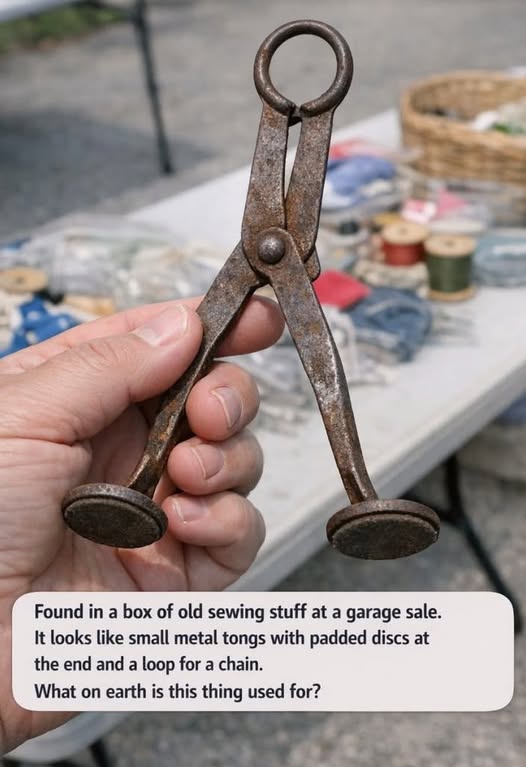
Found a strange pair of tiny metal tongs with padded discs and a chain loop in an old sewing box? Discover what this unusual vintage tool may have been used for and why antique sewing kits contained such specialized accessories.
Found in a Box of Old Sewing Stuff at a Garage Sale—What on Earth Is This Little Tool?
Garage sales are full of mysteries. You can open an old sewing box expecting to find nothing more than needles, buttons, thread, and scraps of fabric—and suddenly discover a tiny metal tool that looks like it belongs in a completely different world.
That is exactly what happened when someone found a small pair of metal tongs with padded discs and a loop for attaching a chain inside a box of old sewing supplies.
At first glance, it is difficult to tell what the object actually does. It doesn’t look like ordinary scissors, a needle threader, or a thimble. The little padded ends make it even more unusual.
So, what could it be?
The Chain Loop Is a Very Important Clue
One of the most interesting features is the small loop designed to attach the object to a chain.
Before modern sewing organizers and plastic storage boxes became commonplace, people often carried small personal tools on chains.
These accessories were sometimes attached to what was known as a chatelaine.
A chatelaine was essentially a decorative chain worn around the waist or attached to clothing. It could hold useful household tools such as scissors, keys, sewing implements, watches, or other small accessories.
That means the mysterious little tongs may have been designed not only to perform a particular task but also to be kept conveniently at hand.
Why Are There Padded Discs?
The padded discs are another fascinating feature.
If the ends were covered with fabric, leather, felt, rubber, or another soft material, they were probably intended to grip something without scratching or damaging it.
That’s particularly useful when working with delicate materials.
A bare metal tool could easily mark:
- Fine fabric
- Embroidery
- Lace
- Thread
- Decorative materials
- Small metal or jewelry components
Adding a soft surface would provide a gentler grip.
Could It Have Been Used for Sewing?
Possibly—but we shouldn’t assume that simply because it was found in a sewing box.
Old sewing boxes often became collections of miscellaneous household objects over many decades. A grandmother might put a small useful tool into her sewing box simply because that was where she kept tiny things.
Nevertheless, the design certainly fits the world of needlework and delicate handwork.
Small gripping tools could be useful when manipulating tiny objects that were difficult to hold with ordinary fingers.
Antique Sewing Tools Were Surprisingly Specialized
Modern sewing enthusiasts have access to hundreds of specialized tools, but vintage sewing equipment could be just as ingenious.
People who regularly worked with clothing and textiles needed tools for very specific jobs.
There were implements for:
- Cutting thread
- Turning fabric
- Handling needles
- Removing stitches
- Working with buttons
- Measuring
- Holding delicate materials
- Repairing garments
- Embroidery and decorative work
Some of these tools were beautifully made and were designed to last for generations.
That’s why an object that looks mysterious today may have been instantly recognizable to someone a century ago.
It Might Not Actually Be a Sewing Tool
This is an important possibility.
The fact that the tongs were found inside a sewing box doesn’t necessarily prove they were used for sewing.
Vintage household collections were often stored together.
The object could potentially have belonged to another category, such as a personal accessory, household implement, jewelry-related tool, or another small Victorian/early-20th-century device.
The exact identification depends on details such as its dimensions, construction, hinge, shape of the jaws, and the material covering the discs.
Look Closely at the Construction
If you still have the mystery object, examine it carefully.
Ask yourself:
Are the padded discs round or oval?
The shape may provide a clue about what they were designed to hold.
Do the tongs spring open automatically?
If they do, the tool may have been designed for repeated gripping.
Are the discs removable?
If so, they may have been replaceable protective surfaces.
Is there decoration on the metal?
Engraving, floral patterns, or ornate metalwork could indicate that the tool was intended to be carried as part of a decorative chatelaine rather than simply thrown into a toolbox.
How large is it?
Measurements are extremely useful when identifying antique objects. A tool only a few centimeters long could have had a completely different purpose from one several inches long.
The Garage-Sale Mystery Is Part of the Fun
One reason vintage sewing boxes are so fascinating is that they provide little snapshots of everyday life.
A modern sewing kit might contain a few basic tools and perhaps an electronic sewing machine.
An older sewing box could contain dozens of tiny implements, many of which were designed for tasks that are rarely performed today.
That makes unidentified vintage tools particularly interesting.
Something that looks completely useless today may once have been an essential little helper.
Don’t Throw It Away
If you find something like this at a garage sale, flea market, or inside an inherited sewing box, don’t automatically discard it just because you don’t recognize it.
Vintage tools can have historical, collectible, or decorative value.
Before cleaning or polishing the metal, take photographs and research the markings. Aggressive cleaning can sometimes remove original finishes or reduce the value of an antique.
If there is a maker’s mark, patent number, engraving, or manufacturer’s name, photograph it carefully.
That tiny detail could be the key to identifying the entire object.
How to Identify It More Accurately
If you want to solve the mystery, take several clear photographs.
Include:
- The entire object from above
- Both sides
- A close-up of the padded discs
- The hinge or gripping mechanism
- The chain loop
- Any markings or engraving
- A ruler or coin beside it for scale
Then compare the shape with photographs of antique sewing tools, chatelaine accessories, and vintage household implements.
Even better, an antique-tool collector or specialist may recognize the design immediately.
A Tiny Object With a Surprisingly Interesting History
The little metal tongs may look insignificant, but their design tells us something about how people once organized everyday life.
The small size, padded gripping surfaces, and chain attachment suggest that this was designed to be both practical and portable.
Whether it turns out to be a specialized sewing implement or a small household accessory, it is a great example of how many clever vintage tools have become mysterious to modern eyes.
And that’s exactly what makes finding old sewing boxes so much fun.
That strange little object sitting at the bottom of the box may have had a very specific purpose—one that was completely obvious to the person who originally owned it.