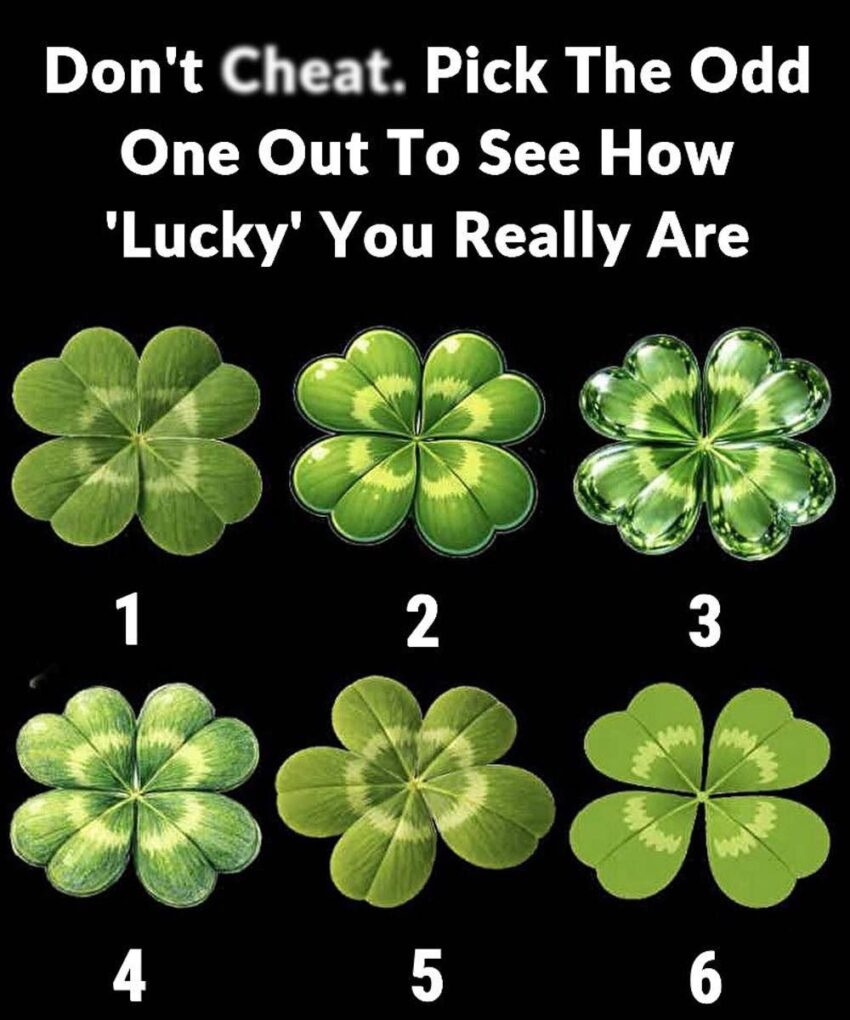
At first glance, this looks like a simple visual puzzle. You are shown several clovers that appear almost identical, and your job is to find the one that does not belong.
Sounds easy, right?
Not quite.
The closer you look, the more difficult the decision becomes. Small differences in shape, symmetry, texture, or overall appearance can make one clover stand out from the others. And sometimes, the one you notice first may not even be the one you eventually choose.
That is what makes this challenge so interesting.
Four-leaf clovers have traditionally been associated with good fortune, so this puzzle adds a playful twist by asking whether your choice can reveal something about your own idea of “luck.”
Of course, your choice cannot scientifically determine whether you are lucky or predict your future. Instead, this is a fun personality-style exercise based on how you observe differences and make decisions.
So, before reading the explanations below, look at the image carefully and choose the clover that you believe is the odd one out.
Don’t change your answer after reading the results.
Why Is the Puzzle Harder Than It Looks?
Odd-one-out puzzles are designed around a simple concept: several objects share a characteristic while one differs.
In more difficult visual puzzles, however, you may need to compare several features at once. Shape, position, symmetry, size, color, and small design details can all influence what your brain notices first.
That means two people can look at exactly the same image and notice completely different things.
One person may immediately spot a tiny shape difference.
Another may focus on symmetry.
Someone else may simply choose the clover that “feels” different.
And that is where the personality element of this challenge comes in.
What Your Choice Might Reveal
If You Chose Clover 1
You may be someone who appreciates simplicity and authenticity.
You tend to prefer things that feel natural rather than overly complicated. When making important decisions, you may rely on your own experience rather than following whatever everyone else is doing.
Your version of “luck” may come from patience.
Rather than expecting something extraordinary to happen overnight, you are more likely to believe that consistent effort eventually produces good results.
You may also be difficult to impress. Flashy appearances don’t necessarily convince you. You tend to look for what feels genuine.
Your lucky trait: Patience.
If You Chose Clover 2
Choosing the second clover may suggest that you are particularly attentive to small details.
You may notice things that other people overlook. Instead of immediately choosing the first option that catches your attention, you are more likely to compare your choices carefully.
This can make you a thoughtful decision-maker.
You may prefer to understand a situation before taking action, especially when the consequences matter.
Your “luck” may therefore come from preparation rather than chance. You notice potential problems early and may avoid mistakes because you take time to think things through.
Your lucky trait: Awareness.
If You Chose Clover 3
If Clover 3 immediately stood out to you, you may value peace, stability, and emotional balance.
You probably don’t need constant excitement to feel that life is going well. Small victories, comfortable relationships, and a peaceful environment may mean more to you than dramatic achievements.
You may also have a practical approach to opportunities.
Instead of chasing every exciting possibility, you may prefer something reliable and realistic.
Your version of luck is therefore less about sudden surprises and more about having the right people, circumstances, and opportunities around you.
Your lucky trait: Stability.
If You Chose Clover 4
Choosing Clover 4 could indicate a more creative and imaginative way of looking at things.
You may naturally search for unusual details and patterns. When everyone else sees the obvious answer, you may wonder whether there is another possibility hiding underneath the surface.
This kind of thinking can be useful when solving problems because you aren’t always restricted by conventional approaches.
You may also enjoy trying new things and exploring ideas that other people might overlook.
Your “luck” may come from seeing possibilities where others see limitations.
Your lucky trait: Creativity.
If You Chose Clover 5
If Clover 5 caught your attention first, you may be more intuitive than analytical.
You might sometimes make decisions based on a feeling before you can fully explain why you feel that way.
That doesn’t necessarily mean you avoid logic. Instead, you may combine your first impression with later reasoning.
People with this kind of approach often trust their instincts when something doesn’t feel quite right.
Your version of luck may be connected to recognizing opportunities quickly and being willing to act before you have every possible detail.
Your lucky trait: Intuition.
If You Chose Clover 6
If you selected Clover 6, you may have a more analytical and independent mindset.
You may naturally look for structure, inconsistencies, and patterns rather than simply accepting what appears obvious.
You may also be comfortable disagreeing with the majority when your own reasoning tells you something different.
That independent thinking can sometimes create opportunities because you are willing to take a different path.
In versions of this particular clover challenge circulating online, Clover 6 is often presented as the intended odd one out because of its more simplified or illustrated appearance. However, the deeper purpose of the challenge is the way you approached the choice, not whether you can prove yourself “lucky.”
Your lucky trait: Independent thinking.
So, Which Clover Is Actually the Odd One Out?
If this is the commonly circulated six-clover version of the puzzle, Clover 6 is often identified as the odd one out because its appearance differs from the more natural-looking clovers.
But there is an important catch.
The idea that your selected clover can reveal your actual level of luck is not a scientific personality test.
The personality descriptions are intended for entertainment. They give you something interesting to think about based on your choice, but they should not be treated as psychological measurements.
What Does This Have to Do With Luck?
The connection comes from the symbolism of the clover.
Four-leaf clovers are commonly associated with good fortune because they are much less common than three-leaf clovers. That cultural association makes them perfect for a puzzle about luck.
But perhaps the more interesting lesson is that what looks like “luck” from the outside can sometimes be influenced by attention, timing, preparation, and decision-making.
Someone who notices an opportunity quickly may appear lucky.
Someone who prepares for a difficult situation may appear lucky when things go well.
Someone who carefully avoids unnecessary risks may seem unusually fortunate.
In reality, many different factors can contribute to the outcome.
Did You Trust Your Instinct or Analyze Every Detail?
Think back to the moment you made your choice.
Did you immediately point to one clover?
Or did you compare all six before deciding?
That difference may actually be more interesting than the number you selected.
If you answered immediately, you may naturally trust your first impressions.
If you spent several seconds comparing the options, you may prefer evidence and careful observation.
Neither approach is automatically better.
Different situations require different ways of thinking.
The Real Challenge Isn’t Finding the “Lucky” Clover
The most entertaining part of this puzzle isn’t necessarily discovering which clover is officially considered different.
It’s asking yourself why you noticed the one you chose.
Our brains naturally search for patterns and differences when we are presented with a visual comparison. More complex odd-one-out tasks can require attention to several characteristics at the same time.
That is why these puzzles can feel surprisingly difficult even when the image appears simple.
You might think you have found the answer, look again, and suddenly notice another detail.
And then you start questioning yourself.
That is exactly what makes the challenge fun.
Final Verdict
So, are you actually lucky?
This puzzle can’t answer that question scientifically.
But it can provide a fun glimpse into how you approach visual information and decisions.
Whether you picked Clover 1, 2, 3, 4, 5, or 6, the most interesting question is not simply “Was I right?”
It’s:
“What made me choose that one?”
Maybe you trusted your instincts.
Maybe you noticed a tiny detail.
Maybe you analyzed every clover carefully.
Or maybe one simply caught your eye.
Whatever your answer, that’s what makes this little challenge more than just another picture puzzle.
Now tell us: Which clover did you pick before reading the results?
SEO Meta
Meta Description:
Pick the odd one out in this fun clover puzzle and discover what your choice might reveal about your observation skills, decision-making style, intuition, and playful idea of luck.