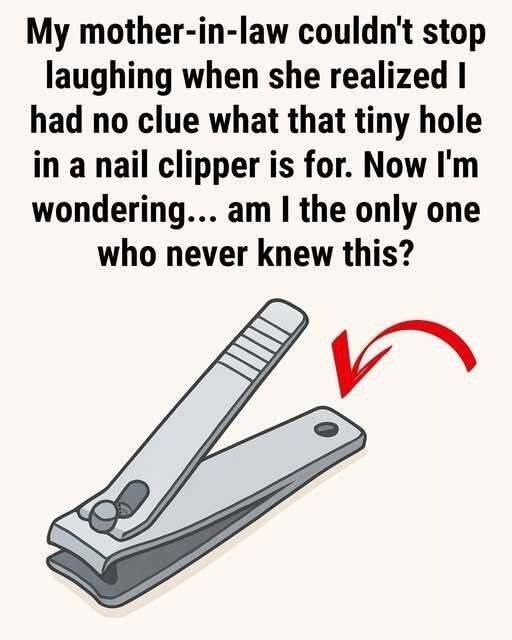
Ever wondered why your nail clipper has a tiny round hole? Discover its original purpose, how it works, and why this simple feature is still found on many nail clippers today.
That tiny round hole near the end of a nail clipper may look like a meaningless design detail. You may have used nail clippers for years without ever wondering why it is there. But in many traditional nail clippers, that little opening has a practical purpose connected to the way the tool is assembled and operates.
The Hole Helps With the Lever Mechanism
A standard nail clipper has several basic parts: two cutting jaws, a metal lever, and a small pivot or pin that holds everything together.
The round opening is commonly associated with the pivot and assembly area of the clipper. Depending on the specific design, it can provide clearance for the mechanism or help accommodate the small post that connects the lever and cutting jaws.
When you squeeze the lever, force is transferred through this mechanism to bring the two sharp cutting edges together. The small hole is therefore part of a design that allows the components to move and work together efficiently.
Some Nail Clippers Use the Hole for Storage
There is another clever possibility with certain designs: the opening can make the clipper easier to attach to a key ring, hook, or small storage loop.
This is especially useful for compact nail clippers that are designed to be carried in a toiletry bag, travel kit, or pocket. Rather than letting the clipper disappear at the bottom of a drawer, the hole can provide a convenient attachment point.
It Isn’t Just Decorative
Manufacturers generally don’t add tiny openings to metal tools without a reason. On nail clippers, the exact purpose of a hole varies according to the model and its construction.
Some holes are associated with the pivot mechanism, while others are intended for hanging or carrying the tool. That’s why you may notice that the location and size of the hole differ between nail clippers.
Why Has the Design Lasted So Long?
Nail clippers haven’t needed dramatic changes because the basic mechanism is remarkably effective. A simple lever provides enough mechanical advantage to cut fingernails and toenails without requiring much hand strength.
The familiar design is inexpensive to manufacture, durable, compact, and easy to use. Once manufacturers found a practical configuration, there was little reason to completely redesign it.
A Small Detail With a Practical Purpose
The next time you pick up a nail clipper, take a closer look at that little round hole. It may be involved in the clipper’s construction, provide a convenient way to carry or hang it, or serve another purpose specific to that model.
What looks like an insignificant hole is actually a reminder that even the smallest everyday objects often contain thoughtful engineering.
So, if you’ve ever wondered about that tiny opening, now you know: its purpose isn’t necessarily the same on every clipper, but it can be an important part of the tool’s design rather than a useless decoration.