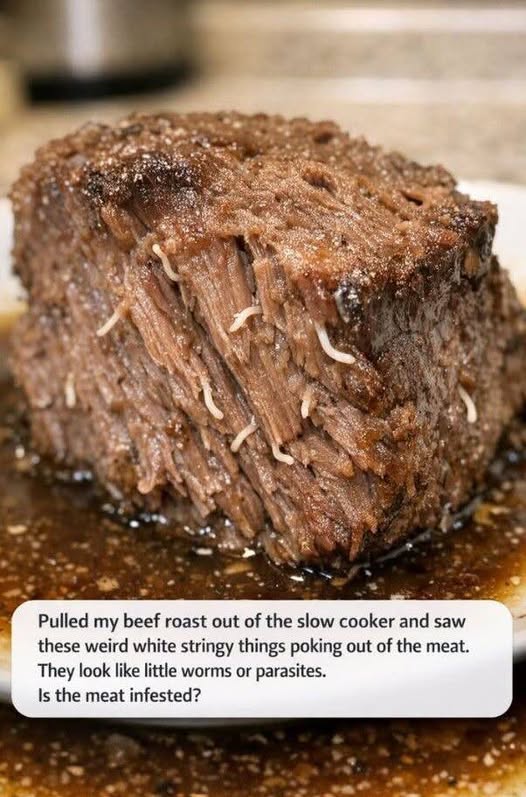
You spend hours letting a beef roast slowly cook until it becomes tender and flavorful. Then, when you finally lift the lid and pull the roast out, you notice something unexpected: thin, white, stringy pieces attached to the meat.
For a moment, it can look alarming.
Are they worms? Fat? Connective tissue? Something that came from the slow cooker?
Fortunately, in many cases, those strange white strands are simply a normal part of the beef that becomes more noticeable after long, slow cooking.
The White Strings Are Often Connective Tissue
Beef contains connective tissue that helps hold muscle fibers together. One important component is collagen, a protein found throughout meat.
When beef is cooked slowly for several hours, collagen gradually breaks down and turns into gelatin. This is one of the reasons a tough cut of beef can become incredibly tender after spending hours in a slow cooker.
Before and during this process, however, some of the connective tissue can remain visible as white, stringy or ribbon-like pieces.
Depending on the cut of beef and how it was trimmed, these strands can look surprisingly unusual.
It Could Also Be Fat or Gristle
Not every white substance you see is connective tissue.
Beef can contain different types of fat and cartilage-like tissue. Some pieces appear white and firm when raw but become softer, translucent, or stringy after cooking.
Fat generally has a softer, waxy appearance, while tougher connective tissue can look more like thin threads, membranes, or strings.
If the material was firmly attached to the roast rather than growing separately from the meat, it is more likely to be a normal component of the cut.
Why Does Slow Cooking Make It More Noticeable?
Slow cooking changes the structure of meat.
As the roast cooks, muscle fibers contract and moisture moves through the meat. Meanwhile, collagen gradually breaks down.
This can cause pieces of connective tissue that were difficult to notice before cooking to become more visible.
The roast may also shrink during cooking, exposing strands or membranes that were previously hidden inside the meat.
So something that wasn’t obvious when you placed the roast into the slow cooker may suddenly be very noticeable when you take it out.
Are They Worms or Parasites?
This is usually the first concern people have when they see unusual white strands.
A photograph would be needed to identify an unknown substance with confidence, but white strands that are firmly integrated into cooked beef are often connective tissue rather than parasites.
Parasites have different appearances and cannot be identified simply by assuming that anything white and string-like is a worm.
If something looks genuinely unusual, especially if it appears separate from the meat, moving, or unlike ordinary connective tissue, don’t rely on appearance alone. Discarding questionable food and consulting a food-safety professional is safer than taking chances.
What Does Normal Connective Tissue Look Like?
Connective tissue can appear as:
- Thin white strings
- Tough white membranes
- Silvery-looking layers
- Fibrous strands
- Small pieces of gristle
- White bands running through the meat
Some cuts naturally contain more connective tissue than others.
Chuck roast, for example, is popular for slow cooking partly because it contains enough connective tissue and fat to become rich and tender after prolonged cooking.
What Should You Do With It?
If the roast smells normal, was stored and cooked properly, and the white material looks like ordinary fat or connective tissue, you can simply trim away any tough pieces before serving.
Some connective tissue becomes soft and gelatinous during cooking and can contribute to the richness of the finished dish. Other pieces remain chewy and may be unpleasant to eat.
You don’t necessarily need to throw away an entire roast just because you see a few white strands.
When Should You Be Concerned?
Appearance isn’t the only thing that matters when judging food safety.
Be cautious if the beef:
- Has an unusual rotten or strongly sour odor
- Feels unusually slimy before cooking
- Was left at unsafe temperatures for an extended period
- Shows unexpected mold-like growth
- Has an unusual substance that doesn’t resemble normal meat, fat, or connective tissue
- Was stored improperly or kept far beyond recommended storage times
Also remember that slow cooking does not make improperly stored meat automatically safe. Proper refrigeration, handling, cooking, and storage are important.
Don’t Confuse Connective Tissue With Spoilage
One common mistake is assuming that anything white on meat means the beef has gone bad.
Fresh beef naturally contains fat, collagen, connective tissue, and membranes, and these can all look different depending on the cut and how the meat was cooked.
Spoilage is more likely to involve changes such as an unpleasant odor, abnormal surface texture, or other clear signs that the food has deteriorated.
A few white strands alone are not enough to conclude that the roast is spoiled.
The Cut of Beef Makes a Big Difference
If you frequently cook beef in a slow cooker, you’ll probably notice that some roasts produce more visible strands than others.
Cuts with more connective tissue are often ideal for long, slow cooking. The extended cooking time gives collagen an opportunity to break down, producing the tender texture people expect from a slow-cooked roast.
This is why the same cooking method can produce a very different-looking result depending on the cut.
The Bottom Line
Finding white, stringy material in a slow-cooked beef roast can look frightening, especially when you aren’t expecting it.
But in many cases, what you’re seeing is simply connective tissue, collagen, fat, or gristle that became more visible during cooking.
Rather than immediately assuming the worst, consider its appearance, texture, smell, and how the meat was handled and stored.
And if you have a photo of the mysterious white strands, that can provide much more useful information than a description alone. A close-up photograph of the roast and the white material can help distinguish ordinary connective tissue from something that deserves further investigation.
Meta Description
Found strange white stringy pieces in your slow-cooked beef roast? Learn what they could be, why connective tissue becomes visible during slow cooking, and when unusual meat should raise a food-safety concern.