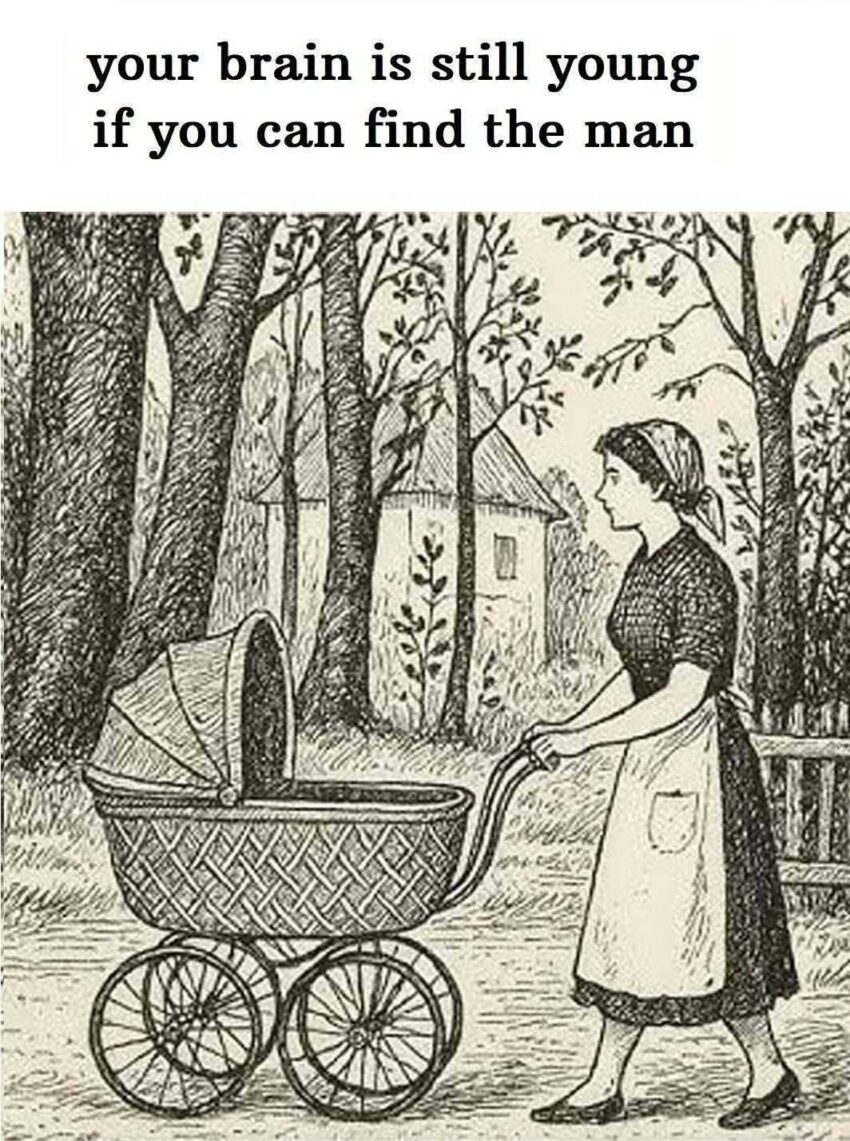
At first glance, this vintage-style illustration looks completely ordinary. A woman is pushing a baby carriage along a quiet path while trees, a small house, and the surrounding countryside create a peaceful scene.
But there is a hidden figure somewhere in the picture.
Can you find the man?
This optical illusion has been shared as a visual brain teaser, with the playful claim that people with “young” brains will spot the hidden man more quickly. In reality, however, this is not a scientific test of your age, intelligence, eyesight, or brain health. It is simply a hidden-image puzzle designed to make your brain interpret the same shapes in more than one way.
Look Carefully Before Reading the Answer
Before you continue, give yourself a chance to solve it.
Don’t immediately focus on the woman, the baby carriage, or the house.
Instead, step back from the screen and look at the entire illustration.
Try squinting slightly or relaxing your focus. Sometimes the hidden image becomes easier to recognize when you stop concentrating on individual details.
The trick is that the man isn’t simply standing somewhere behind a tree.
The surrounding shapes themselves help create the hidden figure.
Why This Puzzle Is So Difficult
Your brain naturally tries to make sense of what your eyes see.
When you look at the picture, you immediately recognize familiar objects:
- A woman
- A baby carriage
- Trees
- A house
- A path
- Grass and vegetation
- A fence
Once your brain decides that the image is a peaceful outdoor scene, it tends to interpret ambiguous lines according to that assumption.
A dark shape looks like a tree trunk.
A curved line looks like part of the landscape.
A patch of shading looks like grass or a shadow.
The hidden man takes advantage of this automatic interpretation.
The Trick Is in the Shapes
This type of puzzle is an example of a hidden-image optical illusion.
Instead of drawing a separate person and trying to camouflage him behind an object, the artist can arrange existing lines, shadows, and negative spaces so that they can be interpreted in two different ways.
At first, you see the landscape.
After you discover the hidden figure, those same shapes can suddenly begin to resemble a person’s face and head.
That change in perception is what makes the puzzle so satisfying.
Try Looking at the Picture From a Distance
One of the easiest ways to approach an optical illusion is to move away from the screen.
When you look closely, your eyes tend to concentrate on small details such as individual leaves, lines, and textures.
When you step back, those details visually merge together.
The larger shapes become more noticeable.
Try this:
- Look at the image normally for a few seconds.
- Move your screen farther away.
- Slightly narrow your eyes.
- Stop examining individual objects.
- Look at the overall pattern.
- Search for the outline of a man’s head and face.
You may find that the hidden figure suddenly becomes much easier to recognize.
Don’t Search for a Tiny Man
This is where many people go wrong.
If you expect to find a miniature man standing behind the trees, you’ll probably spend a long time searching.
The hidden figure is not necessarily represented in the way a normal person would be drawn.
Instead, the puzzle relies on shape recognition.
A collection of lines can form one object when viewed normally and something completely different when interpreted another way.
Think of it as a picture inside a picture.
Why You Can Suddenly “See” Him
Optical illusions often have a fascinating moment when the brain suddenly changes its interpretation.
You can stare at the image for several minutes and see nothing unusual.
Then one small clue causes everything to click.
Suddenly you recognize the shape.
After that, it can become difficult to return to the original interpretation because your brain has learned what to look for.
This phenomenon is one reason hidden-image puzzles are so popular.
Is It Really a Test of a Young Brain?
No.
The statement “your brain is still young if you can find the man” is a catchy challenge, not a medical or scientific assessment.
Not seeing the man quickly doesn’t mean your brain is aging.
Likewise, finding him immediately doesn’t prove that your brain is younger than someone else’s.
How quickly someone solves an optical illusion can depend on many ordinary factors, including attention, familiarity with visual puzzles, viewing conditions, and the particular way a person searches an image.
So don’t worry if you can’t find him immediately.
Your brain isn’t being graded.
What Is Your Brain Actually Doing?
Your visual system constantly organizes information.
It separates objects from backgrounds, identifies familiar patterns, and decides which details deserve attention.
Most of the time, this is extremely useful.
Imagine walking through a forest. You don’t consciously analyze every single line, shadow, leaf, and branch. Your brain quickly organizes everything into meaningful objects.
Optical illusions exploit that ability.
The artist creates an image where the same visual information can support more than one interpretation.
Your brain initially chooses the most obvious one.
The challenge is getting it to switch.
Look for Negative Space
One of the best techniques for hidden-picture puzzles is to pay attention to negative space.
Negative space means the areas around and between objects.
We normally treat those spaces as empty.
But in an optical illusion, empty space can form part of another image.
A gap between trees may become part of a face.
A shadow can become an eye or cheek.
The outline of an object can become the edge of another figure.
So don’t only look at the objects themselves.
Look at the spaces between them.
Try Changing the Image’s Orientation
If you’re still struggling, try viewing the picture upside down or turning your head slightly.
This can temporarily disrupt your brain’s normal interpretation of the scene.
When the picture is no longer recognized immediately as a woman pushing a carriage through the countryside, your brain may become more open to alternative patterns.
Then return to the original orientation and see whether the hidden man is easier to recognize.
Why Vintage Illustrations Are Perfect for Optical Illusions
This particular image has a vintage black-and-white illustration style.
That style is particularly useful for visual puzzles because it contains:
- Strong outlines
- Cross-hatching
- Dark and light areas
- Repeated patterns
- Simple silhouettes
- Carefully positioned lines
These features allow an artist to hide additional shapes without making the illustration look obviously artificial.
The viewer’s brain naturally interprets the lines as part of the scene.
The hidden image remains concealed until you know what you’re looking for.
The Woman and Baby Carriage Are a Distraction
The woman pushing the carriage is probably the first thing most people notice.
That’s intentional from a puzzle-solving perspective.
Your brain immediately identifies the most recognizable subject in the foreground.
Then you naturally examine the carriage, wheels, trees, and house.
Because you already have a clear interpretation of the scene, you aren’t expecting another person to be hidden inside it.
That’s what makes the illusion effective.
Don’t Confuse the Puzzle With a Vision Test
There is an important distinction between an optical illusion and an actual eyesight examination.
If someone can’t see the hidden figure, it doesn’t automatically mean they have poor eyesight.
Likewise, being able to see the figure doesn’t establish anything about visual health.
Actual vision problems should be assessed with appropriate eye examinations rather than Internet puzzles.
This particular challenge is meant for entertainment and visual perception, not diagnosis.
The Fun Comes From the “Aha!” Moment
The best part of a hidden-image puzzle is often not the answer itself.
It’s the moment when you finally see it.
Before that moment, the image seems ordinary.
Afterward, the hidden figure can seem incredibly obvious.
You may even wonder:
“How did I not see that before?”
That’s because your brain has changed the way it groups the visual information.
Nothing in the picture has physically moved.
Only your interpretation has changed.
A Quick Challenge for Your Readers
Before revealing the hidden man, challenge yourself one more time.
Look away from the screen for a few seconds.
Then look back.
Don’t stare at the woman.
Don’t focus on the wheels.
Don’t examine the house.
Instead, look at the larger shapes and shadows throughout the scene.
Try to imagine whether those shapes could form the outline of a human head.
You may find the hidden image much faster this time.
Final Thoughts
This seemingly simple vintage illustration is a clever reminder that seeing isn’t always the same as understanding what you’re seeing.
Your brain quickly organizes the picture into a familiar scene: a woman, a baby carriage, trees, a house, and a country path.
But another image is hidden within those same shapes.
The popular claim that only people with “young eyes” can see the man is best treated as a fun challenge rather than a scientific fact. Your ability to spot the hidden figure doesn’t determine your age, intelligence, or brain health.
The real challenge is much simpler:
Can you make your brain look at the same picture in a completely different way?
And once you finally spot the hidden man, don’t be surprised if you can never look at this picture quite the same way again.
Meta Description
Can you find the hidden man in this vintage optical illusion? Discover how the clever image uses shapes, shadows, negative space, and visual perception to hide a face in plain sight.