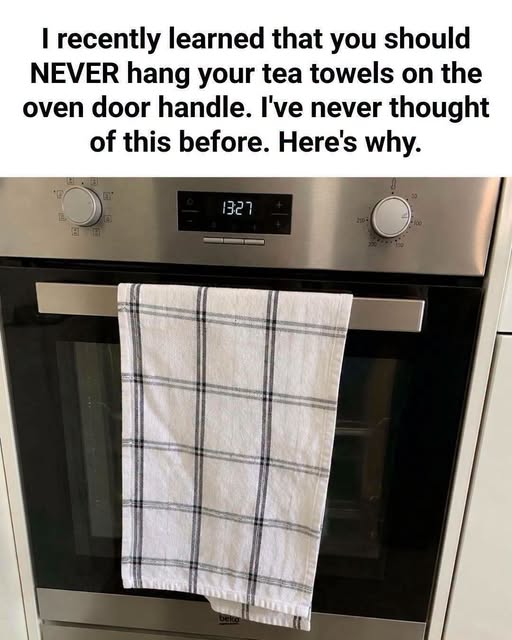
Keeping a kitchen towel on the oven door may seem convenient, but it can create hidden safety and hygiene problems. Learn where towels should go and how to use them safely.
The Kitchen Habit Many People Overlook: Why Keeping a Towel on the Oven Door Matters
In many kitchens, there is one habit that seems completely harmless: hanging a kitchen towel over the oven door handle.
It’s convenient. The towel is always within reach when you need to wipe your hands, dry a dish, or grab something from the oven.
But there is a reason kitchen-safety experts often recommend thinking twice about where towels are placed.
The issue isn’t that a towel automatically makes an oven dangerous. The concern is that a towel hanging from an oven door can come into contact with heat, hot surfaces, food splashes, grease, and flames, depending on the design of the kitchen and appliance.
A simple change in where you keep your towels can reduce several unnecessary risks.
1. A Towel Can Get Surprisingly Close to Heat
Ovens generate significant heat, and some areas around the door and controls can become warm during cooking.
A towel hanging directly from the handle can therefore be exposed to heat for extended periods.
Most ordinary cotton kitchen towels aren’t designed to sit against a hot appliance for long periods. If the towel becomes excessively hot or comes into contact with a heating element or flame, it can potentially become a fire hazard.
This is particularly important in kitchens where an oven is positioned close to a stovetop.
2. The Biggest Problem May Be the Stovetop, Not the Oven
Imagine a towel hanging from the oven handle while someone is cooking on the burners above it.
If the towel is long enough, it may swing or hang close to the stovetop.
A loose towel can accidentally come into contact with a gas flame or a hot burner.
That’s why keeping cloth, paper, and other combustible materials away from cooking flames and hot surfaces is a basic kitchen-safety principle.
A towel that is perfectly safe in one kitchen setup may be much less safe in another.
3. Towels Can Collect Grease and Food Residue
Kitchen towels are frequently used for wiping hands, counters, dishes, and spills.
Over time, they can collect small amounts of grease, oil, food particles, and moisture.
When that towel is hanging beside a cooking appliance, those residues can accumulate more easily.
A towel that looks clean isn’t necessarily hygienically clean.
This is one reason regularly washing kitchen towels is important, particularly if they are used repeatedly throughout the day.
4. Don’t Use a Hanging Towel as an Oven Mitt
Another common mistake is using the towel hanging from the oven handle to grab a hot tray.
A folded kitchen towel may seem thick enough, but it can shift unexpectedly. If heat reaches your hand through a thin or poorly folded towel, you can suffer a burn.
A better option is a properly designed oven mitt or heat-resistant pot holder.
These are made specifically for handling hot cookware and generally provide more secure protection than an ordinary kitchen towel.
5. Children Can Grab Hanging Towels
If young children are around, anything hanging at an accessible height can become something they want to pull.
A child grabbing a towel attached to an oven door could potentially pull the door open or disturb hot cookware.
This doesn’t mean every oven-handle towel will cause an accident, but it is an unnecessary risk when there are safer places to store towels.
Keeping towels away from areas children can easily pull is particularly sensible in busy family kitchens.
6. A Towel Can Also Become a Cross-Contamination Problem
Kitchen towels can move bacteria from one surface to another.
For example, a towel used to wipe raw-meat juices from a counter shouldn’t then be used to dry clean dishes or hands.
If the same towel stays on the oven handle all day, it can become a convenient place to repeatedly wipe contaminated hands.
A better habit is to have separate towels for different tasks or change them frequently.
Wash reusable kitchen towels regularly, especially when they become damp, visibly dirty, or are used for food preparation.
So Where Should You Keep Kitchen Towels?
A good location is somewhere away from direct heat, flames, and food-preparation contamination.
Depending on your kitchen, this might be:
- A towel rack mounted away from the stove
- A hook on a nearby wall
- A drawer or cabinet for clean towels
- A designated rail away from cooking surfaces
The important thing is accessibility without placing the towel directly beside a heat source.
What About the Oven Door Handle?
If your oven manufacturer specifically allows a towel to be placed over the handle, that doesn’t necessarily mean doing so is dangerous.
However, you should still make sure the towel:
- Doesn’t hang near an open flame
- Doesn’t touch hot surfaces
- Doesn’t interfere with the oven door
- Isn’t long enough to reach the stovetop
- Isn’t used to handle hot cookware
- Is kept clean and dry
Always follow the safety instructions provided with your particular oven.
A Small Habit That Can Improve Kitchen Safety
Kitchen accidents often happen because something convenient becomes part of a routine.
A towel on the oven handle may seem insignificant. But when you consider heat, flames, children, grease, and cross-contamination, there are several reasons to choose a safer storage spot.
You don’t need to remove every towel from your kitchen or become overly worried about ordinary habits.
Simply keep combustible materials away from flames and hot surfaces, use proper heat protection for cookware, and change kitchen towels regularly.
Sometimes improving kitchen safety doesn’t require expensive equipment or major changes.
It starts with noticing the little habits we normally don’t think twice about.