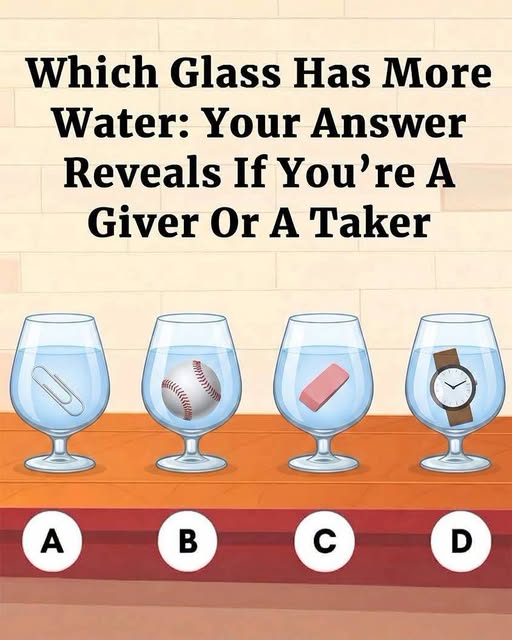
At first glance, this puzzle looks incredibly simple: several glasses are shown, each containing different objects and different amounts of water. The challenge is to figure out which glass actually contains the most water.
It sounds easy—but there is a clever observation hidden in the puzzle.
The Brain Teaser
Imagine four identical glasses filled with the same amount of water. Each glass contains a different object, such as a spoon, a stone, a ball, or another item.
Your task is:
Which glass holds the most actual water?
Don’t answer too quickly.
The amount of water you can see isn’t necessarily the amount of water inside the glass. The objects placed inside the glasses take up space and therefore displace some of the water.
The Trick Behind the Answer
The key is to think about displacement.
When an object is placed into water, it occupies part of the space inside the glass. The larger the submerged object, the more water it displaces.
That means a glass containing a large object may appear to have a higher water level, but it doesn’t necessarily contain more water.
For example, if two glasses have the same overall capacity and the same visible water level, the glass containing the smaller submerged object will generally contain more actual water because less space is occupied by the object.
How to Solve It
Instead of looking only at the water level, examine three things:
- How much space the object takes up
- How much of the object is submerged
- The actual volume of water remaining around the object
This is why these puzzles are excellent observation tests. They encourage you to look beyond the most obvious visual clue.
Why Our First Guess Can Be Wrong
Our brains naturally focus on the water level. If one glass appears fuller, we may immediately assume it contains more water.
But the water level is affected by everything inside the glass.
A large stone, for example, can raise the water level significantly even though the stone itself isn’t water. So the glass may look fuller while actually containing less water.
The Final Answer
The glass with the smallest submerged object holds the most water, assuming the glasses started with the same amount of water and have identical capacity.
The real lesson isn’t just about water—it’s about observation.
Sometimes the answer isn’t hidden in what you see first. You have to consider what is taking up space and what is actually water.
Can You Solve It Without Looking Twice?
Before checking the explanation, take another look at the puzzle and ask yourself:
Am I measuring the water—or am I accidentally measuring the water level?
That small distinction is what makes this simple brain teaser surprisingly tricky.