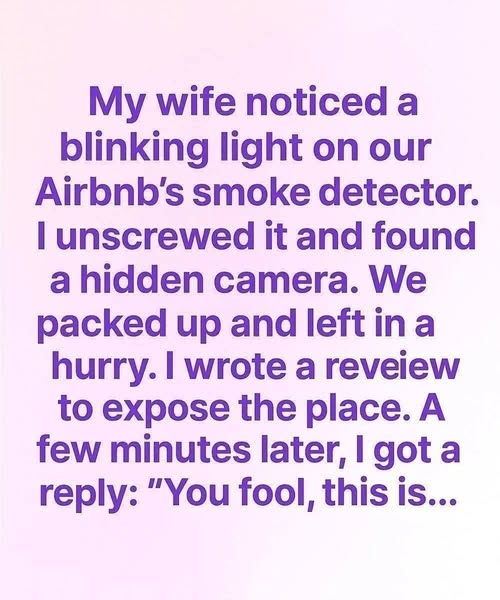
I found a hidden camera in our Airbnb, and the host’s disturbing response changed the way I think about vacation-rental safety. Here’s what happened and the warning signs every traveler should know.
I Found a Hidden Camera in Our Airbnb — And the Host’s Chilling Reply Changed How I See Travel Safety Forever
When you book an Airbnb or vacation rental, you usually think about the obvious things: Is the neighborhood safe? Is the place clean? Are the photos accurate? Does it have good reviews?
You probably don’t expect to spend your first night wondering whether someone is watching you.
That is exactly what happened to me.
What started as an ordinary weekend trip quickly became one of the most uncomfortable experiences I’ve ever had while traveling. We had chosen what looked like a beautiful, highly rated rental. The photographs were inviting, the reviews were positive, and nothing about the listing initially made us suspicious.
But after we arrived, something felt slightly off.
At first, I ignored the feeling. You know how it is when you’re staying somewhere unfamiliar. Every unfamiliar sound seems louder. Every object looks slightly different from what you’re used to seeing at home.
Then I noticed something on the wall.
It was small enough that I probably would have ignored it under different circumstances. But its position immediately caught my attention.
It appeared to be pointed toward an area where guests would naturally spend time.
I took a closer look.
That’s when I realized it wasn’t simply a normal electronic device.
There appeared to be a tiny lens.
The Moment We Realized What It Was
My first reaction wasn’t panic.
It was disbelief.
I remember thinking, There is no way that’s a camera.
We checked the object more carefully and compared it with other devices around the room. The more we examined it, the more uncomfortable we became.
We didn’t want to jump to conclusions. After all, there are plenty of innocent-looking devices in modern rental properties. Smoke detectors, motion sensors, smart-home equipment, routers, speakers, and other electronics can sometimes look suspicious if you’re unfamiliar with them.
But this didn’t seem right.
The location was especially concerning.
A device intended for security purposes should generally be positioned in a way that protects the property without unnecessarily invading a guest’s privacy.
This seemed different.
At that point, our entire attitude toward the apartment changed.
We started looking around the room differently.
What had seemed like ordinary decorations and electronics suddenly became things we wanted to inspect.
We Checked the Room Again
We carefully looked around the rental for anything else that seemed unusual.
We checked common areas and examined electronics that appeared out of place.
We also looked for small openings, unusual wires, unfamiliar devices, and objects positioned in places where a camera could potentially be concealed.
The experience was unsettling because there is a strange psychological shift that happens when you begin questioning your privacy.
A room that felt comfortable an hour earlier suddenly didn’t feel private anymore.
Even sitting down and talking normally felt uncomfortable.
That’s when we decided to contact the host.
And that’s where the situation became even stranger.
The Host’s Response Made Everything Worse
We expected a simple explanation.
Perhaps it was a legitimate security device.
Perhaps the device wasn’t functioning.
Perhaps it was something completely unrelated to recording.
Instead, the host’s response immediately made us more uncomfortable.
Rather than calmly explaining exactly what the device was and why it was there, the response felt dismissive.
The attitude was essentially that we were overreacting.
That was the moment I realized something important:
When your privacy is in question, the response you receive matters almost as much as the device itself.
A responsible host should understand why a guest would be concerned about an unexplained camera-like object.
Instead of making the guest feel foolish for asking questions, the host should be able to clearly identify the device and explain its purpose.
The lack of a reassuring explanation made the situation feel much more serious.
Why Hidden Cameras Are Such a Serious Concern
The problem with hidden cameras isn’t simply that someone might be recording.
It’s the loss of control.
When you stay in a hotel or vacation rental, you’re temporarily treating that space as your private environment.
You change clothes.
You sleep.
You have private conversations.
You may travel with children, partners, friends, or family members.
You naturally behave differently when you believe nobody is watching.
That’s why an undisclosed recording device can feel like such a profound violation of trust.
A guest should not have to wonder whether an ordinary-looking object is secretly recording them.
What Travelers Can Do When They Arrive at a Rental
This experience completely changed the way I approach vacation rentals.
I don’t believe travelers need to become paranoid and inspect every inch of every room.
But spending a few minutes doing a basic privacy check is reasonable.
1. Look at unusual electronics
Pay attention to devices you don’t recognize.
This doesn’t mean every unfamiliar gadget is a camera. Modern homes contain countless electronic devices.
Instead, ask simple questions:
- What is this device?
- Why is it located here?
- Does it appear to have a lens?
- Is it connected to power?
- Does its position make sense?
An unexplained device deserves clarification.
2. Pay attention to positioning
A device isn’t automatically suspicious because it has a camera lens.
What matters is where it is positioned and what it appears capable of seeing.
A security camera pointed toward an entrance may have an obvious purpose.
A device positioned toward a private sleeping or changing area is much more concerning.
3. Don’t ignore your instincts
Sometimes travelers dismiss their concerns because they don’t want to seem difficult.
I understand that feeling.
Nobody wants to be the person who arrives at a vacation rental and immediately starts accusing the host of doing something wrong.
But there’s a difference between making an accusation and asking a reasonable question.
You can simply say:
“Can you tell me what this device is and what it does?”
You don’t need to make assumptions.
4. Document what you find
If you discover something genuinely concerning, document it.
Take photographs of the device and its location.
Record relevant messages from the host.
Keep your booking information and other details associated with the stay.
Documentation can become important if you need to report the issue to the rental platform or another appropriate authority.
5. Don’t immediately destroy or tamper with suspicious equipment
Your first instinct may be to unplug, cover, remove, or dismantle something you believe is recording you.
It’s usually better to document the situation first and seek appropriate assistance.
If you’re genuinely concerned that you’re being recorded without consent, prioritize getting yourself and your travel companions somewhere you feel safe.
The Bigger Lesson Wasn’t Just About Cameras
The experience changed something else for me.
Before this happened, I thought travel safety mostly meant watching your belongings, locking doors, avoiding unfamiliar neighborhoods at night, and keeping your passport secure.
Those things are still important.
But privacy is part of travel safety too.
When you stay somewhere unfamiliar, you are placing a certain amount of trust in the person or company providing the accommodation.
You trust that the listing is accurate.
You trust that the property is being maintained properly.
You trust that your personal space will remain private.
That trust shouldn’t be taken for granted.
Don’t Let Fear Ruin Your Travels
There is another side to this story that’s worth mentioning.
After an experience like this, it’s easy to become suspicious of everything.
You might start staring at smoke detectors.
You might wonder about every smart speaker.
You might feel uncomfortable in every rental you enter.
That’s not the goal.
Most unfamiliar devices have completely ordinary explanations.
The lesson isn’t that every Airbnb is dangerous.
The lesson is that travelers should understand their right to privacy and feel comfortable asking questions when something doesn’t make sense.
A few minutes of awareness can provide peace of mind without turning your entire trip into an investigation.
What I Do Differently Now
I still stay in vacation rentals.
I still travel.
But I approach unfamiliar accommodations differently now.
When I arrive, I take a quick look around.
I notice unusual electronics.
I pay attention to devices located in private areas.
I read the property’s rules carefully.
And if something doesn’t make sense, I ask.
Most importantly, I don’t ignore something simply because I feel embarrassed about bringing it up.
That experience taught me that travel safety isn’t only about preparing for obvious dangers.
Sometimes it’s about recognizing when something doesn’t belong.
Final Thoughts
Finding what appeared to be a hidden camera in our Airbnb was disturbing enough.
But the host’s reaction was what really stayed with me.
It made me realize how quickly a place can stop feeling like a safe, private space when you don’t know who or what may be watching.
I don’t want this story to make people afraid of traveling.
Quite the opposite.
I want travelers to feel more confident.
Before settling into your next hotel, Airbnb, or vacation rental, take a few minutes to look around. Know what devices are there. Ask questions when something seems unusual. Keep records if you encounter something genuinely concerning.
You don’t have to be paranoid.
You just have to be aware.
Because when you’re traveling, feeling safe isn’t a luxury.
It’s part of the experience you should be able to expect.