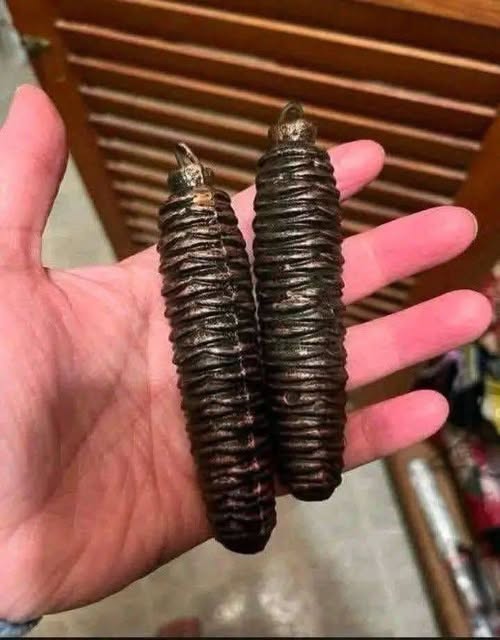
While searching her grandmother and aunt’s lifelong family home, a woman discovered a collection of strange, solid, unusually heavy objects. They looked like Christmas decorations, but their weight suggested something entirely different. What could these mysterious items be?
Sometimes, the most fascinating discoveries are hiding in the places we know best. An old family home can hold decades of memories, forgotten belongings, and unusual objects whose original purpose has been lost over time.
That is exactly what happened when a woman began searching the house where her girlfriend’s grandmother and aunt had lived for their entire lives.
What started as an ordinary search through the family home quickly turned into a mystery.
Among the belongings, she discovered a collection of strange objects that initially looked like Christmas decorations. Their unusual shapes and decorative appearance made them seem as though they might belong on a Christmas tree.
But there was one significant problem.
They were solid and incredibly heavy—far too heavy to hang from the branches of a Christmas tree.
Naturally, the discovery raised an obvious question: If these objects weren’t Christmas decorations, what were they?
A Strange Discovery Inside an Old Family Home
Old houses often contain objects that have been passed down through generations. Some were once everyday household necessities, while others were decorative pieces, souvenirs, tools, or collectibles that eventually became forgotten.
When families live in the same house for decades, belongings can accumulate in cupboards, drawers, basements, attics, and storage rooms. An item that was perfectly familiar to an older family member may appear completely mysterious to someone discovering it for the first time.
In this case, the objects were particularly puzzling because of their appearance.
They seemed decorative, perhaps even festive, but their solid construction and considerable weight suggested that their intended purpose might have been entirely different.
Were they made of metal? Could they have been carved from stone? Were they antique household objects that had simply lost their labels or packaging?
Without photographs or additional details, it is impossible to identify them confidently.
What Could These Heavy Objects Be?
Several possibilities might explain why an object looks decorative but feels unusually heavy.
1. Antique Metal Ornaments
Some older decorative objects were made from solid brass, iron, copper, or other metals. Their shapes might resemble bells, hanging ornaments, figurines, or small sculptures.
Unlike modern lightweight decorations, solid metal objects can be surprisingly heavy. They may have been designed to sit on a shelf, decorate a mantelpiece, or serve a practical purpose.
2. Vintage Paperweights or Decorative Collectibles
Older homes sometimes contain collectible objects made from glass, stone, ceramic, or cast metal. Some have intricate shapes and colorful finishes that make them look like ornaments.
A decorative paperweight, for example, might look like a small sculpture but feel much heavier than expected.
3. Antique Household Tools
Certain household tools were designed with rounded, decorative, or unusual shapes. Over time, their original function can become difficult to recognize, especially when they are separated from the other objects they were originally used with.
4. Objects Associated With Traditional Crafts
Some objects were used in sewing, textile work, cooking, or other traditional activities. Their shapes may appear unusual to people unfamiliar with the craft, and solid materials may explain their weight.
These are only possibilities, not confirmed identifications. The objects’ exact shape, dimensions, material, and any markings would help narrow down the options.
Why Their Weight Matters
Weight is an important clue when identifying an unfamiliar object.
A lightweight plastic decoration and a similarly shaped solid brass object may look almost identical in a photograph, yet their intended uses could be completely different.
The material also offers useful information:
- Metal: May suggest a cast ornament, tool, bell, or collectible.
- Stone: Could indicate a carved decorative piece or paperweight.
- Ceramic: May point toward a figurine, collectible, or household object.
- Glass: Could indicate a paperweight, decorative sculpture, or another vintage collectible.
However, weight alone cannot establish an object’s age, value, or purpose.
Could They Be Valuable Antiques?
Possibly, but an unusual appearance does not automatically mean an object is antique or valuable.
Before cleaning, polishing, selling, or discarding anything found in an older family home, it is sensible to inspect the objects carefully.
Look for maker’s marks, stamped numbers, engraved initials, dates, labels, or distinctive symbols. These details can sometimes reveal the manufacturer, country of origin, approximate age, or intended use.
Avoid using harsh chemicals or abrasive materials on unfamiliar objects because they could damage a valuable finish or remove evidence that would help with identification.
If the objects appear to be made from an unfamiliar material or have unusual residues, avoid handling them unnecessarily until their nature is established.
The One Clue That Could Solve the Mystery
The most useful next step is to examine a clear photograph of the objects.
Ideally, the photographs should show:
- The entire collection together.
- A close-up of one object from several angles.
- Any holes, hooks, handles, openings, or unusual features.
- Any inscriptions, stamps, or markings.
- An ordinary object beside one of them to indicate their size.
It would also help to know approximately how large they are, whether they feel metallic or stone-like, and where in the house they were discovered.
Those details could help distinguish a decorative collectible from an antique tool or another household object.
Final Thoughts
The discovery of strange, heavy objects in a house occupied by the same family for generations is certainly intriguing. Their resemblance to Christmas decorations makes the mystery even more interesting, especially because their weight appears inconsistent with that use.
Still, there is not enough information to determine what they are from the description alone.
The real answer may be hiding in their material, shape, or markings. A photograph could provide the missing clue and help turn this unusual family discovery into a much more specific identification.