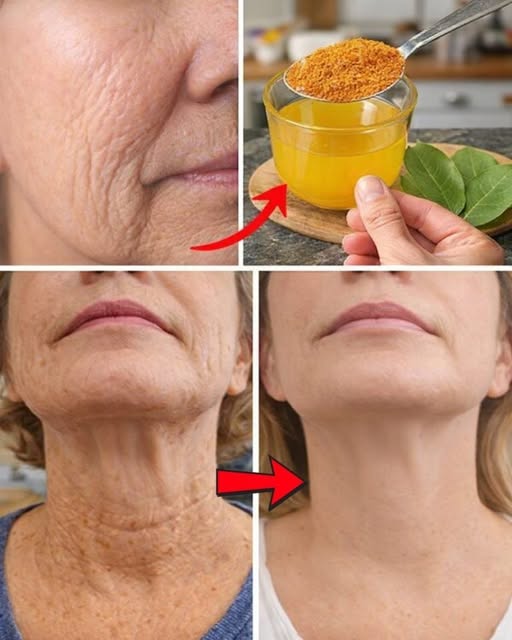
Discover the potential skin benefits of bay leaves, how to prepare a simple bay leaf facial treatment, and what science really says about wrinkles, fine lines, and natural skin care after age 60.
As we grow older, our skin naturally changes. Fine lines appear around the eyes and mouth, the skin may become drier, and its firmness gradually decreases. For many people, these changes are a normal part of aging, but that doesn’t mean healthy, comfortable skin is out of reach.
Recently, claims about bay leaves as a natural alternative to Botox have attracted attention. Some headlines even suggest that bay leaves are millions of times stronger than Botox and can erase every wrinkle, regardless of age.
But is there any scientific evidence behind these claims?
Bay leaves contain naturally occurring plant compounds that researchers study for their antioxidant and other biological properties. However, there is currently no reliable clinical evidence showing that bay leaves erase wrinkles, work like Botox, or reverse skin aging.
That doesn’t mean bay leaves have no place in a home skin-care routine. Understanding their potential benefits, limitations, and safe use can help you make informed choices without spending money on unrealistic promises.
1. Why Are Bay Leaves Being Discussed for Skin Care?
Bay leaves, commonly obtained from the bay laurel plant (Laurus nobilis), are widely used to flavor soups, stews, rice dishes, and sauces.
They contain various plant compounds, including polyphenols and volatile aromatic substances. Some laboratory studies have investigated these compounds for antioxidant and other biological activities.
Antioxidants are substances that can help neutralize certain unstable molecules known as free radicals under appropriate conditions.
Free radicals and oxidative stress are among the many factors studied in relation to skin aging. Sun exposure, inflammation, environmental pollution, and the natural aging process can all contribute to changes in skin structure.
However, an important distinction exists between finding potentially useful compounds in a plant and proving that applying the plant to human skin produces a meaningful cosmetic benefit.
What the evidence tells us: Bay leaves contain interesting plant compounds, but there is insufficient clinical evidence to conclude that a bay leaf preparation reduces wrinkles or produces Botox-like results.
2. Can Bay Leaves Really Work Like Botox?
Botox is a brand name associated with botulinum toxin type A injections. When administered by a qualified medical professional, these injections temporarily reduce the activity of selected facial muscles, softening certain expression lines.
Bay leaves work differently. There is no established evidence that applying bay leaf water, oil, or paste produces the same muscle-relaxing effects.
Wrinkles also have different causes. Some form from repeated facial movements, while others result from cumulative sun exposure, loss of collagen and elastin, and changes in the skin’s structure.
A kitchen herb cannot be assumed to address all these processes simply because it contains antioxidants.
The claim that bay leaves are “1,000,000 times stronger than Botox” has no established scientific basis. Likewise, no topical home remedy has been shown to erase every wrinkle, particularly overnight.
Natural skin care can still be worthwhile, but realistic expectations are essential.
3. Potential Benefits of Bay Leaves for Skin
Although bay leaves are not a proven wrinkle treatment, several properties of their plant compounds have attracted scientific interest.
Antioxidant activity
Certain bay leaf extracts demonstrate antioxidant activity in laboratory research. Antioxidants are relevant to skin research because oxidative stress can contribute to cellular damage.
However, laboratory findings do not automatically demonstrate that a homemade bay leaf preparation protects human skin or reduces visible wrinkles.
A simple addition to a skin-care routine
A carefully prepared, fragrance-free moisturizer and gentle cleansing routine can help keep mature skin comfortable. Some people enjoy experimenting with traditional plant-based preparations, but bay leaf water is not necessary for maintaining healthy skin.
Aromatic properties
Bay leaves have a distinctive fragrance that can make them pleasant to use in cooking. Fragrance, however, does not establish a skin-care benefit, and aromatic compounds may irritate sensitive skin.
For older adults, especially those with dry or delicate skin, a simple routine using products formulated for sensitive skin is often a more dependable choice.
4. How to Prepare a Simple Bay Leaf Water Preparation
If you would like to try bay leaf water as a traditional home-care experiment, keep the preparation simple and understand that its wrinkle-reducing effects have not been established.
Ingredients
- 2 dried culinary bay leaves
- 1 cup (approximately 240 ml) of water
Preparation
- Rinse the leaves to remove visible dust or debris.
- Bring the water to a boil.
- Add the leaves and simmer gently for approximately five minutes.
- Turn off the heat and allow the water to cool completely.
- Remove the leaves and strain the liquid.
- Prepare only a small quantity and discard any remaining liquid promptly rather than storing it for extended periods.
Important safety note: This preparation has not been proven to reduce wrinkles. Homemade water-based preparations are not preserved and may become contaminated. Applying the liquid is optional, and avoiding it altogether is a reasonable choice, especially if your skin is sensitive.
Do not apply it near your eyes, to broken skin, or to areas affected by eczema or active irritation. Stop immediately if redness, itching, burning, or swelling develops.
Never apply concentrated bay leaf essential oil directly to your face. Essential oils can cause irritation or allergic reactions and require appropriate formulation for topical use.
5. What Is a More Reliable Way to Reduce the Appearance of Wrinkles After 60?
For mature skin, a consistent routine is generally more useful than relying on a single kitchen ingredient.
Step 1: Use a gentle cleanser
Wash your face with lukewarm water and a mild cleanser. Avoid very hot water, harsh soaps, and vigorous scrubbing, which can worsen dryness.
Step 2: Moisturize daily
Choose a moisturizer containing ingredients such as glycerin, ceramides, or hyaluronic acid.
These ingredients help improve hydration and make fine lines associated with dryness appear less noticeable. They do not permanently remove wrinkles, but better hydration can improve the skin’s appearance and comfort.
Apply moisturizer after washing while the skin is still slightly damp.
Step 3: Protect your skin from the sun
Sun protection is one of the most important steps in preventing additional visible skin aging.
Use broad-spectrum SPF 30 or higher sunscreen on exposed skin and reapply as directed, particularly after sweating or swimming. Hats, shade, and protective clothing provide additional protection.
Even when wrinkles are already present, protecting your skin helps reduce further UV-related damage.
Step 4: Consider evidence-based ingredients
Depending on your skin type and medical history, some topical ingredients may help improve the appearance of fine lines over time.
- Retinol: A vitamin A derivative that may improve fine lines and skin texture with consistent use, but can cause dryness and irritation.
- Vitamin C: Certain well-formulated products may help provide antioxidant protection and improve uneven skin tone.
- Niacinamide: May support the skin barrier and help improve some aspects of texture and uneven pigmentation.
Introduce one product at a time and follow its instructions. If you have very sensitive skin, a skin condition, or use prescription treatments, ask a dermatologist before adding active ingredients.
Retinoids should be avoided during pregnancy unless your treating clinician specifically advises otherwise; topical retinoids are generally not recommended during pregnancy.
6. Can Wrinkles Improve at Age 70?
Yes, the appearance of some wrinkles can improve at any age, although results depend on their depth, cause, and the treatment used.
Moisturizers may soften the appearance of fine lines caused by dryness. Sun protection helps prevent further UV-related damage, while certain dermatological treatments may improve the appearance of established wrinkles.
Deep folds and expression lines are more difficult to change with topical products alone.
It is also important to remember that wrinkles are not a sign of poor health or personal failure. They reflect a combination of genetics, environmental exposure, facial movement, and natural aging.
The goal of skin care does not have to be looking decades younger. It can simply be maintaining comfortable, healthy skin.
7. Common Mistakes to Avoid When Trying Natural Wrinkle Remedies
Natural ingredients can still cause problems when used incorrectly.
- Expecting immediate results: No credible evidence supports the claim that bay leaves erase all wrinkles in a few minutes.
- Applying concentrated essential oils: These can irritate skin and trigger allergic reactions.
- Ignoring irritation: Burning, swelling, and persistent redness are reasons to stop using a product.
- Replacing sunscreen with herbal remedies: Plant extracts are not a substitute for proven sun protection.
- Using too many ingredients at once: Combining several home remedies makes it harder to identify the cause of irritation.
- Believing exaggerated headlines: Claims involving enormous multipliers or guaranteed results should be treated cautiously unless supported by credible clinical research.
Final Thoughts
Bay leaves are a useful culinary herb containing plant compounds that have attracted scientific interest. However, the claim that they are a million times stronger than Botox or can erase every wrinkle at age 70 is not supported by reliable clinical evidence.
If you enjoy traditional home remedies, remember that natural does not automatically mean effective or safe for every skin type. A gentle cleanser, regular moisturizing, and consistent sun protection have a much stronger foundation in established skin-care guidance.
Aging skin deserves care, not unrealistic promises. With a sensible routine and, when needed, advice from a qualified dermatologist, it is possible to support healthier, more comfortable skin at any age.