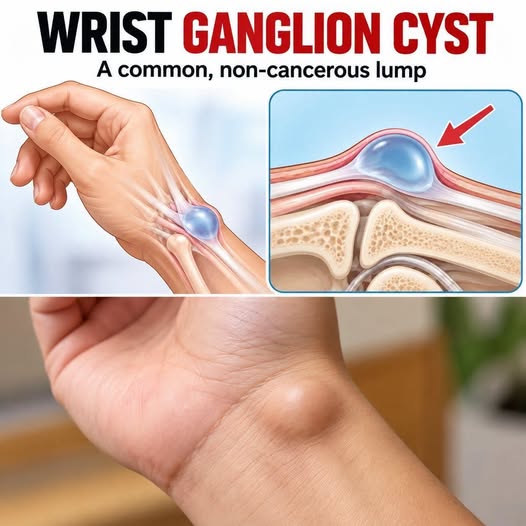
A lump on your wrist may be a harmless ganglion cyst, but not every lump is the same. Learn five important things to know before squeezing, puncturing, or trying to remove a wrist lump yourself.
5 Things You Should Know Before Touching a Lump on Your Wrist
Finding a small lump on your wrist can be surprising, especially if it seems to have appeared suddenly.
You may be tempted to squeeze it, massage it, press on it, or try to make it disappear. But before touching a wrist lump, it’s important to understand what it could be.
One of the most common causes is a ganglion cyst—a fluid-filled lump that often develops near a joint or tendon. Ganglion cysts are usually harmless, but other types of lumps can occur in the wrist as well.
Here are five things you should know before trying to treat one yourself.
1. Not Every Wrist Lump Is a Ganglion Cyst
Ganglion cysts are common, but you shouldn’t assume that every bump is one.
A ganglion cyst often appears as a smooth lump around the wrist or hand. It may feel firm or somewhat rubbery and can sometimes change in size.
Other possible causes of a wrist lump include:
- Lipomas
- Tendon-related conditions
- Inflammation
- Arthritis-related changes
- Other benign growths
- Less commonly, more serious conditions
The location, texture, size, mobility, and behavior of a lump can provide clues, but they cannot reliably establish a diagnosis at home.
2. Don’t Try to Pop or Puncture It
One of the biggest mistakes is trying to pop a wrist lump yourself.
A needle, blade, or other sharp object can introduce bacteria and cause an infection. It can also damage nearby blood vessels, nerves, tendons, or other structures.
Even if the lump is a ganglion cyst, puncturing it yourself isn’t a safe way to treat it.
A healthcare professional can determine what the lump is and, when appropriate, discuss options such as observation, aspiration, or other treatment.
3. Ganglion Cysts Can Change Size
A ganglion cyst may become larger or smaller over time.
Some become more noticeable after repetitive wrist activity or movement and may decrease in size with rest. Others remain relatively stable.
This changing size is one reason people sometimes become convinced that they can “push” the lump away.
But repeatedly pressing or manipulating it isn’t necessary and may irritate the surrounding tissues.
If a lump is painless and has characteristics consistent with a ganglion cyst, a healthcare professional may recommend simply monitoring it.
4. Pain, Numbness, or Weakness Deserves Attention
A small lump isn’t necessarily a problem, but symptoms around it are important.
A ganglion cyst can sometimes press against nearby nerves or structures, potentially causing:
- Wrist or hand pain
- Tingling
- Numbness
- Weakness
- Reduced movement
- Discomfort with certain activities
If you notice numbness, weakness, persistent pain, or difficulty moving your wrist or fingers, don’t keep manipulating the lump in an attempt to fix it.
It’s better to have it examined.
5. Some Lumps Should Be Checked Promptly
Many wrist lumps are harmless, but certain features warrant medical evaluation.
Arrange an assessment if the lump:
- Is rapidly increasing in size
- Is very painful
- Is hard or fixed in place
- Becomes red or warm
- Appears after an injury
- Causes numbness or weakness
- Interferes with wrist or finger movement
- Is associated with fever or other concerning symptoms
- Persists or continues to change without an obvious explanation
A healthcare professional may be able to diagnose a typical ganglion cyst through examination. In some cases, imaging such as ultrasound or another test may be needed.
What Should You Do If You Think You Have a Ganglion Cyst?
If the lump isn’t causing significant symptoms, don’t squeeze, puncture, or repeatedly massage it.
Instead, keep an eye on:
- Its size
- Whether it changes
- Whether it becomes painful
- Any changes in hand or finger movement
- Any numbness or tingling
If you’re unsure what the lump is, arrange a medical examination rather than trying to diagnose it yourself.
Some ganglion cysts disappear without treatment, while others remain or return after treatment. The appropriate approach depends on the individual case.
Can a Ganglion Cyst Go Away on Its Own?
Yes. Some ganglion cysts resolve without treatment.
If the cyst is not painful and doesn’t interfere with normal activities, observation may be all that’s necessary.
For persistent or troublesome cysts, a clinician may discuss treatment options. These can include aspiration in selected cases or surgical removal when appropriate.
Even after treatment, ganglion cysts can sometimes return.
The Bottom Line
A small lump on the wrist is often harmless, and a ganglion cyst is one of the most common explanations. But it’s important not to assume every wrist lump is a cyst.
The safest approach is simple: don’t pop, puncture, or aggressively squeeze an unexplained lump.
If it becomes painful, grows quickly, causes numbness or weakness, or otherwise concerns you, have it examined by a healthcare professional.
What looks like a simple bump on the outside can sometimes involve structures underneath the skin that are better left undisturbed.