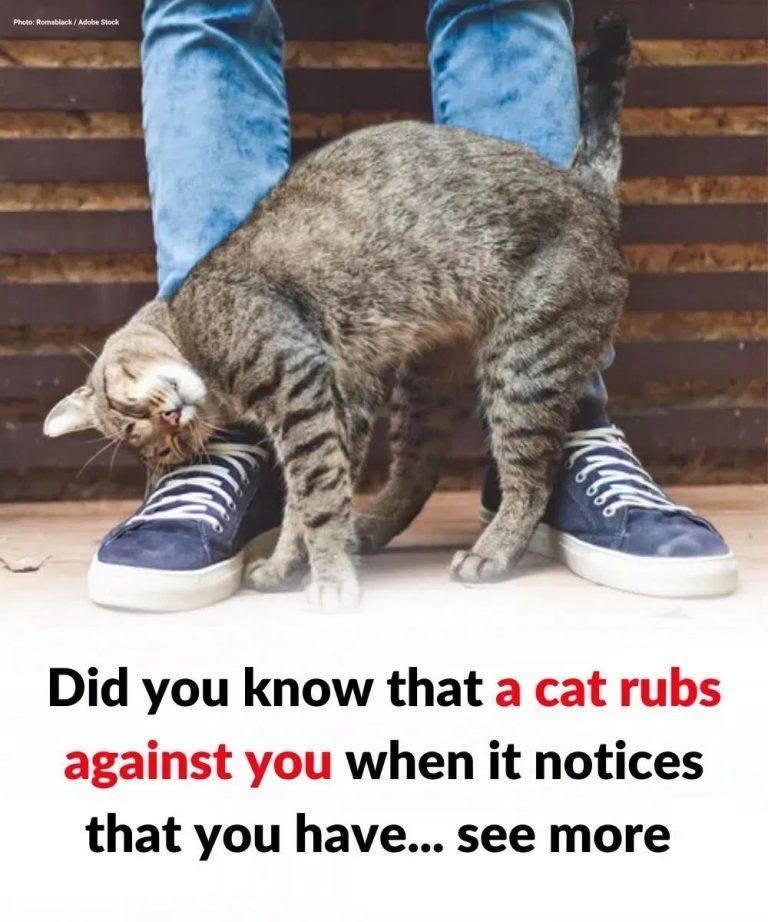
If your cat regularly rubs its head, cheeks, or entire body against your legs, you might wonder what it’s trying to tell you. Is it asking for food? Showing affection? Marking you as its territory?
The answer can actually be several things at once.
Cats communicate largely through body language, scent, posture, and touch. When your cat rubs against you, it’s often engaging in a friendly social behavior that says, in its own feline way, “You’re familiar, you’re safe, and you’re part of my world.”
Let’s look at what this behavior can mean.
1. Your Cat Is Showing Affection
One of the simplest explanations is affection.
Cats may rub their cheeks or bodies against people they trust. Unlike some dogs, cats don’t always show affection through enthusiastic physical contact. A gentle head bump or rub can be one of their ways of saying hello and maintaining a social connection.
If your cat approaches you with a relaxed body, upright tail, and gentle rubbing, it’s generally a positive interaction.
2. Your Cat Is Sharing Its Scent
Cats have scent glands around their cheeks, chin, forehead, and other parts of the body.
When your cat rubs against you, it may leave some of its scent behind. This behavior, sometimes called bunting when it involves the head, helps cats create a familiar communal scent.
It isn’t necessarily your cat saying, “You belong to me.” It’s more accurate to think of it as a way of making you smell familiar and reinforcing a sense of social connection.
3. It’s a Friendly Greeting
Have you noticed your cat rubbing against your legs when you walk through the door?
That may simply be its version of saying hello.
Cats often use rubbing, tail position, vocalizations, and body posture during greetings. A cat that rubs against you after you’ve been away may be reconnecting with you and exchanging familiar scents.
4. Your Cat Wants Attention
Sometimes the message is very straightforward:
“Pay attention to me.”
Your cat may rub against your legs because it wants petting, playtime, or interaction.
Look at what happens immediately afterward. If your cat leads you toward its favourite toy, food bowl, or a comfortable spot, the rubbing may be part of a larger request.
5. It Could Be Asking for Food
Some cats quickly learn that rubbing against their humans gets a response.
If rubbing is followed by meowing, walking toward the kitchen, or staring at the food container, your cat may have developed a very effective routine for requesting a meal.
Cats are excellent at learning which behaviors produce rewards.
6. Your Cat Is Reinforcing a Social Bond
Cats are often portrayed as solitary animals, but many domestic cats are highly social.
They may rub against other cats they trust, groom one another, sleep together, or rest nearby. Rubbing can be part of this broader social behavior.
When your cat does it to you, it may be treating you as a trusted member of its social group.
7. Your Cat May Be Marking Its Environment
Scent communication is extremely important to cats.
A cat may rub against furniture, doorways, people, and other objects. This helps distribute its scent around familiar surroundings.
This behavior is different from urine spraying. Rubbing is generally a normal, non-destructive form of scent marking.
8. Your Cat Is Comfortable Around You
Body language matters.
A cat that approaches with a relaxed posture, gently rubs its head or body against you, keeps its tail comfortably upright, and remains calm is usually communicating confidence and familiarity.
On the other hand, a cat that suddenly becomes withdrawn, excessively vocal, aggressive, or unusually clingy may be experiencing stress or a health problem.
The behavior needs to be interpreted in context.
Why Does Your Cat Rub Against Your Legs?
Leg rubbing is particularly common because your legs are easy for a cat to reach when you’re standing or walking.
Your cat may circle your ankles, brush against your calves, and weave between your feet. This can combine greeting, scent exchange, affection, and attention-seeking.
Be careful when walking, though. A determined cat can become a surprisingly effective tripping hazard!
What Does Head Bunting Mean?
When a cat gently presses or bumps its forehead against you, it’s often called head bunting.
This is generally considered a friendly social behavior. Cats have scent glands around the head, so bunting can combine physical contact with scent communication.
A gentle head bump is very different from repeatedly pressing the head against walls or furniture in an unusual way.
If a cat persistently presses its head against objects while appearing confused, unwell, or disoriented, that is not normal social head bunting and warrants prompt veterinary attention.
Why Does My Cat Rub Against Me and Then Walk Away?
Don’t take it personally!
Cats often initiate contact without wanting an extended cuddle session. Your cat may rub against you, exchange scents, receive a quick stroke, and then continue with whatever it was doing.
This is perfectly normal.
Cats often prefer interactions on their own terms, and respecting those boundaries can actually strengthen trust.
Should You Rub Your Cat Back?
If your cat enjoys being touched, absolutely.
Many cats particularly enjoy gentle strokes around the cheeks, chin, and head. However, individual preferences vary.
Watch your cat’s body language. Signs that your cat is enjoying the interaction may include:
- Relaxed muscles
- Soft or partially closed eyes
- Purring
- Leaning into your hand
- An upright or relaxed tail
- Remaining close to you
If the ears flatten, the tail starts flicking sharply, the body becomes tense, or your cat tries to move away, give it some space.
When Rubbing Could Indicate a Problem
Normal social rubbing is usually relaxed and purposeful. Excessive rubbing or scratching, however, can sometimes indicate an underlying problem.
Contact your veterinarian if your cat is repeatedly rubbing or scratching its face, ears, or body and you notice:
- Hair loss
- Redness
- Scabs
- Swelling
- Wounds
- Persistent itching
- Changes in appetite or behaviour
Skin allergies, parasites, ear problems, and other conditions can cause excessive rubbing or scratching.
The Bottom Line
When your cat rubs against you, it’s usually a good sign.
It may be saying hello, showing affection, sharing its scent, asking for attention, requesting food, or reinforcing the bond it has with you. Cats communicate through subtle combinations of behavior, so the surrounding context is important.
The next time your cat winds around your legs or gently bumps its head against you, there’s a good chance you’re receiving a very feline form of friendship.
Rather than simply asking, “Why is my cat rubbing against me?”, think of it as your cat asking, “Can we share a little familiar space together?”
And if the answer is a gentle scratch behind the ears, your cat will probably appreciate it.