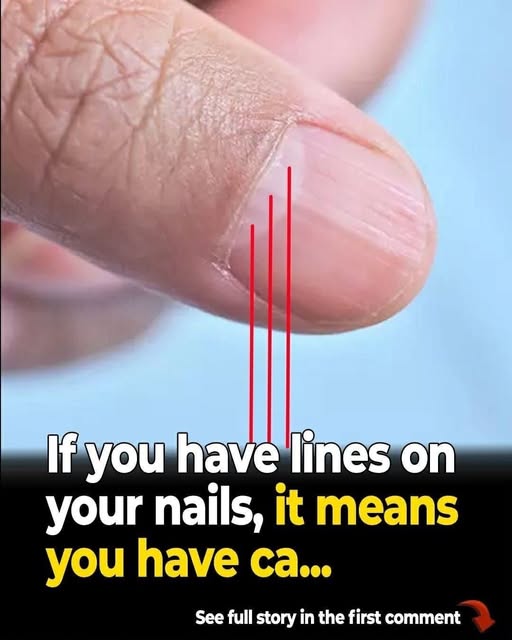
Can your fingernails reveal how long you’ll live? Learn which nail changes may provide clues about your health, what they can indicate, and when you should see a doctor.
Your fingernails can reveal clues about your general health, but can a simple change in the nails really predict how long you will live?
Understanding what nail changes can—and cannot—tell us is much more useful than relying on sensational health claims.
Why Do Doctors Look at Fingernails?
Fingernails are made primarily of keratin, the same structural protein found in hair and skin. Because nails grow gradually and can be affected by changes in the body, doctors sometimes examine them as part of a physical examination.
Changes in nail color, shape, thickness or growth can occasionally provide clues that warrant further investigation.
For example, certain nail abnormalities may occur alongside conditions affecting circulation, the lungs, liver, kidneys, thyroid or nutritional status.
But a nail finding is usually a clue rather than a diagnosis.
Can Your Fingernails Really Predict Life Expectancy?
Not directly.
Life expectancy is influenced by a large number of factors, including age, genetics, cardiovascular health, smoking, physical activity, diet, existing medical conditions and access to healthcare.
A particular nail characteristic cannot accurately combine all of these factors into a personal prediction of lifespan.
Some research has found associations between physical signs of aging and health outcomes, which may explain why headlines describe particular nail changes as potential indicators of longevity. But an association is not the same as a reliable prediction for an individual.
In other words, seeing a particular change in your fingernail does not mean you can determine your life expectancy from it.
What Nail Changes Should You Pay Attention To?
Several nail changes are worth knowing about.
1. A Dark Vertical Line
A dark line running lengthwise along a fingernail is known as longitudinal melanonychia.
There are many possible causes, including normal pigmentation, injury, medications and certain benign conditions.
However, a new or changing dark streak—especially one affecting a single nail—should be examined by a healthcare professional because, in uncommon cases, it can be associated with subungual melanoma, a form of skin cancer that develops beneath the nail.
Warning signs include a band that becomes wider or darker, irregular pigmentation, pigment spreading onto the surrounding skin, or changes in the nail itself.
2. Spoon-Shaped Nails
Nails that become unusually thin and curve inward, creating a spoon-like appearance, are called koilonychia.
Iron deficiency is one possible cause. Other causes can include certain systemic conditions, trauma or occupational exposure.
If spoon-shaped nails develop without an obvious explanation, a healthcare professional may investigate the underlying cause.
3. Clubbing
Nail clubbing occurs when the fingertips become enlarged and the nails curve more dramatically around the fingertips.
It can be associated with several underlying conditions, particularly certain lung and cardiovascular diseases.
Clubbing does not mean that someone has a particular disease, but newly developing clubbing deserves medical evaluation.
4. Brittle or Splitting Nails
Brittle nails are extremely common, particularly with aging.
Frequent exposure to water and cleaning products, nail cosmetics and repeated trauma can contribute to splitting or peeling.
Sometimes, however, nail changes can accompany nutritional deficiencies or other medical problems.
Because brittle nails have many possible causes, they should not automatically be interpreted as a sign of serious disease.
5. Changes in Nail Color
Nails can change color for many reasons.
Yellowish nails, pale nails, bluish discoloration or white markings can sometimes be associated with underlying health conditions, but they can also result from harmless causes such as staining, trauma or cosmetic products.
The pattern and context of the change matter.
What About “Half-and-Half” Nails?
Some people develop nails in which the portion near the nail bed appears different in color from the outer portion. These are sometimes called half-and-half nails.
Such changes have been reported in association with chronic kidney disease and other systemic conditions.
But again, the appearance of a particular nail pattern cannot be used by itself to diagnose kidney disease or predict longevity.
If several nails suddenly change appearance, especially alongside other symptoms, it is sensible to speak with a doctor.
White Spots Don’t Usually Mean Calcium Deficiency
One persistent internet myth claims that small white spots on fingernails automatically indicate calcium deficiency.
Usually, that’s not the case.
Small white marks are commonly related to minor trauma affecting the nail. They generally grow out as the nail grows.
If nail changes are extensive, persistent or accompanied by other symptoms, however, a medical evaluation can help identify the cause.
Your Nails Change Naturally With Age
Nails can become slower-growing, thinner, more brittle or otherwise different as people get older.
That means an unusual-looking nail in an older adult isn’t necessarily evidence of a serious illness.
The key is to pay attention to new, persistent or progressively changing abnormalities rather than assuming every nail imperfection is a warning sign.
When Should You See a Doctor?
Consider having a nail change evaluated if you notice:
- A new dark streak, particularly on one nail
- A streak that changes in width or color
- Pigment extending onto the surrounding skin
- Sudden changes affecting several nails
- Significant nail thickening or distortion
- New clubbing of the fingertips
- Persistent pain, swelling or bleeding around a nail
- A nail separating from the nail bed without an obvious injury
- Nail changes accompanied by unexplained weight loss, fatigue, breathing problems or other concerning symptoms
A doctor may examine the nails and surrounding skin and decide whether further testing or referral to a dermatologist is appropriate.
The Bottom Line
Your fingernails can sometimes provide useful clues about your health, but they aren’t a crystal ball for predicting how long you will live.
A dark streak, unusual curvature, clubbing or significant change in nail appearance can occasionally signal an underlying condition that deserves attention. At the same time, many nail changes are completely harmless and occur because of aging, minor injuries or everyday exposure.
So rather than asking, “What does this nail sign say about my life expectancy?”, a better question is:
“Is this a new or unusual change that I should have checked?”
That approach is more medically useful—and avoids turning an interesting health clue into an unsupported prediction about longevity.