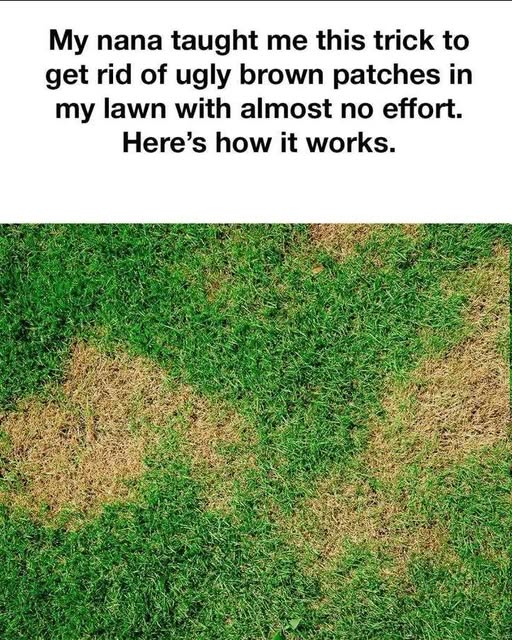
Discover why brown patches appear in your lawn and learn simple, practical ways to help your grass recover. From watering and mowing habits to pet spots, soil problems, and lawn diseases, these tips can help restore a greener, healthier yard.
My Nana Taught Me This Trick to Get Rid of Ugly Brown Patches in My Lawn
Brown patches can make an otherwise healthy lawn look dry, neglected, and uneven. The frustrating part is that simply watering the grass more doesn’t always solve the problem. In fact, different types of brown patches can have completely different causes.
Before reaching for expensive lawn products, take a few minutes to inspect the affected area and figure out what is actually causing the discoloration.
First, Check What the Brown Patch Looks Like
Look closely at the grass. Is the entire area dry and crispy? Are the patches circular? Do they have irregular edges? Is the grass pulling easily from the soil?
These clues can help identify the problem.
1. Check the Soil Moisture
Dry soil is one of the simplest reasons grass turns brown. Push a finger or small screwdriver into the soil around the affected area. If the ground is hard and dry several inches below the surface, your lawn may simply need deeper, more consistent watering.
Instead of watering lightly every day, many lawns benefit from less frequent but deeper watering, depending on the grass type, soil, climate, and local watering recommendations.
2. Don’t Cut the Grass Too Short
Scalping the lawn can place considerable stress on grass, especially during hot weather.
Keep your mower blade sharp and avoid removing too much of the grass blade at once. The appropriate mowing height depends on your particular grass variety, so check the recommended height for your lawn.
3. Look for Pet Damage
If you have a dog, concentrated urine can sometimes create brown or yellow patches, often surrounded by a ring of greener grass.
Simply watering the area may help dilute the salts, but repeatedly affected spots may continue to return unless the underlying cause is addressed.
4. Check for Lawn Disease
Brown patches can also be caused by fungal diseases. If you notice spreading circular or irregular areas, damaged blades, or discoloration that continues despite adequate moisture, disease may be involved.
Avoid automatically applying fungicide without identifying the problem. Over-treating a lawn can waste money and may not solve the actual cause.
5. Inspect for Insects and Grubs
Some insect infestations damage grass roots, leaving sections of lawn brown or weak.
A useful clue is grass that lifts from the soil unusually easily because its roots have been damaged. Digging a small section near the edge of the affected area can help you inspect what’s happening underneath.
6. Improve Compacted Soil
Heavy foot traffic, pets, vehicles, or naturally compacted soil can prevent water and oxygen from reaching grass roots.
Aeration can help improve the movement of air, water, and nutrients through compacted soil. For small areas, a hand aerator can be useful; larger lawns may require mechanical aeration.
What About the “Old-Fashioned Trick”?
Many traditional lawn-care tips involve using ordinary household ingredients or changing the way the lawn is watered. However, there isn’t one universal household trick that will safely eliminate every brown patch.
The best approach is to identify the cause first. A remedy that helps a drought-stressed lawn may do nothing for fungal disease, insect damage, poor soil, or pet urine—and some household products can actually damage grass if applied incorrectly.
A Simple Recovery Routine
Once you’ve identified the likely cause:
- Remove heavily damaged debris from the area.
- Correct the watering problem.
- Avoid cutting the grass excessively short.
- Loosen compacted soil where appropriate.
- Address insects or disease only when properly identified.
- Reseed or repair areas where the grass has died completely.
- Give new grass adequate moisture while it establishes.
With consistent care, many damaged lawn areas can gradually become green again.
Final Thought
Those ugly brown patches don’t necessarily mean your lawn is beyond saving. The key is finding out why the grass is turning brown before treating it. A little observation, proper watering, sensible mowing, and attention to soil and pests can often make a noticeable difference.
And sometimes, the simplest old-fashioned lawn-care habits really are the ones worth keeping.