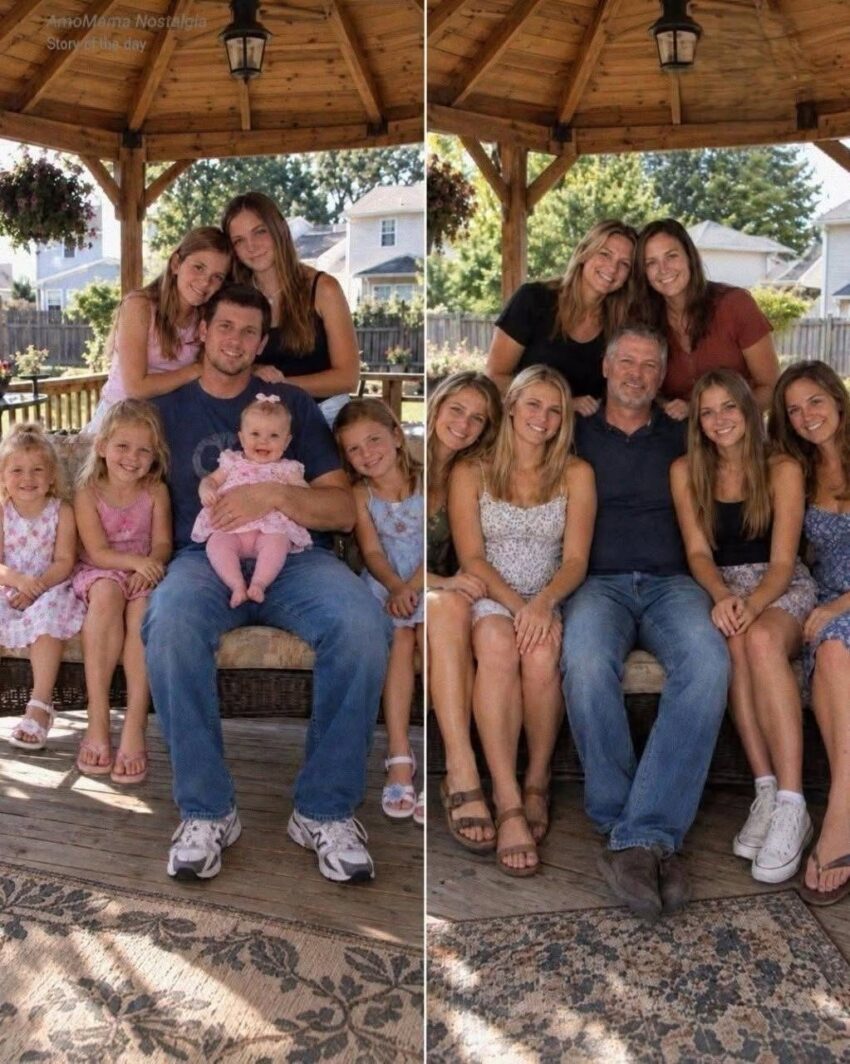
After his wife abandoned him and their six daughters for a wealthy man, a devoted father spent 15 years raising his girls alone. But when his ex-wife unexpectedly appeared at their eldest daughter’s wedding, a shocking decision in front of 150 guests revealed the true meaning of family, sacrifice, and forgiveness.
My Wife Left Me With Our Six Daughters for a Wealthy Man—15 Years Later, She Appeared at Our Oldest Daughter’s Wedding, and What Our Daughter Did Shocked 150 Guests
When my wife walked out of our house fifteen years ago, she took two suitcases, her jewelry box, and the last of the happiness I thought our family had left.
She didn’t take our six daughters.
They were standing in the hallway, watching her leave, too young to understand why their mother was crying but not turning around.
Our oldest, Emily, was twelve.
Our youngest, Sophie, was barely two.
I remember Sophie reaching toward the door and calling, “Mommy, wait!”
My wife stopped for half a second.
Then she stepped into the waiting black luxury car and disappeared down the road with a man who had more money than I could have imagined.
That evening, I sat on the edge of our bed, staring at the empty side where my wife had slept for fourteen years.
I had no idea how I was going to raise six girls alone.
But I knew one thing.
They would never have to wonder whether their father would stay.
The Day Our Family Fell Apart
My name is Daniel Carter, and at the time my wife, Vanessa, left us, I was working long hours as a maintenance supervisor at a local manufacturing plant.
We weren’t wealthy, but we had a modest home, a reliable old car, and enough money to keep food on the table.
Our life was noisy and exhausting. There were school lunches to pack, laundry piled in baskets, arguments over bathroom time, and bedtime stories that always seemed to take longer than expected.
But I believed we were happy.
Vanessa had begun complaining about our financial situation several months before she left.
She wanted expensive clothes, holidays abroad, and a bigger house. She compared our life with those of her friends and seemed increasingly ashamed of our small home.
Then she met Richard, a wealthy businessman who owned several properties and drove a car that cost more than our house.
At first, she described him as a friend.
Eventually, the truth became impossible to ignore.
One evening, after the girls had gone to bed, Vanessa stood in our kitchen and told me she was leaving.
“You’re choosing him over your children?” I asked, struggling to understand.
She looked away.
“I’m choosing a different life, Daniel. I’m tired of struggling.”
“They’re your daughters.”
“I know that.”
“Then how can you walk out?”
Her eyes filled with tears, but she didn’t change her mind.
“I can’t keep living like this.”
I wanted to shout. I wanted to ask whether the years we’d spent building our family meant anything to her.
Instead, I looked toward the staircase, where I could hear one of the girls moving around in her bedroom.
“Please don’t do this to them,” I whispered.
But Vanessa had already made her decision.
Within an hour, she was gone.
And I was left to explain the unexplainable to six little girls.
Learning to Be Both Parents
The first few months were the hardest.
I learned how to braid hair by watching online tutorials after the girls fell asleep. I learned which lunches my daughters would actually eat and which ones would return home untouched.
I learned that Emily hated mushrooms, Lily couldn’t sleep during thunderstorms, Grace needed extra time with her reading assignments, and Sophie would only drink milk from her favorite blue cup.
I also learned that children can be heartbroken without knowing the words for heartbreak.
At first, the girls asked when their mother was coming home.
“Maybe next weekend?” Sophie would ask.
I couldn’t bring myself to tell her that I didn’t know.
So I said, “I hope you’ll see her again someday, sweetheart.”
As the weeks turned into months, the questions became less frequent.
Emily stopped asking altogether.
That frightened me more than the crying.
One night, I found her sitting on the back porch with her knees pulled against her chest.
“You’re supposed to be asleep,” I told her gently.
She wiped her face.
“I heard you crying in the kitchen.”
I sat beside her.
For several minutes, neither of us spoke.
Then she asked the question I had been dreading.
“Was it because we weren’t good enough?”
My heart broke.
“No, Emily. No. Not even a little.”
“Then why did she leave?”
I looked at my twelve-year-old daughter and realized there was no explanation that would make the situation fair.
“Sometimes adults make choices that hurt the people who love them,” I said. “But her choice isn’t a reflection of your worth.”
Emily leaned against my shoulder.
That night, I promised myself I would repeat those words as many times as she needed to hear them.
I couldn’t make their mother stay.
But I could make sure my daughters never blamed themselves for her leaving.
Six Daughters, One Father, and a Thousand Small Sacrifices
Life became a routine of early mornings and late nights.
I woke at five to prepare breakfast, drove the girls to school, worked my shift, and returned home to cook dinner and help with homework.
On weekends, I repaired broken furniture, fixed neighbors’ appliances, and accepted extra shifts whenever they were available.
There were times when money was so tight that I postponed buying new shoes for myself so the girls could have what they needed for school.
When Emily’s school announced a formal dance, I learned how to alter a dress with a sewing machine borrowed from a neighbor.
When Lily wanted to join the school orchestra, I found a secondhand instrument.
When Grace struggled with mathematics, I sat beside her with a notebook until we finally understood the problem together.
None of it made me a perfect father.
I lost my temper sometimes. I forgot appointments. I burned dinner more often than I care to admit.
But I showed up.
Every school performance, every parent-teacher meeting, every birthday, every difficult conversation.
I was there.
Over time, the girls stopped waiting for their mother to return.
They began building their own lives.
Emily became responsible and determined. Lily developed a sharp sense of humor. Grace was endlessly curious. Hannah loved helping people. Olivia became the peacemaker of the family. Sophie, the youngest, grew into a confident girl who seemed determined to make everyone laugh.
Our home was far from perfect.
But it was ours.
And the six girls who once stood in the hallway watching their mother leave became six young women who knew they could depend on one another.
The Woman Who Never Called
For the first few years, Vanessa occasionally sent short messages.
She asked how the girls were doing and promised she would arrange a visit.
Those visits never happened.
Sometimes she sent birthday cards. Sometimes a small gift arrived around Christmas. But there were long periods when we heard nothing at all.
I never hid the cards from my daughters.
I also never forced them to respond.
When Emily turned eighteen, Vanessa sent her a message saying she hoped they could reconnect.
Emily read it at the kitchen table.
Then she put her phone down.
“Are you going to answer her?” I asked.
“I don’t know.”
“You don’t have to decide today.”
She stared at the screen for a long time.
“Why now?”
I didn’t have an answer.
Years later, Vanessa contacted Lily. Then Hannah. Each time, she spoke about how much she missed them and how difficult it had been to stay away.
The girls listened, but they had questions.
Why hadn’t she called when Sophie had nightmares?
Why hadn’t she attended Emily’s graduation?
Why had she missed the birthdays, the school plays, the illnesses, and the ordinary days that make up a child’s life?
Vanessa never gave them answers that made everything right.
And I never told my daughters what they should feel.
They were allowed to miss her.
They were allowed to be angry.
They were allowed to want nothing to do with her.
Their relationship with their mother was theirs to decide.
Fifteen Years Later, Emily Found the Love of Her Life
When Emily turned twenty-seven, she met a man named Michael Reynolds.
He was kind, patient, and thoughtful in a way that reminded me of the best people I’d known throughout my life.
The first time he came to dinner, he arrived carrying flowers for Emily and a box of pastries for her sisters.
He spent two hours listening to stories about our family.
At one point, Sophie described the time I had accidentally put salt instead of sugar into a birthday cake.
Michael laughed so hard that he nearly spilled his drink.
By the end of the evening, I liked him.
Over the next two years, I watched Emily become happier and more relaxed than I’d ever seen her.
When Michael proposed, she called me before she called anyone else.
“Dad,” she said through tears, “he asked me to marry him.”
I sat down at the kitchen table.
For a moment, I couldn’t speak.
My little girl—the twelve-year-old who had once asked whether she and her sisters had been good enough—was getting married.
“Are you happy?” I finally asked.
“I’m so happy.”
“Then I’m happy, too.”
The wedding preparations began almost immediately.
My daughters worked together to choose flowers, invitations, dresses, and decorations. The six sisters argued about seating arrangements and laughed over childhood photographs.
Emily asked me to walk her down the aisle.
She didn’t ask me to give her away.
She asked me to walk beside her.
That distinction meant more to me than she could possibly have known.
The Unexpected Invitation
Three weeks before the wedding, Emily received a message from Vanessa.
Her mother wanted to attend.
I learned about it that evening when Emily came to my house and sat quietly at the kitchen table.
“Mom wants to come to the wedding,” she said.
I put down my coffee.
“What do you want?”
“I don’t know yet.”
I nodded.
“Then take your time.”
She looked at me, searching my face for an answer I couldn’t give her.
“Would you be upset if I invited her?”
The question hurt, but I tried not to let it show.
“Emily, it’s your wedding. You shouldn’t make that decision to protect my feelings.”
“But she hurt you, too.”
“She did. But this day belongs to you and Michael. If you want her there, I’ll respect that.”
Emily looked down at her hands.
“I’m not sure I want her there. Part of me wants her to see the family she left. Another part of me doesn’t want to look at her and remember everything.”
I reached across the table and held her hand.
“You don’t owe anyone a reunion. Not even your mother.”
For several days, Emily thought about it.
Finally, she sent Vanessa an invitation.
Not because everything had been forgiven.
Not because the past no longer mattered.
But because Emily wanted to make her own decision without letting fifteen years of pain control every part of her future.
Vanessa accepted.
And so, on the morning of the wedding, 150 guests gathered at a beautiful country venue, unaware that the most emotional moment of the day would have nothing to do with the vows.
The Woman in the Back Row
The ceremony began beneath an arch decorated with white roses.
Michael stood at the front with his best man. Emily’s sisters sat together in the first row, trying not to cry before the music even started.
I waited beside Emily in a small room behind the ceremony space.
She wore a simple ivory gown, and her hands trembled slightly as she adjusted her bouquet.
“You look beautiful,” I told her.
She smiled.
“Dad, do you remember the blue dress you sewed for my school dance?”
I laughed softly.
“Unfortunately, yes. I still have nightmares about that zipper.”
She giggled, then grew serious.
“You were there for everything.”
I looked at her.
“Not everything, sweetheart. But I tried.”
“You were there when I needed someone.”
I kissed her forehead.
“Always.”
When the music began, I offered her my arm.
We walked toward the ceremony together.
The guests rose to their feet.
And near the back of the room, I saw Vanessa.
She wore an elegant navy-blue dress and carried a small clutch. Her hair was styled perfectly, and she looked much the same as I remembered her.
For one brief second, our eyes met.
Then she looked away.
I felt a familiar ache, but I turned my attention back to Emily.
This was her day.
Nothing else mattered.
Or so I thought.
The Reception Took an Unexpected Turn
The ceremony was beautiful.
Michael promised to love Emily through every season of life. Emily promised to stand beside him through uncertainty, hardship, and joy.
When they kissed, the room erupted in applause.
At the reception, guests ate dinner, shared stories, and danced beneath strings of warm lights.
Vanessa sat at a table near the back.
She watched the six sisters laughing together. She watched Michael dance with Emily. She watched me stand near the dance floor while my daughters pulled me into photographs.
For fifteen years, I had imagined what it might feel like to see Vanessa again.
I thought I might feel anger.
I thought I might want her to understand every sleepless night and every sacrifice.
Instead, I felt tired.
The kind of tiredness that comes after carrying something heavy for so long that you almost forget what life feels like without it.
Then the master of ceremonies announced the traditional father-daughter dance.
Emily approached me.
“Dad, may I have this dance?”
I smiled and took her hand.
The music began, and we stepped onto the floor.
She rested her head against my shoulder.
“Thank you,” she whispered.
“For what?”
“For staying.”
My throat tightened.
“I love you, sweetheart.”
“I know.”
We danced slowly while our family and friends watched.
When the song ended, Emily kissed my cheek and walked toward the microphone.
I assumed she wanted to thank the guests.
Instead, she turned toward the room and asked for everyone’s attention.
“There is someone here tonight I need to speak to,” she said.
The room grew quiet.
Vanessa straightened in her chair.
Emily took a breath.
“Mom, would you please come up here?”
A murmur passed through the guests.
Vanessa rose slowly and walked toward the front.
I stood near the dance floor, unable to guess what my daughter intended to say.
Emily waited until her mother reached her.
Then she held out a small, folded piece of paper.
“I wrote this a long time ago,” she said. “I was twelve when you left. I wrote it because I didn’t know how else to tell you what I was feeling.”
Vanessa’s face changed.
Emily continued.
“I kept it for fifteen years. I thought about giving it to you when I graduated. I thought about giving it to you on my twenty-first birthday. I even thought about sending it when I got engaged.”
Her voice trembled, but she continued.
“But I never knew whether I wanted you to read it, or whether I just wanted you to know that I had been hurt.”
Vanessa unfolded the paper.
Her hands began to shake.
The Letter That Silenced 150 Guests
Emily had kept the letter in a box with childhood photographs and school certificates.
The paper had yellowed slightly at the edges.
On it, in the uneven handwriting of a twelve-year-old girl, were the words:
“Dear Mom,
I don’t know why you left. Dad says it wasn’t our fault, but sometimes I wonder if we were too noisy or if we asked for too much.
I try to help with the girls. I make Sophie breakfast when Dad has to leave early. I help Lily with her homework, and I tell Hannah stories when she can’t sleep.
Sometimes I get angry at you. Then I feel bad because you’re my mom.
I don’t know if you miss us.
I hope someday you understand that we didn’t need a bigger house or expensive things.
We just needed you.
Love, Emily.”
By the time Vanessa reached the last line, tears were running down her face.
The reception hall was silent.
No one reached for a phone. No one whispered.
For the first time in fifteen years, Vanessa had to face the pain her absence had left behind—not through an argument or accusation, but through the words of the little girl she had abandoned.
Emily let her mother finish reading.
Then she spoke again.
“I invited you here because I wanted you to see the family you left. My sisters grew up. We went to school, celebrated birthdays, got our first jobs, and learned how to become adults.”
She looked toward her sisters.
“We did all of that together. Dad worked hard to give us a home. He was there when we were sick, when we were frightened, and when we needed someone to tell us we were going to be okay.”
I lowered my head.
I didn’t want to cry in front of everyone, but I could no longer stop myself.
Emily turned back to Vanessa.
“I used to think that if you came back, everything would feel right again. I thought maybe I could finally stop wondering why you chose to leave.”
She paused.
“But I understand now that I may never get an answer that makes sense to me.”
Vanessa tried to speak.
“Emily, sweetheart—”
Emily gently raised her hand.
“Please let me finish.”
Her mother fell silent.
“I didn’t bring you here to embarrass you. I didn’t invite you so I could punish you. I invited you because I wanted to make a decision about our relationship for myself.”
She took a shaky breath.
“I can’t give you back the fifteen years we lost. I can’t pretend they didn’t matter. And I can’t promise that one wedding will make everything okay.”
Then Emily looked at her mother with an expression I will never forget.
“But I don’t want to spend the rest of my life carrying the same pain. If we ever have a relationship again, it has to begin with honesty. Not money. Not promises. Not pretending nothing happened.”
She reached for Vanessa’s hand.
“I am willing to find out whether we can build something new. But you have to understand that trust takes time, and being my mother doesn’t automatically erase what happened.”
Vanessa began to cry harder.
“I know,” she whispered. “I know I don’t deserve to ask you for anything.”
Emily shook her head.
“This isn’t about what you deserve. It’s about what I’m willing to do.”
Then she turned toward me.
“And Dad, I want everyone here to know something. The man who walked me down the aisle today wasn’t just the person who raised me. He was the person who stayed when staying was difficult.”
The guests began to applaud, softly at first.
Within seconds, the entire room was standing.
I covered my face with one hand.
Fifteen years of exhaustion, worry, and quiet determination seemed to catch up with me all at once.
My daughters surrounded me.
Lily hugged my left arm. Grace held my hand. Hannah and Olivia pressed close to my shoulders, while Sophie wrapped both arms around my waist.
Emily stepped away from her mother and joined us.
For a moment, we were all together.
The family that had survived the hardest years of our lives.
What Happened After the Wedding
Vanessa left the reception before the dancing ended.
She didn’t make a scene. She didn’t argue with Emily or ask anyone to take her side.
She simply hugged Emily goodbye and walked out into the night.
I watched her go without following.
For years, I had imagined that seeing her regret her decision would make me feel better.
It didn’t.
What made me feel better was seeing my daughters stand together, knowing they had grown into women who understood their worth.
The next morning, Emily called me.
“How are you feeling?” she asked.
I laughed softly.
“Like I need a week of sleep.”
She giggled.
Then she grew quiet.
“Do you think I was too hard on Mom?”
I considered the question carefully.
“No, sweetheart. You told her the truth. You didn’t insult her, and you didn’t demand that she suffer. You simply explained what her decision meant to you.”
“She looked so sad.”
“She may be sad for a long time. But you are not responsible for making her feel better about the choices she made.”
Emily was silent for a moment.
“I don’t know if I can forgive her completely.”
“You don’t have to decide that today.”
“And what if I never can?”
I looked out the kitchen window at the sunlight falling across the garden.
“Then you keep living your life. Forgiveness isn’t something anyone can force you to give. If it comes, let it come honestly. If rebuilding the relationship takes time, take the time you need.”
She exhaled slowly.
“Thanks, Dad.”
“Always.”
Over the following months, Vanessa began writing to Emily and the other girls.
This time, the messages were different.
She stopped making promises she couldn’t keep. She acknowledged that she had missed important moments and that no explanation could undo the hurt.
Some daughters chose to respond. Others needed more time.
Emily agreed to meet her mother for coffee several months later, with no expectations beyond an honest conversation.
Their relationship did not suddenly become perfect.
There were difficult questions, uncomfortable silences, and memories that still hurt.
But Vanessa began listening instead of defending herself.
For the first time, she understood that returning to her daughters’ lives was not a right she could claim. It was an opportunity she would have to earn through consistent actions.
And Emily understood something, too.
She could choose to leave the door open without pretending the past had never happened.
The Real Meaning of Family
A year after the wedding, I found the old letter in Emily’s childhood box.
She had made a copy for herself and given the original back to Vanessa.
I read it again, thinking about the twelve-year-old girl who had written those words while trying to help raise her younger sisters.
I thought about the little girl who had wondered whether she and her sisters were somehow not enough.
And I thought about the woman who had stood before 150 wedding guests and finally spoken the truth she had carried for half her life.
I was proud of her.
Not because she had made her mother cry.
Not because she had delivered a dramatic speech.
I was proud because she had found the courage to tell the truth without allowing her pain to turn into cruelty.
My daughters taught me that family is not defined by wealth, appearances, or promises made during happy moments.
It is defined by the people who show up when life becomes difficult.
By the people who sit beside you in hospital waiting rooms, help you through exams, comfort you after heartbreak, and stay awake when you cannot sleep.
It is defined by the people who choose you again and again, even when no one is watching.
My wife once left us for a life she believed would be better.
Fifteen years later, she returned to find that the six little girls she had left behind had become strong, independent women.
She came expecting to attend a wedding.
Instead, she witnessed the family she had walked away from—and learned that love cannot be replaced by money, that trust cannot be demanded, and that time lost cannot simply be reclaimed.
As for me, I learned that raising six daughters alone was never proof that I was strong enough to do everything.
It was proof that I didn’t have to do everything perfectly to keep showing up.
And when Emily danced with me at her wedding, I finally understood that the little girl who had once asked whether she and her sisters were good enough had grown into a woman who no longer needed an answer from someone who had left.
She already knew her worth.
And so did the five sisters standing beside her.
Because sometimes the most powerful thing a person can do isn’t to punish the one who hurt them. It’s to speak the truth, establish boundaries, and decide for themselves what kind of future they are willing to build.