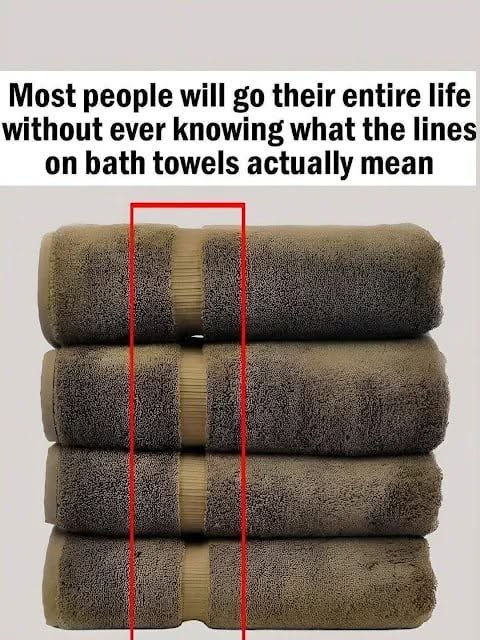
Ever wondered what the decorative lines or bands on bath towels are actually for? Discover the practical purpose behind these woven stripes, how they affect towel performance, and why they appear on so many everyday towels.
Here’s What the Lines on Bath Towels Actually Mean
Have you ever noticed the raised lines or decorative bands running across the ends of your bath towel and wondered why they’re there?
Those stripes aren’t simply a random design choice. In many towels, they are created as part of the towel’s woven construction and serve several practical purposes.
1. They’re Called a Dobby Border
The patterned strip near the end of many towels is commonly known as a dobby border or dobby weave.
Unlike the fluffy terry portion of the towel, this section uses a different weaving pattern. It can create simple lines, geometric designs, or more elaborate patterns.
That’s why the band feels flatter and less absorbent than the rest of the towel.
2. They Help Give the Towel Structure
The decorative bands can help provide a transition between the main terry fabric and the finished edge of the towel.
The tighter weave creates a more stable section near the towel’s end, helping give the towel a defined appearance and finish.
3. They Make the Towel Look More Finished
There’s also a clear aesthetic purpose.
A plain towel can look fairly ordinary, while a woven border gives it a more polished, hotel-like appearance. That’s one reason you’ll see these bands on everything from inexpensive everyday towels to luxury hotel linens.
4. They’re Not Mainly There to Make the Towel More Absorbent
A common misconception is that the stripes somehow improve the towel’s ability to soak up water.
Actually, the opposite is closer to the truth: the flatter woven strip generally absorbs less water than the surrounding terry loops.
The fluffy loops across the main body of the towel provide much of the surface area responsible for absorbing moisture.
5. Why Do Some Towels Have One Line and Others Have Several?
The number and design of the bands can vary depending on the manufacturer and style of the towel.
Some towels have a single narrow border, while others have multiple lines or intricate patterns. These differences are usually related to design, weaving technique, and construction, rather than a hidden code about towel quality or intended use.
6. The Border Can Also Help With Finishing
The tighter woven area can make it easier for manufacturers to create a neat, durable edge and transition into the towel’s hem.
However, the exact construction varies between towels, so not every decorative stripe performs exactly the same function.
Final Thoughts
So, the next time you grab a bath towel and see those familiar horizontal lines, you’ll know they’re more than decoration. They’re part of the towel’s woven construction, often serving as a dobby border that adds structure, creates a finished edge, and gives the towel its distinctive look.
The fluffy terry loops do most of the absorbing, while the flatter band helps give the towel a neat, finished appearance.