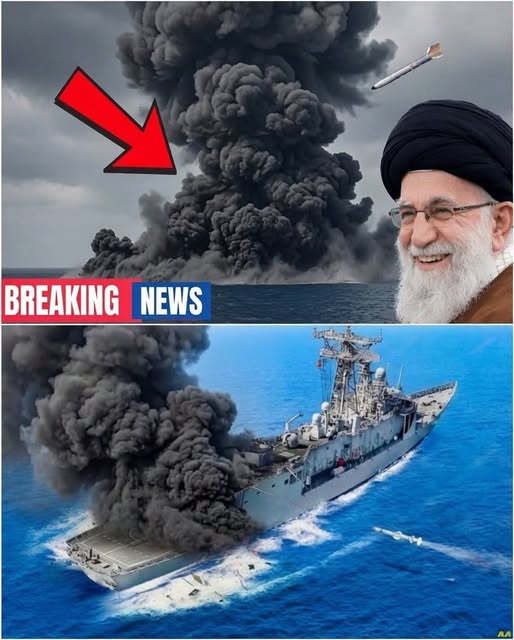
Iran has repeatedly threatened U.S. naval forces amid the ongoing conflict. Here’s what is known about claims involving the USS Abraham Lincoln, the defenses protecting a carrier, and why a successful strike would have enormous consequences.
Tensions between Iran and the United States have reached an extraordinary level, with the Strait of Hormuz becoming a major flashpoint in the wider conflict.
Among the most dramatic claims have been reports that Iran attempted to strike the U.S. aircraft carrier USS Abraham Lincoln. Iranian forces have made claims about hitting the carrier, while U.S. officials have disputed those claims. As of the latest reporting, there is no confirmed evidence that Iran successfully struck or sank the carrier.
Why an Aircraft Carrier Is Such a Difficult Target
A modern U.S. aircraft carrier does not operate alone. It travels as part of a carrier strike group, surrounded by other warships that provide layers of protection.
Those defenses can include fighter aircraft, radar systems, electronic warfare, interceptor missiles, and close-range defensive weapons.
That means an attacker must overcome multiple defensive layers before an incoming weapon can even reach the carrier.
Iran’s Anti-Ship Capabilities
Iran possesses a range of weapons designed to threaten ships in the Persian Gulf and surrounding waters, including anti-ship cruise missiles, ballistic missiles, drones, fast attack boats, and naval mines.
The challenge, however, is not simply launching a missile.
An attacker must first locate a moving carrier, maintain accurate targeting information, and guide the weapon toward the ship despite electronic warfare, defensive systems, decoys, and the enormous distances involved.
What Would Happen If a Carrier Were Hit?
Sinking the carrier is not necessarily the only objective that could have a major military effect.
A sufficiently damaging strike could potentially disable flight operations, damage aircraft, start fires, or force the carrier to withdraw for repairs.
Military analysts often describe this as a “mission kill”—the ship remains afloat but can no longer effectively perform its primary mission.
Historical carrier fires have demonstrated how vulnerable flight operations can be even when the ship itself survives.
Viral Videos Have Added to the Confusion
Social media has circulated dramatic videos supposedly showing Iranian missiles striking or sinking the USS Abraham Lincoln. However, fact-checkers have identified some of these videos as AI-generated or found no credible evidence supporting the claims.
This is why dramatic footage circulating online should not automatically be treated as proof of a successful attack.
The Bigger Strategic Picture
The confrontation is about much more than one aircraft carrier.
The Strait of Hormuz is one of the world’s most strategically important waterways, and the continuing conflict has severely disrupted shipping and energy markets. Reuters reported in late August that the conflict had developed into a prolonged struggle centered heavily on control of the waterway.
Iran has also claimed it has “full control” of the Strait, while the United States has disputed Tehran’s characterization of the situation.
The USS Abraham Lincoln has since been reported preparing to leave the region after an exceptionally long deployment.
The Bottom Line
Iran has demonstrated that it possesses weapons capable of threatening ships in the region, and the confrontation around the Strait of Hormuz remains extremely serious.
But there is an important distinction between attempting to attack a U.S. carrier, claiming that a carrier was hit, and actually sinking one.
As of the latest available reporting, there is no credible confirmation that Iran successfully sank the USS Abraham Lincoln. The dramatic “carrier sinking” videos circulating online should therefore be treated with extreme caution.