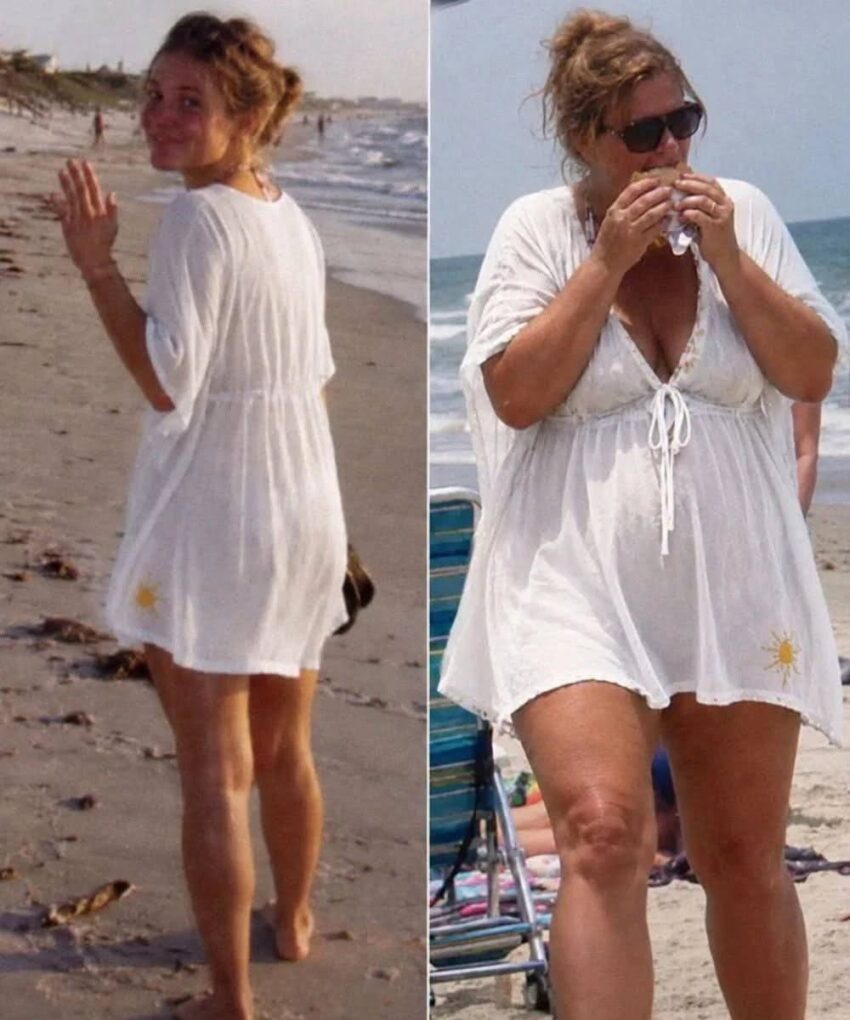
When a mother’s 16-year-old daughter disappears from a crowded beach, her world falls apart. Eight years later, a chance encounter with a stranger wearing her missing daughter’s handmade cover-up uncovers a mystery that refuses to stay buried.
The Stranger Who Was Wearing My Daughter’s Clothes
The woman standing outside the little seaside café was a complete stranger.
I had never seen her before. I didn’t know her name, where she lived, or why she had chosen that particular afternoon to walk through a crowded street nearly six hundred miles from my home.
But I knew the clothes she was wearing.
I would have recognized them anywhere.
The white cotton cover-up had tiny blue flowers embroidered around the sleeves, a crooked row of wooden buttons down the front, and a small yellow sun stitched near the hem. The left pocket was slightly uneven because my daughter had insisted on sewing it herself.
I had watched her make it at our kitchen table.
I remembered the blue thread tangled around her fingers, the way she bit her lower lip when she concentrated, and the proud smile she gave me when she finally finished.
“Nora,” I had told her that afternoon, “you could sell these one day.”
She had laughed.
“Maybe I will, Mom. When I’m famous.”
That was eight years ago.
Nora was sixteen when she disappeared from a crowded beach on a bright July afternoon. She had been wearing that exact cover-up over her swimsuit.
And now, eight years later, I was staring at a stranger wearing it as casually as if it had come from a shop.
For a moment, the street seemed to tilt beneath my feet.
I couldn’t breathe properly.
I couldn’t think.
All I could do was stare at the tiny yellow sun near the hem.
Then the woman turned toward the café door.
And I finally found my voice.
“Excuse me!”
She stopped.
I walked toward her, trying desperately to keep my hands from shaking.
“Where did you get that?”
She glanced down at her clothes.
“This?”
“Yes. That cover-up. Where did you get it?”
Her expression changed when she saw my face.
“I’ve had it for years,” she said cautiously. “Why?”
I swallowed.
“Because my daughter was wearing it when she disappeared.”
The woman went completely still.
Then she whispered four words that changed everything.
“Oh my God. Nora.”
The Day My Daughter Vanished
Eight years earlier, our family had gone to the beach for what was supposed to be an ordinary summer outing.
Nora had been excited for weeks. She had just finished another year of school and was making plans for the future with the confidence only a sixteen-year-old could possess.
She wanted to study photography. She wanted to travel. She wanted to open a little clothing business with the money she hoped to save from a summer job.
Most of all, she wanted to be independent.
That morning, she had packed her beach bag herself and insisted on bringing the handmade cover-up she had spent several weekends creating.
“It’s finally warm enough,” she told me, holding it up.
I teased her about the crooked pocket.
She rolled her eyes.
“That’s called character, Mom.”
I kissed her forehead.
“Then it has plenty of character.”
It was the last completely ordinary conversation we ever had.
The beach was crowded when we arrived. Children ran between colorful umbrellas, vendors called out their prices, and families gathered near the water.
I remember spreading our towels beneath a striped umbrella.
I remember Nora laughing at something her younger cousin said.
I remember telling her to put on sunscreen.
And I remember her walking toward the water in that white cover-up.
At some point, she told me she was going to meet a friend near the beach promenade.
I assumed she would be back in a few minutes.
When twenty minutes passed, I began looking for her.
At first, I wasn’t worried. Teenagers lose track of time. They become distracted by conversations, shops, and friends.
But when another half hour passed, I started calling her phone.
There was no answer.
I walked toward the promenade, asking people whether they had seen a teenage girl with brown hair and a white cover-up decorated with blue flowers.
Some shook their heads.
Others barely looked at me.
Then I returned to our towels and discovered that Nora’s beach bag was still there.
Her sandals were beside it.
Her phone was not.
I called her again.
Nothing.
By late afternoon, my husband was searching the parking area while I ran along the shoreline, calling Nora’s name until my voice became hoarse.
The police arrived before sunset.
They interviewed witnesses, searched the beach, and examined the areas around the public facilities and nearby roads.
Nobody could tell us where she had gone.
No one remembered seeing her leave.
No message arrived explaining what had happened.
Nora had simply vanished.
And the white cover-up became one of the last things I could picture her wearing.
Eight Years of Questions
The first months were unbearable.
I woke every morning believing, for a few seconds, that the nightmare might have ended. Then I remembered.
Nora wasn’t in her room.
Her shoes remained beside the bed. Her notebooks were still stacked on the desk. A half-finished sketch of a summer dress lay beneath a folder.
I couldn’t bring myself to move anything.
The police followed leads and spoke with people who had been at the beach. Investigators considered different possibilities, but no explanation could be established.
We distributed photographs.
We answered calls.
We followed every credible lead that came our way.
Sometimes, someone reported seeing a girl who resembled Nora in another town. My husband and I would immediately gather our things and go.
Every time, it was someone else.
As the years passed, the calls became less frequent.
Friends stopped asking whether there was news because they didn’t know what else to say.
Some people believed Nora had run away.
Others thought something terrible had happened.
I refused to accept either possibility without evidence.
I learned to live with uncertainty, though I never learned to make peace with it.
Every July, I returned to the beach.
I sat beneath the same kind of striped umbrella and watched the crowds moving along the shoreline.
I imagined Nora walking toward me, older now, perhaps with different hair and a different way of speaking, but still carrying that familiar smile.
Eight years is a long time.
But a mother’s memories do not always measure time the way a calendar does.
To me, Nora was still sixteen.
And I was still waiting.
The Woman Outside the Café
Now, standing in that unfamiliar seaside town, I stared at the woman who had just spoken my daughter’s name.
She looked frightened.
Not frightened of me, exactly.
More as though something she had kept locked away had suddenly been pulled into the light.
“How do you know Nora?” I asked.
She glanced at the people passing us on the pavement.
“Not here,” she said quietly. “Please.”
My heart began pounding.
“Tell me where you got that cover-up.”
She touched the embroidered sleeve.
“I didn’t know who made it. I swear. I bought it secondhand.”
“From whom?”
She hesitated.
“An older woman. At a charity sale, years ago.”
My stomach tightened.
“Where?”
“Near a small town outside Port Mason. I don’t remember the exact address.”
She looked at me again.
“Are you really Nora’s mother?”
I nodded.
The woman pressed her lips together.
Then she reached into her handbag and pulled out a small, folded piece of paper.
“I kept this because I thought it was strange,” she said. “I never understood what it meant.”
She handed it to me.
The paper was worn and yellowed at the edges.
There were only a few words written on it.
If anyone ever asks about the blue flowers, tell them to look where the tide turns.
I read the sentence once.
Then again.
The handwriting looked familiar, although I couldn’t immediately explain why.
I had spent years studying Nora’s school notes, drawings, and birthday cards. I knew the shape of her letters almost as well as I knew my own.
But I couldn’t yet tell whether the message was hers.
“Where did this come from?” I whispered.
The woman shook her head.
“It was inside the pocket when I bought the cover-up. I thought it was an old receipt or something. I nearly threw it away.”
I looked down at the uneven pocket.
The same pocket Nora had sewn herself.
My knees felt weak.
For eight years, I had searched for a person.
Now, for the first time, I had found something that might lead me toward an answer.
The Secret Inside the Pocket
We went into the café and sat at a small table near the window.
I introduced myself as Nora’s mother. The woman told me her name was Elise.
She explained that she had purchased the cover-up at a charity sale several years earlier. She remembered the garment because of the unusual embroidery and the little yellow sun near the hem.
She had worn it occasionally, never imagining it belonged to a missing girl.
I showed her an old photograph of Nora wearing the cover-up at home.
Elise covered her mouth.
“That’s her,” she whispered.
“You’re sure?”
“The picture looks like the girl in the photograph you showed me. And the cover-up is exactly the same.”
I called the police department that had originally investigated Nora’s disappearance.
I explained what I had found and asked how to preserve the garment and note properly. They advised me to keep both safe and avoid altering them while they considered the information.
For the first time in eight years, I felt that someone was listening to a lead that might actually matter.
But the note was not proof that Nora had written it.
The garment might have passed through several hands before reaching Elise.
And the phrase about the tide could mean many things.
I knew I had to be careful.
Hope can be powerful, but after eight years of disappointment, I could no longer afford to mistake every possibility for an answer.
Still, I couldn’t ignore the message.
Look where the tide turns.
I had grown up near the coast. I knew there were places where the tide moved around rocks, old sea walls, and narrow inlets.
But one particular location came to mind.
A place Nora and I had visited years earlier.
A narrow stretch of shoreline where the water curved around a cluster of dark rocks before flowing back toward the open sea.
Nora had loved that place.
She once told me that the ocean looked as though it was hiding something there.
I had laughed and told her that the ocean was simply the ocean.
Now I wasn’t laughing.
The Journey to the Shore
The next morning, Elise agreed to accompany me to the police station.
We gave our statements and explained everything we knew about the cover-up, the note, and the charity sale.
Investigators would need to verify the details and determine whether the information connected to any existing evidence.
I didn’t expect them to solve the case in a single day.
But I asked whether I could visit the shoreline that had come to mind.
They advised me not to disturb anything that might be relevant and to report any discovery rather than handle it myself.
I understood.
The drive took nearly an hour.
When we arrived, the sky was gray, and the wind carried the familiar smell of salt and wet stone.
I stood near the path leading down to the water.
For a moment, I was sixteen years younger.
I could see Nora running ahead of me, her hair blowing across her face, her laughter disappearing beneath the sound of the waves.
I closed my eyes.
“Please,” I whispered. “If there’s anything left to find, let me find it.”
Then I noticed something beside the old sea wall.
A narrow metal box had been fitted into a recessed space between two stones.
It was weathered and partly covered by dried seaweed.
I didn’t touch it.
I called the police and described what I had found.
When officers arrived, they examined the area and carefully recovered the box.
Inside was a small collection of old photographs, a folded letter, and a piece of blue thread.
The letter was addressed to me.
My hands trembled as an officer showed me the envelope.
My name was written across the front.
And beneath it were two words I hadn’t seen in eight years.
Mom, please.
The Letter
The letter was brief.
It did not explain everything, and it did not immediately establish what had happened to Nora.
But the handwriting looked remarkably like hers.
The opening lines read:
Mom, if you’re reading this, it means someone finally found the things I left behind.
I’m sorry I disappeared without telling you where I was going. I thought I could fix everything myself, and I was afraid that if I told you the truth, you wouldn’t understand.
I stopped reading.
My vision blurred.
The words could have been written by Nora, but they could also have been copied or placed there by someone else. Investigators would need to examine the letter and its origins before drawing conclusions.
I knew that.
But hearing the name of the person I had searched for, seeing her familiar handwriting, and holding a letter addressed to me after eight years of silence was almost more than I could bear.
The rest of the letter referred to a secret Nora believed she needed to protect.
It mentioned someone she trusted.
And it ended with a sentence that left me with more questions than answers.
Please don’t stop looking for me.
I pressed the paper against my chest and cried.
Not because I knew Nora was alive.
Not because I had finally discovered the truth.
But because, for the first time in eight years, I had something tangible to follow.
A lead.
A possible message.
A reason to ask new questions.
And the terrifying possibility that my daughter’s disappearance had not been the end of her story.
What Happened Next?
The police took possession of the letter, photographs, and other items for examination.
They also began investigating the charity sale Elise had described and whether the cover-up could be traced to its original owner.
I provided copies of Nora’s handwriting and photographs from before her disappearance. Investigators would need to compare them with the newly discovered material and assess whether the evidence was authentic.
There were no immediate answers.
No dramatic phone call confirming Nora’s location.
No stranger arriving with a complete explanation.
Only a series of new questions that might finally lead somewhere.
I returned home with the same uncertainty I had lived with for eight years.
But something had changed.
For the first time, I was no longer searching only through memories of the day Nora disappeared.
I was following evidence that had surfaced long after everyone had stopped expecting a breakthrough.
I placed Nora’s photograph on my bedside table and looked at her familiar smile.
“I found something,” I whispered. “I’m going to keep looking.”
Outside, the evening tide was turning.
And somewhere beyond the questions, the unanswered letters, and the years of silence, I held on to one possibility I had never been able to abandon.
That my daughter still had a story to tell.
Sometimes, the smallest surviving detail—a handmade garment, a familiar stitch, or a forgotten note—can reopen a mystery that seemed closed forever. But finding a clue is only the beginning. The truth must still be uncovered, carefully and honestly, one piece at a time.