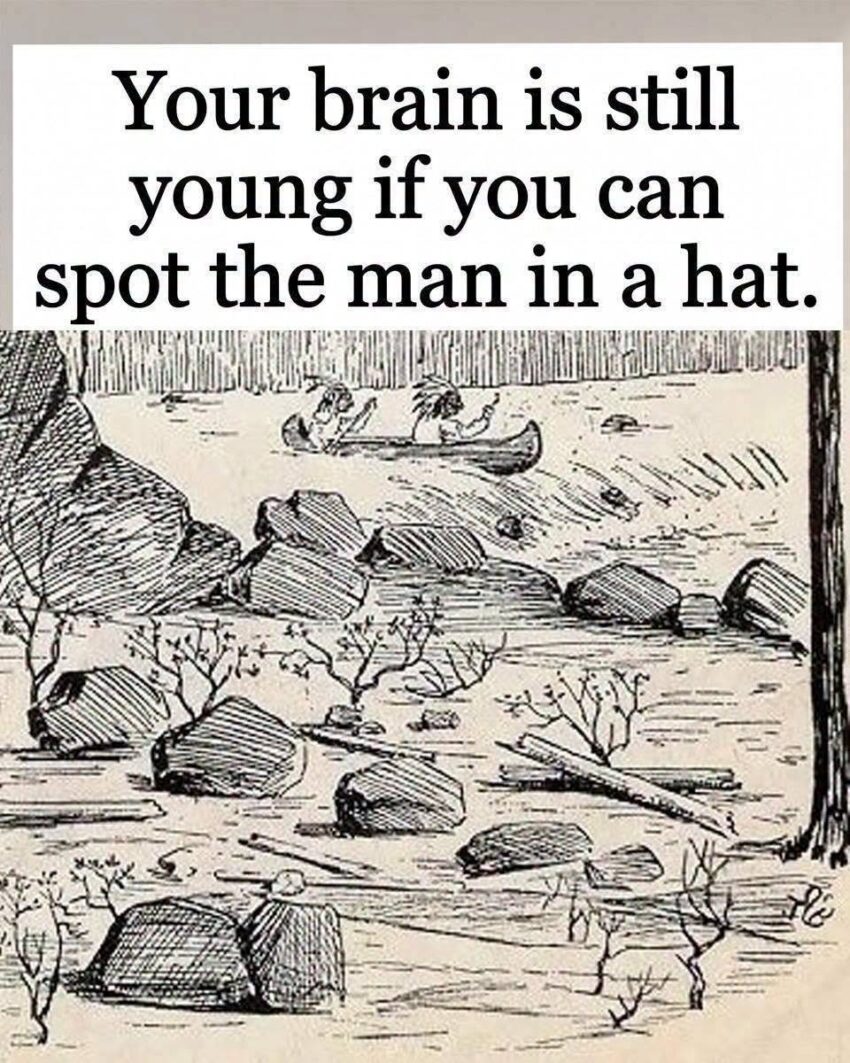
Can you find the hidden man in the hat? This vintage optical illusion hides a face within rocks, shadows, and landscape shapes. See why your brain may miss it.
At first glance, this vintage-style illustration looks like an ordinary peaceful landscape.
There are rocks scattered across the foreground, trees and branches in the distance, dry ground, and a body of water stretching across the background. A small canoe with people in it adds another recognizable detail to the scene.
Everything seems perfectly normal.
But look a little closer.
There is another image hiding inside the landscape.
Somewhere among the rocks, shadows, curves, and empty spaces is the face of a man wearing a hat.
And the challenge is simple:
Can you spot him before someone gives you the answer?
Don’t Look for a Tiny Person
One of the biggest mistakes people make with this puzzle is searching for a small hidden person.
You might examine the trees.
You might look behind the rocks.
You might inspect the canoe.
But that’s not really how this optical illusion works.
The hidden man isn’t simply standing somewhere in the background.
Instead, his face is created by the larger shapes and contours within the landscape itself. The rocks, shadows, and spaces between objects combine to create another visual interpretation.
That’s what makes the puzzle so difficult.
Your eyes are looking at the correct picture, but your brain is initially interpreting it in the wrong way.
Take Another Look at the Rocks
If you haven’t found the man yet, concentrate on the larger rock formations.
Don’t focus on every tiny line or piece of texture.
Instead, look at the overall shapes.
Imagine that some of the rocks are no longer rocks.
Could one curve represent part of a forehead?
Could a dark area resemble an eye?
Could another shape form a nose or cheek?
And somewhere above the face, look for the outline of a hat.
The moment you recognize one facial feature, the rest of the hidden image may begin to emerge.
Why Is the Man So Difficult to See?
Our brains are extremely good at organizing visual information.
When we look at a landscape, we automatically identify familiar objects.
A rock becomes a rock.
A tree becomes a tree.
Water becomes water.
A shadow becomes a shadow.
Once your brain has established what it thinks you’re looking at, it doesn’t normally stop and ask whether those same shapes could represent something completely different.
That’s exactly what this illusion takes advantage of.
The illustration encourages your brain to see a landscape first.
The hidden face only appears when you change your interpretation.
The Power of Figure-Ground Perception
This type of illusion is related to a visual principle often called figure-ground perception.
Our brains constantly separate objects from their surroundings.
For example, when you look at a person standing in front of a wall, your brain immediately recognizes the person as the main figure and the wall as the background.
Optical illusions can make that separation ambiguous.
In this puzzle, some of the shapes that appear to belong to the landscape can simultaneously become parts of the hidden man’s face.
The background can suddenly become the figure.
The ordinary objects become facial features.
And the image seems to transform without actually changing.
Look at the Negative Space
Here’s another useful trick.
Don’t only examine the objects themselves.
Look at the spaces between them.
The empty areas around rocks and shadows may be just as important as the visible objects.
A gap can become part of a nose.
A lighter patch can help form a cheek.
A dark outline can become part of the face.
Another shape can complete the hat.
This is known as using negative space, and artists have used it for centuries to create hidden shapes and secondary images.
The Hat Is Your Biggest Clue
The title gives you an important hint: the man is wearing a hat.
Use that clue.
Instead of searching for a complete human figure, first look for a shape that could represent the brim or outline of a hat.
Once you recognize the hat, try following the shapes underneath it.
Where would the forehead be?
Where might the eyes appear?
Where is the nose?
Can you identify the outline of the jaw?
You may find that the face suddenly becomes much easier to see.
Try Stepping Away From the Screen
If you’re staring at the image on your phone or computer and still can’t find the hidden man, try something simple.
Move slightly farther away.
Then relax your eyes.
Instead of focusing intensely on individual details, look at the illustration as one large composition.
Sometimes the hidden image becomes easier to recognize when the smaller details become less dominant.
You can also try slightly squinting.
Squinting reduces the importance of fine details and can make larger patterns more noticeable.
Try Looking at the Image Upside Down
Another interesting technique for optical illusions is changing the orientation.
If you’re stuck, briefly turn the image upside down or mentally rotate it.
The familiar landscape may no longer look like a normal landscape.
That can help break the brain’s original interpretation.
When you return to the normal orientation, you may suddenly notice shapes that you completely missed before.
Don’t Let the Canoe Distract You
The people in the canoe are naturally attention-grabbing.
They’re recognizable human figures, so your brain may focus on them first.
That can actually make the puzzle more difficult.
Your brain sees people and may unconsciously assume that you’ve already found the important human element in the image.
But the real challenge is somewhere else.
The hidden man is much more integrated into the landscape.
Is This a Test of Intelligence?
Not really.
The wording of these viral puzzles sometimes suggests that people who find the hidden figure quickly have a younger brain or superior intelligence.
That’s more of a fun challenge than a scientific test.
Failing to spot the hidden man doesn’t mean you’re unintelligent, and taking longer doesn’t automatically indicate anything about your age or cognitive abilities.
People simply approach visual information differently.
Some naturally search for large patterns.
Others focus on small details.
Some people are familiar with optical illusions and know immediately that they should look for a second interpretation.
Others may need a little more time.
Why Some People See It Immediately
When someone solves an optical illusion within seconds, it can seem as though they have extraordinary eyesight.
But the difference may simply be their search strategy.
Experienced puzzle-solvers often know not to examine every individual object.
Instead, they look for:
- Unusual outlines
- Repeated shapes
- Negative space
- Symmetry
- Faces
- Silhouettes
- Unexpected patterns
Once you know what type of trick you’re looking for, the puzzle can become much easier.
The Fascinating Role of Pareidolia
Another concept connected with hidden-face illusions is pareidolia.
Pareidolia is the tendency to perceive familiar patterns, especially faces, in ambiguous shapes.
It’s why people sometimes think they see a face in:
- Clouds
- Tree bark
- Rocks
- Mountains
- Shadows
- Buildings
- Household objects
Your brain is constantly searching for meaningful patterns.
A successful optical illusion takes advantage of that ability and guides your brain toward a particular interpretation.
In this case, the landscape contains shapes that can be interpreted as the features of a man’s face.
The Moment the Illusion “Clicks”
This is probably the most satisfying part of the puzzle.
At first, you see nothing unusual.
You stare at the image.
You move your eyes around.
You examine the rocks.
Still nothing.
Then suddenly—
There he is.
The face becomes recognizable.
The hat becomes obvious.
And you may immediately wonder:
“How did I not see that before?”
That’s because your brain has created a new interpretation of the exact same visual information.
The image itself hasn’t changed.
Your perception has.
Once You See Him, You May Not Be Able to Unsee Him
One of the defining characteristics of a good optical illusion is that discovering the hidden image changes the way you perceive the picture.
Before finding the man, the rocks look like random rocks.
After finding him, those same rocks suddenly seem carefully arranged.
The shadows begin to resemble facial features.
The negative spaces become meaningful.
The hat appears to stand out.
The landscape now seems to contain two images at once.
That’s what makes these puzzles so memorable.
A Simple Challenge for Your Friends
If you can see the hidden man, don’t immediately tell everyone where he is.
Instead, show the picture to a friend or family member.
Give them a few minutes.
Tell them only:
“There is a man wearing a hat hidden somewhere in this picture. Can you find him?”
Then watch how they approach the image.
Some people will search the trees.
Others will inspect the water.
Some will immediately study the rocks.
And eventually, someone will probably say:
“Wait… I see him!”
That’s usually the best moment.
Don’t Give Up Too Quickly
If you still can’t see the man, don’t assume there is nothing there.
Try changing your viewing method.
Look at the picture from farther away.
Relax your eyes.
Focus on the large shapes rather than small details.
Study the foreground rocks.
Look at the negative spaces.
Search for the hat first.
Then try to follow the outline of the face.
The hidden figure is created by the landscape rather than simply placed inside it, which is why a normal “find the person” strategy may not work.
The Answer
Spoiler: The hidden man is formed through the larger contours and negative spaces in the foreground landscape.
His face isn’t presented as a separate, clearly drawn person. Instead, the surrounding rocks, shadows, and shapes combine to create the appearance of a man’s face, with the hat completing the hidden image.
If you haven’t found him yet, it’s worth giving yourself another few seconds before looking closely at the answer.
You may discover that once your brain recognizes the correct pattern, the hidden face suddenly becomes obvious.
Final Thoughts
This vintage optical illusion is a great reminder that seeing isn’t always the same as understanding what you’re seeing.
Your eyes can take in all the necessary information, yet your brain may organize that information according to its first interpretation.
In this case, the first interpretation is a peaceful outdoor landscape.
The second interpretation is a hidden man wearing a hat.
The trick is learning to switch between those two ways of seeing.
So take another look.
Ignore the obvious objects for a moment.
Study the large shapes.
Pay attention to the shadows and empty spaces.
Look for the hat.
Then follow the contours beneath it.
Can you finally see the hidden man?