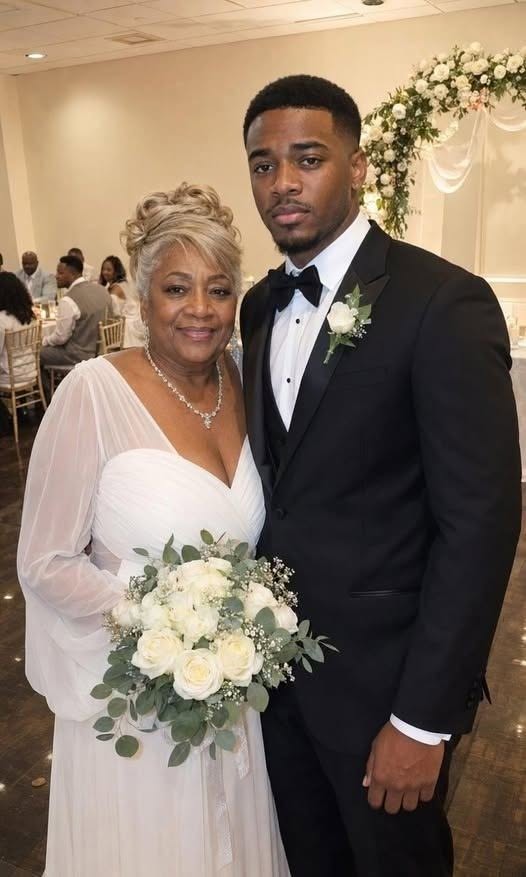
I Married a Lonely Older Woman for Stability and a Place to Stay — After Her Funeral, Her Lawyer Handed Me a Box and Said, “She Said This Is What You Really Earned.”
When I married Evelyn, I was twenty-five, broke, drowning in debt, and sleeping in my truck behind a grocery store.
She was seventy-one.
Widowed.
Quiet.
And she owned a beautiful little house on a peaceful street where people actually knew their neighbors.
I told myself I wasn’t taking advantage of her.
I told myself I was simply making a practical choice.
Evelyn needed companionship.
I needed stability.
It seemed fair.
At least, that’s what I believed.
We met at a small diner where I worked occasional shifts washing dishes.
She came in every Thursday afternoon.
Always alone.
Always ordering the same thing: tomato soup, grilled cheese, and black coffee.
One rainy evening, I noticed she was struggling with several grocery bags.
I offered to help.
She smiled.
“That’s kind of you.”
That was the beginning.
Over the next few months, we talked.
She told me about her late husband, Arthur.
She told me about the house.
She told me she had no children.
I told her about my debts, my failed jobs, and the fact that I had nowhere permanent to live.
One night, she surprised me.
“You could stay in my guest room,” she said.
I stared at her.
“Seriously?”
“You need somewhere safe.”
I should have known then that Evelyn’s kindness came without conditions.
Mine didn’t.
Within a year, we were married.
I never told anyone the real reason.
I thought I was being clever.
I’d stay with her.
I’d take care of her.
And eventually, when she died, I’d inherit the house.
It was a simple plan.
Except Evelyn was far kinder than I expected.
She cooked dinner every night.
She remembered exactly how I liked my coffee.
When my boots fell apart, a new pair appeared beside my chair.
When winter arrived, she bought me a heavy coat.
“You’ll freeze in that thing,” she said.
I laughed.
“Thanks.”
But deep down, I didn’t think much of it.
I was always calculating.
How much was the house worth?
How much money did she have?
What would happen if she needed nursing care?
How old was she really?
Every doctor’s appointment became a reminder of my future.
I hate admitting that.
But it’s the truth.
I didn’t see Evelyn as my wife.
I saw her as a waiting game.
Then, one morning, everything changed.
Evelyn was making breakfast when I heard a loud crash.
I ran into the kitchen.
She was lying on the floor.
Her coffee cup had shattered beside her.
“Evelyn!”
She opened her eyes.
“I’m okay.”
She wasn’t.
Three days later, she died in the hospital.
I was devastated.
Not because I had suddenly become a perfect husband.
But because something inside me had changed.
The woman I thought would simply disappear from my life had actually become part of it.
I didn’t realize how much until she was gone.
At the funeral, her relatives barely spoke to me.
Her niece, Margaret, wouldn’t even look me in the eye.
I heard whispers.
“Gold digger.”
“He got what he wanted.”
“He’ll take the house and disappear.”
I wanted to defend myself.
But how could I?
They weren’t entirely wrong.
I had married Evelyn for security.
I had expected to inherit everything.
And I thought I had succeeded.
Until the lawyer read the will.
We gathered in a quiet conference room two weeks after the funeral.
Evelyn’s lawyer, Mr. Harris, sat at the head of the table.
Margaret was there.
Two distant cousins were there.
And I sat alone.
Mr. Harris opened the file.
“Evelyn’s wishes are very clear.”
He began reading.
The house was left to Margaret.
Her savings were divided between several charities.
Her jewelry went to family members.
Her car went to a neighbor who had cared for her garden for years.
Her personal belongings were distributed among people she had known.
I waited.
My name never appeared.
Not once.
My heart sank.
Then Mr. Harris closed the document.
“That concludes the will.”
I stared at him.
“What about me?”
He looked at me.
“You have no inheritance under the will.”
Margaret smiled faintly.
I felt humiliated.
Angry.
And strangely ashamed.
Then Mr. Harris reached beneath the table.
He pulled out an old shoebox.
It was battered and covered in dust.
My name was written across the top.
To Daniel.
My hands went cold.
“What is that?”
Mr. Harris looked at me.
“She specifically instructed me to give this to you after her funeral.”
Margaret leaned forward.
“What is inside?”
Mr. Harris shook his head.
“I was told not to open it.”
I stared at the box.
Then he said something I will never forget.
“She said this is what you really earned.”
My fingers trembled as I lifted the lid.
Inside was an old photograph.
It showed Evelyn standing outside her house.
But she wasn’t alone.
Beside her stood a young man.
I recognized him immediately.
It was me.
But the photograph had been taken years before I met her.
I stared at it in confusion.
“How is that possible?”
Mr. Harris said nothing.
Underneath the photograph was a letter.
My name was written on the envelope.
I opened it.
The first line read:
Daniel, if you’re reading this, then I’m gone.
I stopped breathing.
The letter continued.
You probably believe you married me because you needed a home.
My eyes filled with tears.
And you probably believe I never knew why you married me.
I looked up at Mr. Harris.
He remained silent.
I continued reading.
I knew from the beginning.
My stomach dropped.
Evelyn had known.
She had known everything.
The calculations.
The inheritance.
The way I watched her health.
The reason I stayed.
All of it.
But then I read the next sentence.
That’s not why I married you.
I froze.
Beneath the letter were several envelopes.
One was labeled:
The Night We Met.
Another:
The House.
Another:
Your Debts.
And the final envelope had only three words written across it.
What You Earned.
My hands began shaking.
I opened the first envelope.
Inside was a photograph from the diner.
It showed Evelyn sitting at her usual table.
But in the corner of the picture was me.
Working behind the counter.
On the back she had written:
I noticed you long before you noticed me.
I opened the second envelope.
There were copies of bank statements.
Every debt I had.
Every overdue bill.
Every payment I had missed.
Evelyn had known about all of it.
But then I found something that made no sense.
She had been quietly paying some of my debts.
Not after our marriage.
Before.
Before we had even started dating.
I looked at Mr. Harris.
“Why?”
He finally spoke.
“Because Evelyn investigated you.”
“Investigated me?”
“She wanted to know who you really were.”
I felt sick.
“What did she find?”
Mr. Harris looked at the box.
“Keep reading.”
The next envelope contained another letter.
Daniel,
You thought you rescued me from loneliness.
The truth is that I chose you because I remembered what it felt like to be alone.
After Arthur died, people treated me differently. Some wanted money. Some wanted favors. Some wanted access to the house. Some pretended to love me because they thought I was vulnerable.
You were different.
I almost laughed.
Different?
I had married her for her house.
Then I read the next sentence.
You were the only person who admitted what you wanted.
I stopped.
She knew.
Of course she knew.
She continued:
You never pretended to be in love with me. You told me you needed somewhere to live. You told me you were drowning in debt. You told me you were afraid of becoming homeless.
You were selfish.
But you were honest.
I sat there staring at the page.
Then came the sentence that broke me.
And honesty was worth more to me than fake affection.
I couldn’t stop the tears.
For the first time, I realized something.
Evelyn hadn’t been fooled.
She had chosen me anyway.
I opened the final envelope.
Inside was a single key.
And another letter.
This key opens the basement cabinet.
I knew the cabinet.
I’d seen it countless times.
Evelyn never let me touch it.
I had assumed it contained old family documents.
I looked at Mr. Harris.
“Can we go to the house?”
He nodded.
Margaret objected.
“What are you doing?”
Mr. Harris calmly replied:
“Evelyn left instructions.”
That was enough.
We drove to the house.
I walked through the front door for the last time.
The place felt different.
The kitchen where she cooked.
The chair where she drank her coffee.
The hallway where she always reminded me to take my shoes off.
I walked downstairs.
The cabinet was still there.
I inserted the key.
The lock clicked.
Inside was a stack of files.
The first file had my name.
The second had Evelyn’s.
The third had a name I didn’t recognize.
Thomas Reed.
I opened it.
My blood ran cold.
Thomas Reed was my biological father.
A man I hadn’t seen since I was a child.
I knew he had abandoned my mother.
I knew almost nothing else.
But Evelyn had apparently known everything.
Inside the file were photographs, court records, financial documents, and letters.
Then I found the truth.
Thomas had not simply abandoned my family.
He had stolen money from my mother’s business.
He had disappeared.
And years later, he had tried to contact Evelyn.
Why?
Because Evelyn’s late husband had once worked with him.
Thomas knew Evelyn had money.
He wanted access to it.
But Evelyn had refused.
And then she discovered something else.
Thomas had been searching for me.
Not because he wanted to be my father.
Because he believed I might eventually inherit from Evelyn.
My entire body went cold.
I sat on the basement floor.
Evelyn had known.
She had protected me.
And I had spent years waiting for her to die so I could take her house.
At the bottom of the cabinet was one final letter.
Daniel,
If you found this, then you finally know why I never gave you the house.
It was never meant to be yours.
I closed my eyes.
Then I read:
You came into my life wanting security.
Instead, I wanted to give you something you had never had.
A chance.
The letter explained that Evelyn had created a trust.
The trust would pay off every remaining debt in my name.
It would pay for vocational training.
It would provide enough money for me to rent a small apartment for two years.
But the house?
No.
The house belonged to Margaret.
Evelyn wanted her family home to remain with someone who had genuinely loved it.
I had not earned the house.
But I had earned something else.
A second chance.
The final paragraph said:
I don’t want you to spend your life believing you were a bad person. You made a bad choice when you married me. But you changed while you were here. You just didn’t notice it.
I began crying.
Then I read the last line.
The greatest thing you earned was the ability to become someone who no longer needs to calculate what people are worth.
I couldn’t move.
For years, I had thought Evelyn was the lonely old woman I had married for money.
I had never realized she had been watching me become someone else.
The boots.
The coat.
The dinners.
The quiet kindness.
None of it had been weakness.
It had been her way of teaching me something I was too selfish to understand.
Six months later, I was working full-time at a construction company.
I had paid off my debts.
I rented a small apartment.
I kept Evelyn’s old coffee mug on my kitchen shelf.
I visited Margaret occasionally.
At first, she hated me.
Eventually, she understood.
One afternoon, she handed me a letter.
It was from Evelyn.
I hadn’t seen it before.
The letter contained only one sentence:
If he ever learns to love people without asking what they’ll leave him, then he finally earned the life I hoped he would have.
I folded the letter carefully.
And for the first time in my life, I understood what Evelyn had really left me.
Not a house.
Not an inheritance.
Not money.
She left me the one thing I had never known how to earn.
A chance to become better.
And that was worth far more than anything I thought I had married her for.