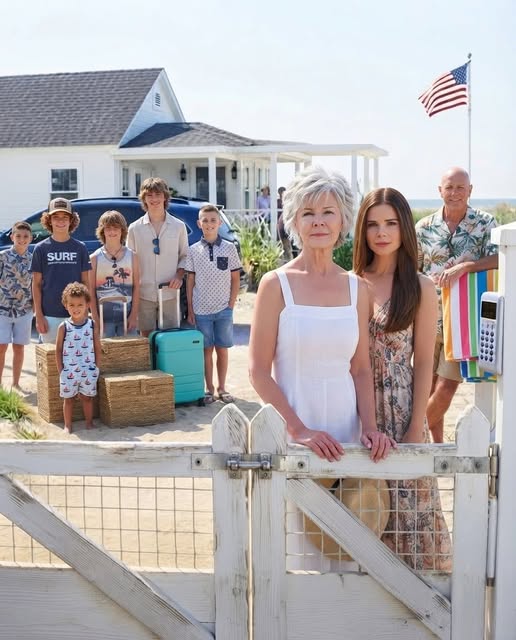
The text arrived at 6:14 on a Monday morning.
I was sitting at my kitchen table, drinking coffee and looking through the paperwork for my upcoming trip when my phone buzzed.
It was from my daughter-in-law, Melissa.
I opened the message.
“My children, my mother, and I will be spending spring break at your beach house. Make sure the refrigerator is stocked before Thursday.”
I read it twice.
Not Could we stay?
Not Would it be okay?
Not even Are you using the beach house during spring break?
Just an announcement.
As if she were telling me the weather forecast.
I stared at the screen.
Then I laughed.
Not because it was funny.
Because I genuinely didn’t know what else to do.
The beach house had belonged to my late husband, Robert, and me for almost twenty years.
It wasn’t some enormous luxury mansion.
It was a modest three-bedroom house near the water.
A place where we had spent summers with our children.
A place where Robert and I had gone after difficult years just to sit on the porch and listen to the ocean.
After Robert died, the house became even more precious to me.
It was one of the few places where I still felt like he was nearby.
Melissa knew that.
She knew everything about that house.
She knew how much it meant to me.
Apparently, that didn’t matter.
I typed a reply.
Then deleted it.
Typed another.
Deleted that too.
Finally, I sent:
“I’m sorry, but the house isn’t available.”
The typing bubble appeared immediately.
Then disappeared.
Then appeared again.
Finally, her response arrived.
“Why?”
I stared at the single word.
I wrote:
“Because I didn’t agree to this.”
Three dots.
Then:
“You’re really going to make the kids stay somewhere else?”
I felt my jaw tighten.
The children were my grandchildren.
I adored them.
But loving my grandchildren didn’t mean I had to surrender my home whenever their parents wanted a free vacation.
I put my phone down.
I thought the conversation was over.
It wasn’t.
At 7:02, my son called.
“Mom.”
“Good morning.”
“Melissa says you’re refusing to let us use the beach house.”
“I never said you couldn’t use it forever. I said this weekend doesn’t work.”
“Why not?”
“Because I have plans.”
There was a pause.
“What plans?”
I looked at the photograph sitting on my desk.
Robert and I were standing on the beach.
Twenty years younger.
Smiling.
“I’m going there myself.”
My son sighed.
“Mom, seriously?”
“Yes.”
“It’s spring break.”
“I know.”
“You don’t even like going there alone.”
“I didn’t say I was going alone.”
He became quiet.
“Who are you going with?”
I smiled.
“That’s none of your business.”
He sounded irritated.
“Why are you being difficult?”
I almost laughed.
“I’m being difficult?”
“Yes.”
“No, sweetheart. I’m setting a boundary.”
He hung up.
I sat there staring at my phone.
My son had never spoken to me like that before.
At least not until he married Melissa.
Melissa had always been charming in public.
Beautiful.
Confident.
The kind of person who could walk into a room and make everyone feel like they were already friends.
But privately, she treated my generosity like an entitlement.
Birthdays?
I was expected to host.
Holidays?
I was expected to cook.
Babysitting?
“Mom, could you keep the kids tonight?”
Trips?
“Can we borrow the beach house?”
And every time I said yes, it became the new expectation.
The beach house had slowly stopped feeling like mine.
It became their vacation property.
Their escape.
Their free hotel.
Once, I arrived at the house and found six people sleeping there.
I had never agreed to it.
Melissa simply said:
“Oh, I assumed it was okay.”
I cleaned the kitchen myself.
I washed the sheets.
I replaced the broken coffee maker.
And I said nothing.
That was my mistake.
Because people often mistake silence for permission.
Thursday morning arrived.
I drove to the beach house.
I had planned everything carefully.
Groceries.
Fresh flowers.
New sheets.
A stack of Robert’s old records.
And a small framed photograph I had recently restored.
For the first time in years, I was going to spend a few days there without anyone asking me to cook, clean, babysit, or solve a problem.
I arrived around noon.
The ocean was unusually calm.
I unlocked the door.
And froze.
There were suitcases in the hallway.
Several pairs of children’s shoes were scattered near the entrance.
A pink backpack sat on the sofa.
I walked farther inside.
The refrigerator was completely empty.
Except for one bottle of wine.
Then I heard laughter upstairs.
My heart began pounding.
I walked toward the staircase.
“Hello?”
Silence.
Then footsteps.
Melissa appeared.
She stopped when she saw me.
For several seconds, neither of us spoke.
Then she smiled.
“Oh.”
I looked at her.
“What are you doing here?”
She blinked.
“This is your house.”
“Yes.”
“And?”
“You told me you were coming Thursday.”
She smiled again.
“I assumed you’d have everything ready.”
I looked around.
“You broke into my house?”
Her smile disappeared.
“Don’t be dramatic.”
“Did you have a key?”
She shrugged.
“Your son gave me one.”
I slowly turned toward the living room.
My son stood there.
Behind him were my grandchildren and Melissa’s mother.
Everyone looked uncomfortable.
I couldn’t believe it.
“You brought your mother?”
Melissa nodded.
“She needed a break too.”
I looked at my son.
“You gave her my key?”
He didn’t answer.
I felt something inside me crack.
Not anger.
Something deeper.
Disappointment.
I looked at Melissa.
“You’re leaving.”
She laughed.
“What?”
“I said you’re leaving.”
“Mom, come on,” my son said.
“No.”
“But we’ve already unpacked.”
“Then pack again.”
Melissa’s face turned red.
“You can’t seriously throw your grandchildren out.”
“I am not throwing my grandchildren out.”
I looked at the children.
“I love you.”
Then I looked back at Melissa.
“But this is my home.”
She crossed her arms.
“We’re family.”
“Yes.”
“And family shares.”
I nodded.
“Family also asks.”
She stared at me.
I continued.
“You didn’t ask.”
She looked at my son.
“Say something.”
He finally stepped forward.
“Mom, please.”
I shook my head.
“No.”
“It’s just a few days.”
“No.”
“Why are you doing this?”
I looked at him.
“Because I’ve been saying yes for years.”
He didn’t understand.
So I explained.
“And every time I said yes, you took a little more.”
Melissa started crying.
Not genuine tears.
The kind that arrive when someone realizes they aren’t getting their way.
“You’ve changed.”
“No.”
I smiled sadly.
“I finally stopped pretending.”
My son looked at me.
“What does that mean?”
“It means I’m done being treated like the family resource.”
He lowered his voice.
“Mom, we’re your family.”
“I know.”
“Then why don’t you act like it?”
I stared at him.
“Because family doesn’t mean ownership.”
Nobody spoke.
Then my youngest grandson quietly asked:
“Grandma, are we in trouble?”
My heart broke.
I knelt beside him.
“No, sweetheart.”
I hugged him.
“You did nothing wrong.”
I looked at my son.
“If you want to spend time here with your children, ask me. If I’m available, I’ll gladly welcome you.”
Then I looked at Melissa.
“But this house is not a hotel.”
She stormed upstairs.
My son followed.
Twenty minutes later, they were gone.
The house became quiet.
For the first time, I could hear the ocean again.
I thought that was the end.
It wasn’t.
That evening, my son called.
“Mom, Melissa is furious.”
“I can imagine.”
“She says you’re punishing the kids.”
“I am not.”
“She says you’re trying to control us.”
“I don’t care what she says.”
There was silence.
Then he asked:
“Did Dad leave you this house?”
“Yes.”
“Only you?”
“Yes.”
Another silence.
Then:
“There’s something you don’t know.”
My stomach tightened.
“What?”
“Melissa has been talking about selling the house.”
I sat down.
“What?”
“She wants to sell it.”
“Why?”
“She says it’s worth a lot.”
I closed my eyes.
Suddenly, everything made sense.
The sudden interest.
The demands.
The entitlement.
The pressure.
It wasn’t about spring break.
It was about access.
To my property.
To my finances.
To the asset they believed would eventually become theirs.
My son continued.
“She thinks we could make enough from it to buy a bigger house.”
I laughed bitterly.
“And you agreed?”
He didn’t answer.
That was answer enough.
The next morning, I called my attorney.
I explained everything.
He wasn’t surprised.
Apparently, my late husband had anticipated this kind of situation.
Years earlier, Robert had placed the beach property into a protected family trust.
I was the sole beneficiary during my lifetime.
After my death, the property would go to a nonprofit organization that funded scholarships for children in our county.
My son would never inherit it.
Neither would Melissa.
I sat quietly after hearing this.
My husband had planned this long before I understood why.
But there was more.
My attorney told me Robert had left a private letter.
I asked to see it.
He sent me a scanned copy.
The letter began:
My love,
If you’re reading this, then I’m gone, and you’re probably still trying to make everyone happy.
I smiled through my tears.
That sounded exactly like Robert.
Then I read:
Please don’t confuse being generous with being obligated.
My throat tightened.
Our children are adults. They will build their own lives. Give them love. Give them advice. Give them help when you genuinely want to. But never let them make you feel guilty for owning your own life.
I stopped reading for a moment.
Then continued.
And if anyone ever treats our beach house like it’s theirs, remind them of one simple thing: We bought it with love, not as an inheritance promise.
I cried.
Not because Robert had predicted this.
Because he had known me.
He knew I would struggle to say no.
He knew I would feel guilty.
And he had given me permission to stop.
Three days later, my son came to see me.
Alone.
He looked exhausted.
“Mom.”
“Come in.”
He sat at the kitchen table.
“I owe you an apology.”
I didn’t answer.
He looked down.
“Melissa and I were wrong.”
I waited.
“We got used to you helping us.”
“I know.”
“We stopped seeing it as help.”
He looked at me.
“We started seeing it as something we were entitled to.”
I nodded.
“That hurt.”
“I know.”
He took a deep breath.
“I want to fix it.”
“Then start by understanding something.”
“What?”
“I love you.”
His eyes became wet.
“I love your children.”
He nodded.
“But I will not buy your love with a house, money, vacations, or favors.”
He looked down.
“You shouldn’t have to.”
“No.”
He wiped his eyes.
“And Mom?”
“Yes?”
“Can we still come to the beach sometime?”
I smiled.
“Of course.”
“Just not whenever we want.”
“Exactly.”
He smiled.
“Then we’ll ask.”
A month later, my son brought the children to the beach house.
They knocked on the door.
My grandson stood there holding a small paper bag.
“What is that?” I asked.
He smiled.
“Mom said we had to bring you something.”
Inside was a handwritten card.
It said:
Dear Grandma,
Thank you for letting us visit your house.
We promise to ask next time.
Love,
Your grandchildren.
I hugged him.
Behind him stood my son.
No Melissa.
No demands.
No assumptions.
Just my family.
That weekend, we sat on the porch.
We grilled burgers.
The kids ran along the beach.
And for the first time in years, the house felt like what it had always been.
A place for people who loved one another.
Not a place people felt entitled to.
That night, after everyone went to bed, I walked down to the water.
I thought about Robert.
I thought about the years we had spent there.
And I finally understood something he had tried to teach me long ago.
Sometimes loving your family means opening your door.
And sometimes loving them means closing it.
Not because you don’t care.
But because people can only learn to respect a boundary after you finally have the courage to draw one.
The next morning, my phone buzzed.
A message from Melissa.
For a moment, I hesitated before opening it.
It said:
“Can we talk?”
I smiled.
Then I typed the answer I should have given years earlier.
“Yes. But this time, let’s start with asking.”