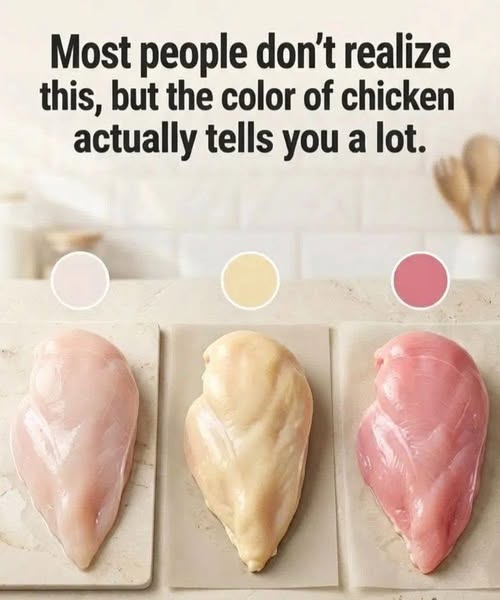
Does chicken color really tell you whether it is fresh or high quality? Learn what pink, pale, yellow, or darker chicken meat can mean and how to recognize actual signs of spoilage.
When you open a package of chicken, one of the first things you may notice is its color. Some chicken breasts look pale pink, others appear almost white, while some pieces may have a slightly darker or yellowish appearance.
This often leads to an important question: Does the color of chicken tell you anything about its quality or safety?
The answer is more complicated than many people realize.
Chicken color can provide useful visual information, but color alone cannot reliably tell you whether chicken is safe to eat, fresh, or spoiled. Natural differences can occur because of the bird’s breed, age, diet, muscle activity, and the way the meat has been stored or packaged.
Understanding these differences can help you avoid throwing away perfectly good chicken—or, more importantly, eating chicken that actually shows signs of spoilage.
Why Does Chicken Have Different Colors?
Raw chicken does not have one universal “correct” color.
Depending on the cut and the individual bird, fresh poultry may range from bluish-white to yellowish, while the meat itself can have different shades of pink. USDA explains that poultry color can vary naturally based on factors including breed, exercise, age, and diet.
The muscle pigments in meat also play a role. Myoglobin is one of the important proteins involved in meat color, and differences in muscle activity and animal age can influence how much pigment is present.
This means that two packages of chicken sitting beside each other in a refrigerator may look noticeably different without one necessarily being unsafe.
Does Pale Chicken Mean Better Quality?
Not necessarily.
Many people assume that very pale or almost white chicken is cleaner, fresher, or higher quality. Others believe that deeper pink chicken must be fresher.
Neither assumption is reliable on its own.
Chicken color can be influenced by several natural and environmental factors. A lighter-looking breast does not automatically mean the chicken is superior, and a slightly darker piece does not automatically mean it has spoiled.
Instead of judging chicken exclusively by appearance, look at odor, texture, storage conditions, packaging, and the product’s use-by or sell-by information.
What About Yellow Chicken Skin?
Yellowish chicken skin can also be completely normal.
According to USDA, raw poultry skin may naturally range from bluish-white to yellow. Breed, diet, age, and exercise can all contribute to differences in appearance. Certain feed ingredients, including marigolds, can contribute to yellow skin.
So if you see chicken with noticeably yellow skin, that alone is not proof that the meat is old or unsafe.
What Does Darker Chicken Mean?
Darker meat can occur naturally, particularly in muscles that are used more frequently.
Chicken thighs and legs, for example, tend to be darker than breast meat because those muscles contain more myoglobin and are used more actively.
Storage can also affect the appearance of meat. Changes in color can occur during refrigeration, packaging, exposure to oxygen, or freezing. USDA notes that color changes alone do not necessarily mean fresh meat has spoiled.
However, a color change becomes more concerning when it appears together with other signs of deterioration.
When Chicken Color Should Concern You
Color should not be examined in isolation.
If chicken has developed an unpleasant or unusual odor, feels sticky or tacky, or has become slimy, those are much stronger warning signs that it should not be eaten. USDA specifically identifies objectionable odor and slimy or sticky texture as signs associated with spoilage.
Be especially cautious when several warning signs appear together:
- Strong unpleasant or unusual odor
- Slimy or excessively sticky surface
- Significant deterioration in texture
- Unusual discoloration combined with other spoilage signs
- Packaging that appears damaged or leaking
- Chicken that has not been kept properly refrigerated
When in doubt, don’t taste raw chicken to determine whether it is safe.
Pink Chicken Does Not Automatically Mean Undercooked Chicken
This is another common misunderstanding.
People sometimes cut into cooked chicken and see a little pinkness, immediately assuming it is unsafe.
But USDA says color is not a reliable indicator of poultry doneness. Safely cooked chicken can range from white to pink to tan.
The safest way to determine whether chicken has been adequately cooked is to use a food thermometer.
The Safe Internal Temperature
Chicken should reach an internal temperature of:
165°F (73.9°C)
Use a food thermometer to check the thickest part of the meat. For whole poultry, USDA recommends checking appropriate thick portions such as the innermost thigh and wing and the thickest part of the breast.
This is far more dependable than judging doneness by whether the meat looks completely white.
Why Can Cooked Chicken Still Look Pink?
Several factors can contribute to pink coloration after cooking.
For example, chicken that has been grilled or smoked can retain a pink appearance even when it has reached a safe internal temperature. USDA notes that smoked poultry can remain pink and that color is not a dependable measurement of doneness.
This is why cutting into chicken and judging it solely by color can sometimes be misleading.
What About Rainbow or Iridescent Chicken?
Occasionally, cooked or processed meat can display an unusual rainbow-like or greenish sheen.
This can look alarming, but iridescence is not necessarily evidence of spoilage.
USDA explains that iridescent colors can result from the way light interacts with meat fibers and from pigments in meat compounds. Iridescence itself does not indicate reduced quality or safety.
Again, the surrounding circumstances matter.
If the chicken also smells bad or feels slimy, however, that is a different situation.
How to Judge Chicken Freshness More Reliably
Instead of asking only, “What color is this chicken?” use a broader checklist.
1. Check the smell
Fresh chicken should not have a strong, unpleasant, rotten, sour, or otherwise objectionable odor.
An unusual odor combined with other signs of deterioration is a reason to discard the product.
2. Check the texture
Chicken should not feel excessively slimy or sticky.
A slippery surface can be a warning sign when it occurs alongside unpleasant odor or other evidence of spoilage.
3. Consider storage
Chicken is highly perishable and needs proper refrigeration.
USDA recommends keeping meat and poultry refrigerated at 40°F (4.4°C) or below.
If chicken has been left in unsafe temperatures for an extended period, appearance alone cannot make it safe.
4. Look at the packaging
A damaged, leaking, or badly compromised package deserves extra caution.
Also consider how long the chicken has been stored and whether it has remained properly chilled.
5. Use a thermometer when cooking
For cooked chicken, temperature is much more useful than color.
The safe minimum internal temperature is 165°F (73.9°C).
Does Chicken Color Affect Nutrition?
Color and nutrition are not necessarily directly connected.
A darker piece of chicken is not automatically more nutritious, and a paler piece is not automatically less nutritious.
Different cuts naturally have different amounts of fat, protein, and other nutrients. For example, skinless breast meat is generally leaner than many dark-meat cuts.
Therefore, choosing chicken based solely on its visual color isn’t a reliable way to determine its nutritional value.
The Biggest Mistake People Make
One of the biggest mistakes is assuming:
“If it looks good, it must be safe.”
Unfortunately, food safety doesn’t work that way.
Chicken can look normal while still requiring proper handling and cooking. Conversely, chicken can have a harmless color variation and still be perfectly usable.
That’s why safe food handling is more important than chasing a particular shade of pink or white.
A Simple Chicken Safety Checklist
Before cooking chicken, ask:
Does it smell normal?
Does it have a normal texture?
Has it been kept properly refrigerated or frozen?
Is the package intact?
Is the chicken within the recommended storage period?
And after cooking:
Did the thickest portion reach 165°F (73.9°C)?
These questions are much more useful than simply asking whether the chicken is pink, white, yellow, or slightly darker.
What You Should Remember
Chicken color can be interesting, but it shouldn’t be treated as a simple quality score.
A pale chicken breast isn’t automatically better.
A darker piece isn’t automatically spoiled.
Yellowish skin isn’t necessarily a problem.
Pink cooked chicken isn’t automatically undercooked.
And a rainbow-like sheen doesn’t automatically mean the meat is dangerous.
Color is only one part of the picture.
When evaluating raw chicken, pay attention to odor, texture, storage, packaging, and signs of deterioration. When evaluating cooked chicken, use a food thermometer rather than relying on appearance.
The safest rule is simple: don’t judge chicken by color alone.