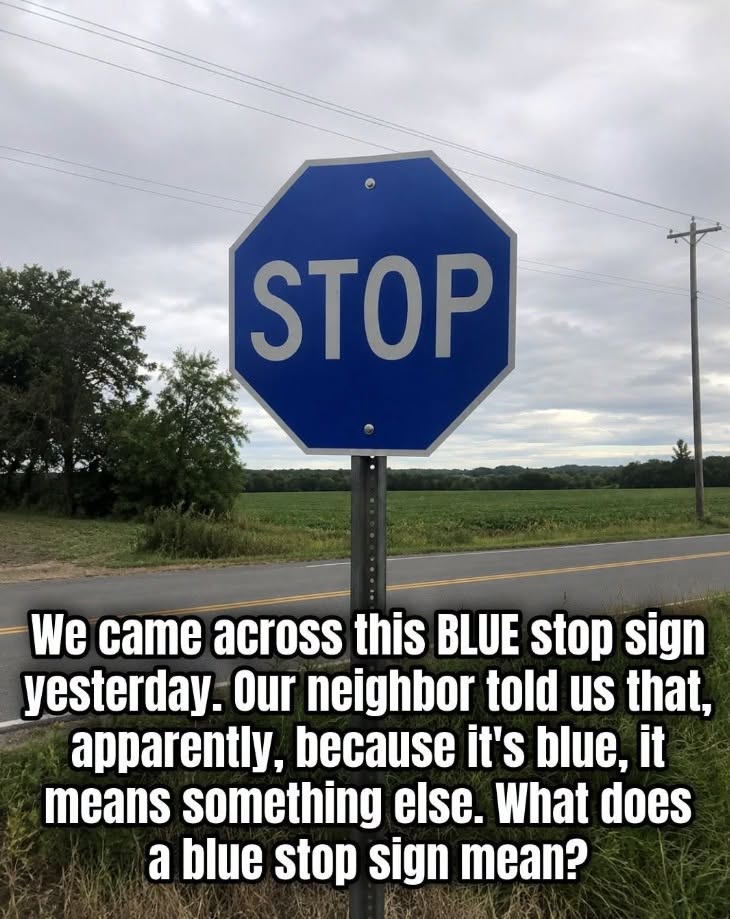
Ever seen a blue stop sign and wondered what it means? Discover why some stop signs may appear blue, how road signs differ between countries, and what drivers should do when encountering an unusual sign.
What Does a Blue Stop Sign Mean?
Most drivers are familiar with the traditional red STOP sign. Its distinctive shape and color are designed to immediately attract attention and tell motorists to come to a complete stop.
But occasionally, people come across photographs or videos showing a blue stop sign and naturally wonder: Does it have a different meaning? Is it an official traffic sign?
The answer isn’t quite as simple as it may appear.
A blue sign that resembles a stop sign can have different meanings depending on where it is located, who installed it, and the exact wording or symbol displayed on it.
In many places, a blue sign is not a standard replacement for the familiar red regulatory STOP sign.
Why Are Stop Signs Usually Red?
The red color of a conventional stop sign is intentional.
Traffic signs use standardized colors and shapes so drivers can recognize important instructions quickly, even from a distance.
Red is commonly associated with:
- Stopping
- Prohibition
- Danger
- Restrictions
- Immediate attention
The familiar octagonal shape also has an important purpose. It allows drivers to recognize a stop sign even when the sign is partially obscured or when its lettering cannot be read clearly.
That’s why the combination of red + octagon + STOP has become one of the most recognizable road-sign designs in the world.
So Why Would a Stop Sign Be Blue?
There are several reasons why you might see a blue octagonal sign that appears to be a stop sign.
1. It May Not Actually Be a Standard Stop Sign
The first possibility is that the sign is simply being mistaken for a conventional stop sign.
Some signs have similar shapes but serve completely different purposes.
A blue octagonal sign may be:
- A private sign
- A decorative sign
- A temporary sign
- A sign used on private property
- A locally produced traffic-control sign
- Part of a special road system
The color alone isn’t enough to determine its legal meaning.
2. It Could Be Used on Private Property
Large private properties sometimes use traffic signs that resemble public road signs.
You may encounter unusual signs in:
- Shopping centers
- Parking areas
- Residential communities
- Private roads
- Industrial facilities
- Theme parks
- Large campuses
Because these locations may have their own traffic-management systems, a sign may look different from the signs used on public roads.
However, drivers should still follow posted instructions and exercise caution.
3. Different Countries Use Different Sign Systems
Traffic signs aren’t identical everywhere in the world.
Although many countries use internationally recognizable designs, individual nations and local authorities can have different standards for:
- Colors
- Shapes
- Symbols
- Languages
- Road markings
- Warning signs
- Regulatory signs
Therefore, seeing an unusual sign in another country doesn’t necessarily mean it is incorrect.
The location of the sign is extremely important when determining its meaning.
Does Blue Mean “Stop”?
Not necessarily.
One of the biggest mistakes people make is assuming that blue is simply another color for STOP.
In many international road-sign systems, blue is commonly associated with information, services, or certain mandatory instructions rather than the standard stop command.
Therefore, a blue octagonal sign should not automatically be interpreted as a normal red STOP sign.
The exact design and local regulations need to be considered.
What Should a Driver Do When Seeing an Unusual Sign?
If you’re driving and encounter a sign you don’t recognize, the safest response is to slow down and assess the situation.
Don’t assume that an unfamiliar sign can be ignored simply because it doesn’t look like the signs you’re accustomed to seeing.
Look for:
- Written instructions
- Symbols
- Road markings
- Other nearby signs
- Traffic lights
- Police or traffic-control personnel
- Information about the road or property
If the sign clearly instructs you to stop, you should stop.
When driving in another country, learning the local traffic-sign system before traveling is especially important.
Blue Signs Can Have Other Meanings
Blue traffic signs are commonly used for purposes other than stopping.
Depending on the country’s road-sign system, blue may indicate things such as:
- Mandatory directions
- Motorway or road information
- Parking
- Services
- Pedestrian facilities
- Bus or transportation information
- Other designated road facilities
This is why identifying a road sign based solely on its color can be misleading.
The shape, symbol, wording, location, and local road regulations all matter.
Why Do Unusual Traffic Signs Go Viral Online?
Images of blue stop signs often attract attention because they look unusual to people who are accustomed to the standard red sign.
Social media posts can make the situation even more confusing.
A photograph may be shared with a dramatic caption such as:
“Have you ever seen a blue stop sign?”
The image may then circulate without explaining:
- Where the sign is located
- Who installed it
- Whether it is official
- What country it is from
- What the sign actually says
As a result, people may assume that every blue octagonal sign has a special universal meaning when that isn’t necessarily true.
Don’t Rely on Viral Posts Alone
If you encounter a strange traffic sign online, check the context before believing claims about its meaning.
Useful questions include:
Where was the sign photographed?
Traffic regulations vary from country to country.
Does the sign actually say STOP?
A similar shape doesn’t necessarily mean the same thing.
Is it on a public road?
Private roads can use different signage.
Is there additional wording or a symbol?
The smaller details may completely change the interpretation.
Is the claim supported by an official road authority?
Official transportation agencies are generally the best source for determining the legal meaning of a traffic sign.
The Bottom Line
A blue sign shaped like a stop sign is certainly unusual, but there is no universal rule that every blue octagonal sign means the same thing.
Traditional STOP signs are generally red because standardized colors and shapes help drivers recognize the command quickly.
If you encounter a blue octagonal sign, don’t automatically assume that it is simply a “blue version” of a regular STOP sign. Its meaning depends on the country, road system, sign design, and context.
When in doubt, slow down, observe the surrounding signs and road markings, and follow the applicable local traffic regulations.
Frequently Asked Questions
Is a blue stop sign real?
Blue octagonal signs can exist, but they are not universally equivalent to the standard red STOP sign. Their meaning depends on the location and sign system.
Why are normal stop signs red?
Red is widely used for stopping, prohibition, and immediate attention. The octagonal shape also makes the sign recognizable from different angles.
Can I ignore a blue stop sign?
No. Never ignore an unfamiliar road sign simply because it looks different. Determine its meaning from the sign, surrounding information, and local traffic rules.
Are traffic signs the same in every country?
No. Many countries share international conventions, but colors, symbols, wording, and specific sign designs can differ.
What is the safest thing to do when I don’t recognize a road sign?
Slow down, look carefully for additional information, and follow the instructions that apply to the road you’re traveling on.