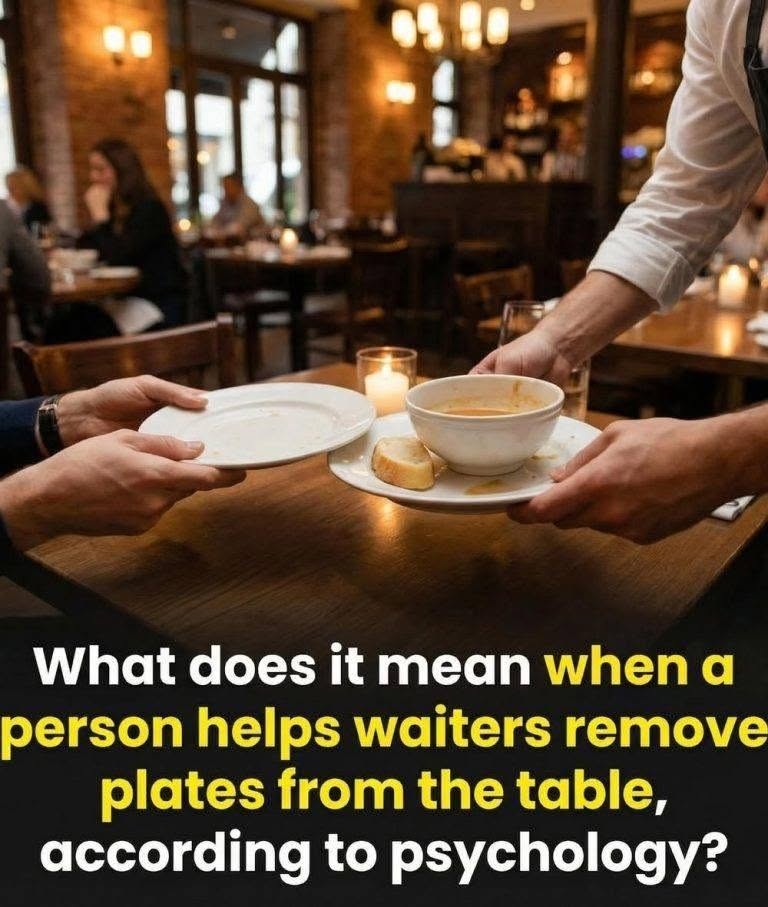
Helping a waiter clear dishes or carry items may seem like a small gesture, but it can reveal interesting qualities such as empathy, awareness, cooperation, and respect.
Have you ever finished a meal at a restaurant and instinctively started gathering your plates, stacking dishes, or moving glasses toward the edge of the table to make things easier for the waiter?
To some people, it is simply good manners. To others, it is an unnecessary gesture because clearing tables is part of the server’s job.
But psychologically, this small behavior can reveal something about the way a person notices other people, responds to their needs, and understands social situations.
Of course, one behavior cannot determine someone’s personality. People help restaurant staff for many different reasons, including habit, upbringing, politeness, empathy, or simply wanting to make the table less cluttered. Still, the gesture can offer an interesting window into certain personality tendencies.
1. It May Reflect Empathy
One possible explanation is empathy.
A person who notices that a waiter is carrying several plates may automatically think, “I can make this easier for them.”
Rather than focusing exclusively on their own experience, they briefly consider what another person is dealing with.
This doesn’t necessarily mean they are exceptionally empathetic. However, repeatedly showing consideration for service workers can be consistent with an awareness of other people’s workload and comfort.
2. It Can Show Social Awareness
Helping a waiter often requires noticing what is happening around you.
You might see that the table is crowded, notice that the server is reaching for dishes, or realize that there isn’t enough room to place another plate.
That kind of awareness is sometimes associated with being attentive to one’s surroundings.
Socially aware people tend to notice small environmental cues and adjust their behavior accordingly.
3. It May Come From Good Manners
Sometimes there is no deep psychological explanation at all.
People often behave according to what they learned growing up.
Someone who was taught to say “please” and “thank you,” respect workers, clean up after themselves, or help others may naturally move dishes together when dining out.
In this case, the behavior reflects learned social norms and habits rather than a specific personality trait.
4. It Can Reflect Respect for Service Workers
A person’s behavior toward waiters can sometimes reveal how they view people working in service positions.
Someone who treats a waiter with patience, courtesy, and respect may understand that providing a service does not make someone less worthy of consideration.
The same principle applies beyond restaurants—to cashiers, delivery workers, cleaners, receptionists, drivers, and other service professionals.
Small acts of courtesy can communicate, “I see you as a person, not merely as someone performing a task for me.”
5. Some People Simply Like Being Helpful
Certain people genuinely enjoy making situations easier for others.
They may hold doors open, offer directions, help someone carry a bag, or move dishes when they see an opportunity.
For these individuals, helping can be almost automatic.
Psychologists sometimes distinguish between helping motivated by internal satisfaction and helping motivated by external rewards. A person may help because they enjoy being useful, not because they expect praise.
6. It May Reflect Cooperation
Humans routinely cooperate in everyday social environments.
At a restaurant, the waiter has a job to do, while the customer has responsibilities such as communicating clearly, treating staff respectfully, and following basic etiquette.
When a customer makes a small effort to organize dishes, they may simply be cooperating with the process.
This doesn’t mean customers should perform the waiter’s job. Rather, it can represent a willingness to contribute a little when doing so is easy and appropriate.
7. But Helping Isn’t Always Helpful
There is an important distinction between being considerate and interfering.
Not every waiter wants customers to stack plates.
Some restaurants have particular systems for collecting dishes. Plates may need to remain separated, utensils may be positioned in a certain way, or fragile glasses may need to be handled differently.
So if you want to help, the safest approach is often to make the server’s job easier without creating additional work.
For example, simply keeping your personal belongings away from the dishes may be more helpful than attempting to carry a large stack yourself.
8. It Doesn’t Automatically Mean Someone Is a “Good Person”
This is perhaps the most important point.
Psychology rarely works as simply as:
“They help waiters, therefore they are kind.”
Human behavior is influenced by many factors.
A person might help clear a table because they are empathetic. Another might do it because their parents taught them to. Someone else may do it because they dislike clutter.
Likewise, a person who doesn’t help may still be extremely kind and considerate in other areas of life.
A single action should never be used as a complete personality test.
9. The Way Someone Treats Waiters Can Be More Revealing
Interestingly, the broader interaction with restaurant staff may tell us more than whether someone stacks plates.
Pay attention to behaviors such as:
- How they speak to the waiter
- Whether they say “please” and “thank you”
- Whether they become impatient over small mistakes
- Whether they acknowledge the server’s effort
- Whether they respect personal boundaries
- Whether they treat staff differently when other people are watching
These patterns provide more information than one isolated gesture.
10. Helping Can Create a Positive Social Atmosphere
Small acts of consideration can influence the atmosphere around us.
When one person behaves respectfully, others may become more conscious of their own behavior.
A simple “thank you,” moving a bag out of the way, or making room for someone can make an interaction feel smoother.
These actions may be tiny, but everyday social interactions are built from hundreds of tiny moments.
11. Kindness Doesn’t Need to Be Dramatic
Modern conversations about kindness often focus on large gestures.
But kindness can also be extremely ordinary.
It can be:
- Holding a door
- Letting someone go ahead
- Speaking patiently
- Returning a shopping cart
- Saying thank you
- Giving someone your full attention
- Making another person’s task slightly easier
Helping a waiter with something appropriate can fall into the same category.
The value isn’t necessarily in the size of the action. Sometimes it is simply the fact that you noticed another person.
12. The Best Interpretation Is Simple
If you find yourself helping waiters, you don’t need to assume it reveals some extraordinary psychological trait.
It may simply mean that you were raised to be considerate.
It may mean you notice when people need help.
It may mean you enjoy cooperating.
Or it may just be a habit.
And that’s perfectly fine.
Final Thoughts
Helping a waiter may look like an insignificant gesture, but it can reflect several positive tendencies—including consideration, social awareness, cooperation, and respect.
Still, personality cannot be accurately judged from one small behavior.
What matters more is the pattern.
How do you treat people when there is nothing to gain? How do you respond when someone makes a mistake? Are you respectful toward people who are serving you? Do you notice when someone needs a little help?
Those everyday choices may tell us far more about character than any single action at a restaurant.
Sometimes, a small gesture really is just a small gesture—but it can still be a good one.