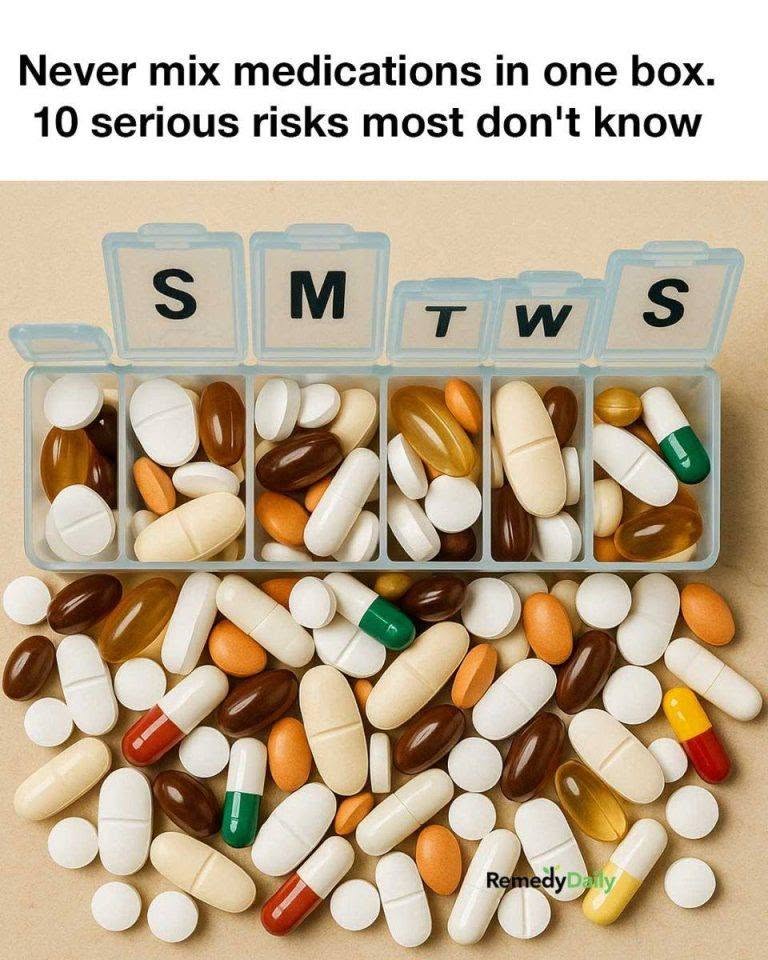
Mixing different medications in one pill box may create medication errors, storage problems, confusion, and accidental overdoses. Learn 10 important risks and safer ways to organize your medicines.
Never Mix Medications in One Box: 10 Serious Risks Most People Don’t Know
A pill organizer can make a complicated medication schedule easier to follow, but there is an important distinction between organizing medicines safely and simply throwing different pills into one container.
Many people remove tablets and capsules from their original packaging and place them together because it seems convenient. In some situations, this may be appropriate when a pharmacist has confirmed that the medicines are suitable for the organizer. In others, it can create avoidable risks.
Medicines are designed to be stored under specific conditions, and their original containers often provide important information about the drug, strength, expiration date, and storage requirements. MedlinePlus recommends keeping medicines in their original containers unless another storage method is appropriate and has been confirmed.
Here are 10 reasons to think twice before mixing medications together.
1. You May Take the Wrong Medicine
When several different pills are mixed together, they can become difficult to distinguish.
This is especially concerning when tablets have similar:
- Colors
- Shapes
- Sizes
- Imprints
Medication errors can occur when people confuse one medicine with another. The FDA specifically works to reduce medication errors caused by confusing names, labels, packaging, and product designs.
Keeping medicines clearly identified can greatly reduce this risk.
2. You May Accidentally Take the Wrong Dose
Different medicines may come in multiple strengths.
For example, one tablet might contain 5 mg while another looks almost identical but contains 10 mg.
If the original labeled packaging is no longer available, it can be much harder to confirm the strength before taking the medication.
This becomes particularly important when a medicine has a narrow safety margin or when an incorrect dose could cause serious effects.
3. Moisture Can Damage Some Medicines
Moisture is one of the enemies of medication stability.
Heat, air, light, and humidity can affect certain medicines, potentially causing them to deteriorate or become less effective.
This is one reason storing pills loosely in a container that is not designed for their specific storage requirements may not always be appropriate.
Bathrooms can be particularly problematic because showers and baths increase humidity.
4. Different Medicines Can Have Different Storage Requirements
Not every medication should be stored in exactly the same way.
Some may need protection from:
- Light
- Humidity
- Heat
- Air
- Physical damage
A single pill box may not provide the protection required by every medicine.
Before transferring a medication from its original package, check the pharmacy label and manufacturer’s storage instructions.
5. Capsules Can Be Particularly Sensitive
Some capsules contain materials that can interact with the environment inside a storage compartment.
The UK’s Specialist Pharmacy Service notes that gelatin capsules have a relatively high water content. When gelatin capsules are stored together with tablets, moisture can potentially transfer between formulations and affect physical or chemical stability.
This doesn’t mean every capsule will become unsafe in a pill organizer—but it demonstrates why different medicines should not automatically be mixed together without checking compatibility.
6. You Can Lose Important Instructions
The original package may contain information that isn’t printed on the pill itself.
For example, the label may tell you:
- Take with food
- Take on an empty stomach
- Take at bedtime
- Do not crush
- Protect from light
- Refrigerate
- Take at a specific time
- Avoid certain foods or medicines
Once everything is removed from its labeled packaging, those instructions can easily be forgotten.
7. You May Lose Track of Expiration Dates
When medicines are kept in their original packages, the expiration date is easy to check.
When loose pills are mixed together, determining which tablet belongs to which expiration date can become difficult.
This is especially risky when people keep leftover medicines for months or years.
MedlinePlus advises checking expiration dates and disposing of old or unused medicines appropriately.
8. You Could Confuse Different People’s Medicines
A box containing several medications can become particularly dangerous when medicines belonging to different family members are mixed together.
One person’s blood-pressure medicine may look similar to another person’s medication.
Never combine medicines belonging to different people in the same unlabeled container.
Medicines should remain clearly identified and separated.
9. Children May Have Easier Access
A pill organizer is not necessarily child-resistant.
Small compartments can also make medications easier for children to access if the organizer is left somewhere within reach.
Medication poisoning can be extremely serious. The CDC continues to emphasize keeping medicines securely stored away from children and using appropriate child-resistant packaging.
Research has also found an association between medication organizers and unintentional pediatric medication ingestion.
Keep all medicines out of sight and reach of children, even when they are inside an organizer.
10. You May Not Know Which Medicine Caused a Reaction
Suppose several loose tablets are mixed together and you accidentally develop:
- A rash
- Severe dizziness
- Vomiting
- Swelling
- Breathing difficulty
- Unusual sleepiness
If you cannot identify exactly which medication you took, it may be harder for a healthcare professional to determine what happened.
Keeping medicines labeled makes it much easier to establish what was taken and when.
Does This Mean You Should Never Use a Pill Organizer?
Not necessarily.
Pill organizers can be useful for people who take multiple medications, particularly when remembering daily doses is difficult.
However, the safest approach is to ask your pharmacist whether each specific medicine can be removed from its original packaging and placed in the organizer.
Some medicines are suitable for this type of organization, while others may require special packaging or protection.
The NHS Specialist Pharmacy Service says original packaging is generally preferred, while compliance aids may be appropriate for some people after the medicines and storage conditions have been assessed.
A Safer Way to Organize Multiple Medicines
Instead of putting every loose pill into one unmarked container:
Keep the Original Labels
Keep prescription bottles, blister packs, or other labeled packaging whenever possible.
Use a Day-and-Time Organizer When Appropriate
If your pharmacist confirms that your medicines are suitable, use a properly designed organizer divided by day and dosing time.
Don’t Mix Different Medicines Into One Compartment Without Checking
Even if two medicines are taken at the same time, that does not automatically mean they should be stored together.
Keep a Medication List
Write down the medicine name, strength, dosage, and time it should be taken.
Store Medicines in a Cool, Dry Location
Avoid places exposed to excessive heat or humidity, unless the medicine specifically requires different storage.
Keep Medicines Away From Children
Use appropriate secure storage and don’t assume a regular pill organizer is child-resistant.
What If You Already Mixed Your Pills?
Don’t automatically throw them away.
If you can confidently identify every tablet and know that the medicines are still within their expiration dates and were stored appropriately, contact your pharmacist for advice about whether they can still be used.
If you cannot identify a pill, don’t guess.
Take the container and medication information to a pharmacist or healthcare professional for identification and guidance.
If you believe you have accidentally taken the wrong medication or an excessive dose, seek urgent medical advice or contact your local poison/emergency service rather than waiting for symptoms.
The Bottom Line
The problem isn’t simply that different medications are physically touching each other. The bigger concerns are medication mix-ups, loss of labeling, inappropriate storage, moisture exposure, expiration confusion, and accidental access by children.
A pill organizer can be helpful, but it should be used thoughtfully.
When in doubt, keep medicines in their original labeled containers and ask a pharmacist before transferring them. This simple step can prevent avoidable medication errors and help ensure that each medicine remains identifiable and properly stored.