For years, there was almost nothing to explain what had happened to an Amish family that seemed to vanish without a trace.
There were no dramatic headlines at the time. No obvious signs of a struggle. No clear explanation for why the family had suddenly disappeared from the community that had known them for years.
Then, an old photograph surfaced.
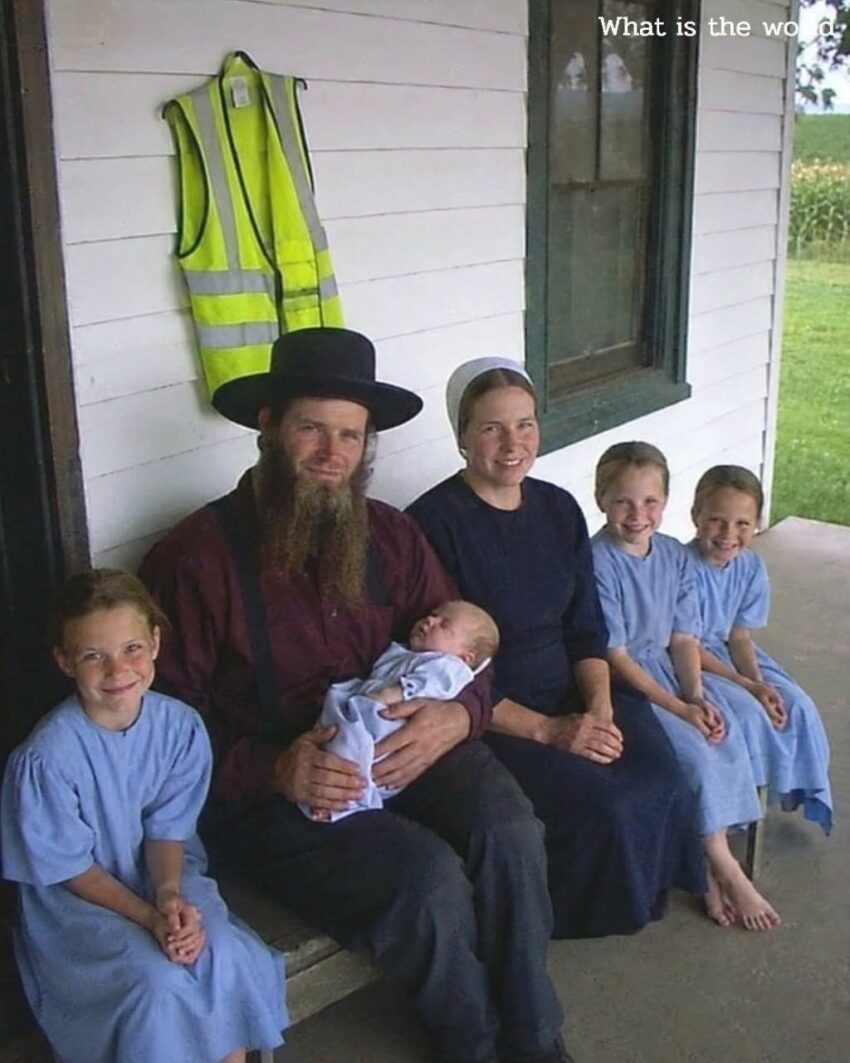
At first glance, it looked completely ordinary: a family gathered together, dressed in traditional Amish clothing, standing quietly for the camera. But when investigators began examining the image more carefully, they noticed details that raised questions no one had thought to ask before.
The Photograph That Changed Everything
The photograph had been preserved among old personal belongings and might easily have been overlooked.
There was nothing immediately suspicious about it. The family appeared calm, and the setting looked familiar.
But photographs can sometimes reveal information that memories do not.
Investigators began comparing the people in the photograph with historical records, family accounts, and information about the family’s movements. One detail led to another, and a picture that initially seemed insignificant became an important piece of the investigation.
The photograph helped establish a timeline.
And timelines can be crucial in disappearance cases.
A Family Suddenly Gone
The Amish community is often associated with privacy, simplicity, and limited use of modern technology. That can make investigations particularly challenging when someone disappears.
There may be fewer digital records, fewer photographs posted online, and less of the electronic trail that investigators might normally use to reconstruct someone’s movements.
That does not mean there are no records.
Church membership, property documents, school information, transportation records, correspondence, and conversations with relatives and neighbors can all become important pieces of a larger puzzle.
In this case, investigators began asking a simple question:
When was the family last known to be together?
The answer helped narrow the search.
Looking Beyond the Photograph
The photograph alone could not explain a disappearance.
Instead, it became a starting point.
Investigators reportedly began examining seemingly ordinary details—the location where the photograph was taken, the approximate date, the people present, and what happened before and after the image was created.
Small inconsistencies became more interesting when placed beside other information.
A person who remembered one detail might unintentionally contradict another account. A date that seemed insignificant could suddenly become important. An old document could establish that someone was somewhere at a particular time.
Piece by piece, the mystery began to take shape.
Why Old Photographs Can Matter
Photographs are often treated as memories, but investigators can view them differently.
A photograph can potentially provide:
- Evidence of who was present
- Clues about the approximate time and location
- Information about relationships between people
- Background details that may identify a particular place
- Objects, vehicles, buildings, or clothing that help establish a timeline
Even something as simple as a building in the background can sometimes help investigators identify where an image was taken.
That is why investigators examining old photographs often look beyond the faces.
They look at everything.
The Detail Nobody Expected
The most important discovery was not necessarily something dramatic in the center of the photograph.
It was a small detail that connected the family to another part of the story.
That connection prompted investigators to revisit information they had previously considered unrelated. Once the pieces were placed together, the family’s disappearance began to look less like an isolated event and more like a sequence of events that could potentially be reconstructed.
The photograph had not solved the mystery by itself.
It had simply opened the door.
A Reminder That Evidence Can Hide in Plain Sight
Cases involving missing families can remain unanswered for years because important evidence is sometimes scattered across ordinary places—old photographs, letters, documents, family albums, and memories.
Something that appears meaningless to one person can become significant when combined with information from another source.
That is what makes historical investigations so fascinating.
A photograph captures only a fraction of a second.
But sometimes, that single moment can contain a clue to an entire story.
And when investigators finally learn how to interpret that clue, an image that once seemed like nothing more than an old family photograph can become the beginning of a search for answers.
Final Thought
The story of the missing Amish family serves as a powerful reminder that disappearances are not always solved through dramatic discoveries.
Sometimes the breakthrough begins quietly—with an old photograph, a forgotten document, or one tiny detail that someone finally notices.
Because sometimes, the clue that changes everything has been sitting in plain sight all along.