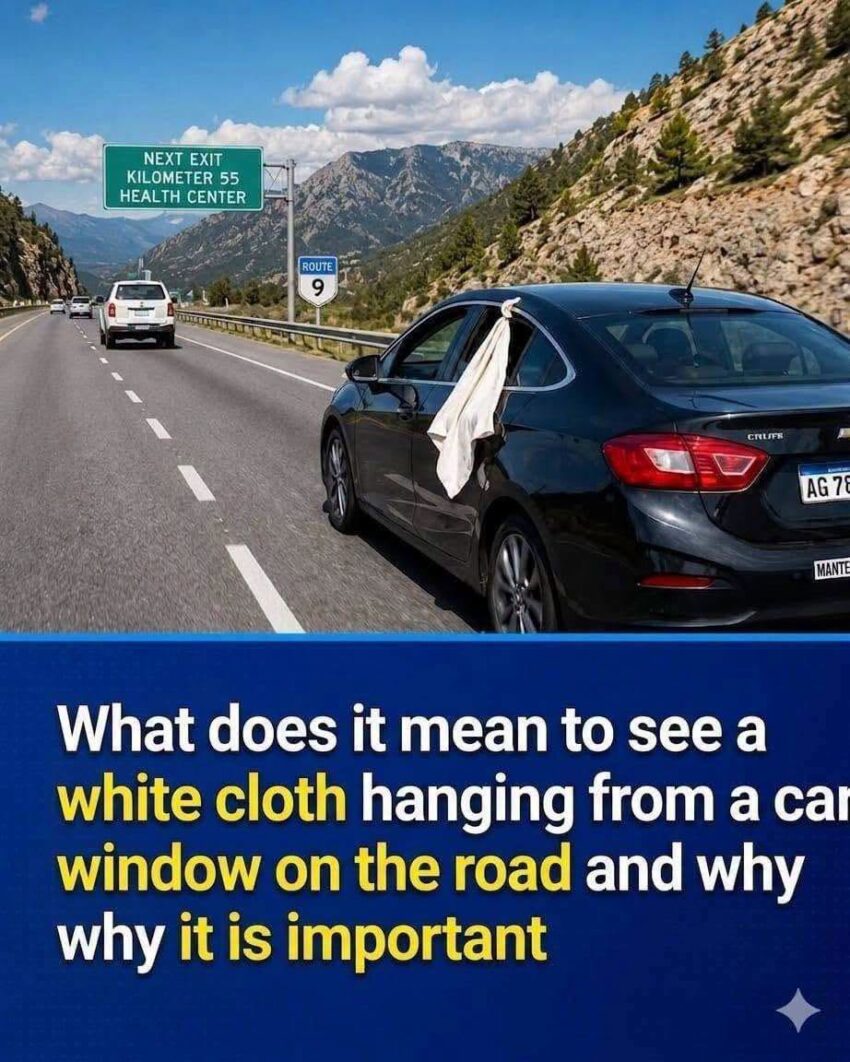
Have you ever noticed a white cloth hanging from a car window? Discover what this unusual roadside signal may mean, when drivers use it to request help, and how to respond safely when you see one.
You are driving down a road when you notice something unusual: a white cloth hanging from the window of a car parked on the shoulder. A few miles later, you spot another vehicle with a similar piece of fabric tied to its door.
Is it a warning? A request for help? Or simply something left hanging out of the window?
For many drivers, a white cloth on a car is an unfamiliar sight. Yet in some places, drivers use visible objects, including white fabric, to signal that their vehicle has broken down or that they need assistance.
The important detail is that a white cloth in a car window does not have one universal meaning. Its significance depends on local customs, the circumstances, and whether an established roadside signaling practice is in use.
Understanding the possible meanings can help you respond sensibly without making assumptions about a stranger’s situation.
1. A White Cloth May Signal a Vehicle Breakdown
One possible explanation is that the driver is trying to attract the attention of passing motorists.
A car that has broken down on a quiet road may leave its occupants with limited ways to communicate their need for assistance. A white cloth placed where it can be seen may serve as a makeshift signal.
The driver might need help with a flat tire, an overheated engine, an empty fuel tank, or another mechanical problem.
However, a white cloth is not a universally recognized breakdown signal. In many places, drivers are expected to use hazard warning lights, warning triangles, or other locally approved safety measures.
If you see a cloth on a stationary vehicle, treat it as a possible indication of difficulty rather than proof that the driver needs a specific type of help.
2. It Could Be a Request for Assistance
Sometimes a driver may use whatever visible material is available to draw attention to a vehicle in trouble.
A cloth hanging from a window could indicate that the occupants would appreciate help, especially if the vehicle is stationary in an isolated location.
But the cloth alone cannot tell you whether the occupants need fuel, mechanical assistance, medical help, or something else.
If you want to help, consider stopping only where it is safe and legal to do so. On a busy highway, it may be safer to contact roadside assistance or the appropriate emergency service instead of stopping directly beside the vehicle.
3. Why White Fabric?
White fabric is often easy to distinguish from a vehicle’s darker interior, particularly in daylight. Its contrast may make it noticeable to passing motorists.
That does not mean white fabric is an official signal everywhere. Its visibility can vary depending on the weather, lighting, road background, and distance.
A small cloth may be difficult to see at highway speeds, especially at night or in poor weather.
For this reason, drivers should not rely on an improvised cloth as their only safety measure when a vehicle becomes disabled.
4. Is It an Official Road Signal?
In most places, a white cloth hanging from a car window is not a standardized traffic signal with one legally defined meaning.
Official roadside safety procedures vary by country and road type. They may include hazard lights, reflective warning triangles, high-visibility clothing, and calls to roadside assistance.
A white cloth may be used informally in a particular community, but drivers should not assume that every motorist understands the same meaning.
If you are traveling in an unfamiliar country or rural area, learn the local rules for breakdowns and emergency signaling before setting off.
5. Could It Mean Something Else?
Yes. A piece of white fabric may have nothing to do with an emergency.
For example, it could be:
- A cloth left hanging after cleaning the vehicle.
- Fabric being transported or drying.
- A makeshift cover or repair.
- An informal signal whose meaning is specific to a local community.
- An object caught in a window accidentally.
The surrounding circumstances matter. A broken-down vehicle with hazard lights on presents a different situation from a moving car with a loose piece of fabric fluttering from its window.
Avoid assuming that the driver is in danger—or that the situation is harmless—based solely on the cloth.
6. What Should You Do If You See a White Cloth in a Car Window?
If you notice a vehicle displaying a white cloth, use the same caution you would use around any potentially disabled vehicle.
First, watch the road. Do not slow suddenly, stop in a traffic lane, or make an unsafe maneuver just to investigate.
Second, look for other signs of trouble. A stationary vehicle, hazard lights, visible damage, or a person signaling for help may provide additional context.
Third, choose a safe way to assist. If the vehicle appears to be in danger, contact the relevant roadside assistance service or emergency authorities. Give a clear description of the location and what you observed.
Fourth, protect your own safety. Do not enter an isolated area or approach a situation that feels unsafe. If you stop, choose a safe, legal location away from moving traffic.
Finally, do not assume the cloth replaces official warning equipment. Drivers experiencing a breakdown should follow local road-safety requirements.
7. What If You Need Help and Have No Warning Equipment?
If your own vehicle breaks down, prioritize visibility and safety.
- Move out of the traffic lane if you can do so safely.
- Activate your hazard warning lights.
- If appropriate and legally required, use approved warning equipment according to local guidance.
- Contact roadside assistance or emergency services if the situation presents a danger.
- If you cannot safely exit the vehicle, remain in a safe position and follow the advice of emergency personnel.
Do not stand behind a vehicle or walk into traffic to attract attention. A makeshift cloth is not worth risking an injury.
The Bottom Line
A white cloth hanging from a car window can be an informal attempt to attract attention or request assistance, but its meaning is not universal and should not be treated as an official road signal without local confirmation.
The safest approach is to look at the entire situation, follow local road-safety rules, and offer help only in a way that does not put you or other road users at risk.
The next time you see a white cloth in a car window, remember that it may have a practical explanation—but the cloth alone cannot tell you exactly what the driver means.