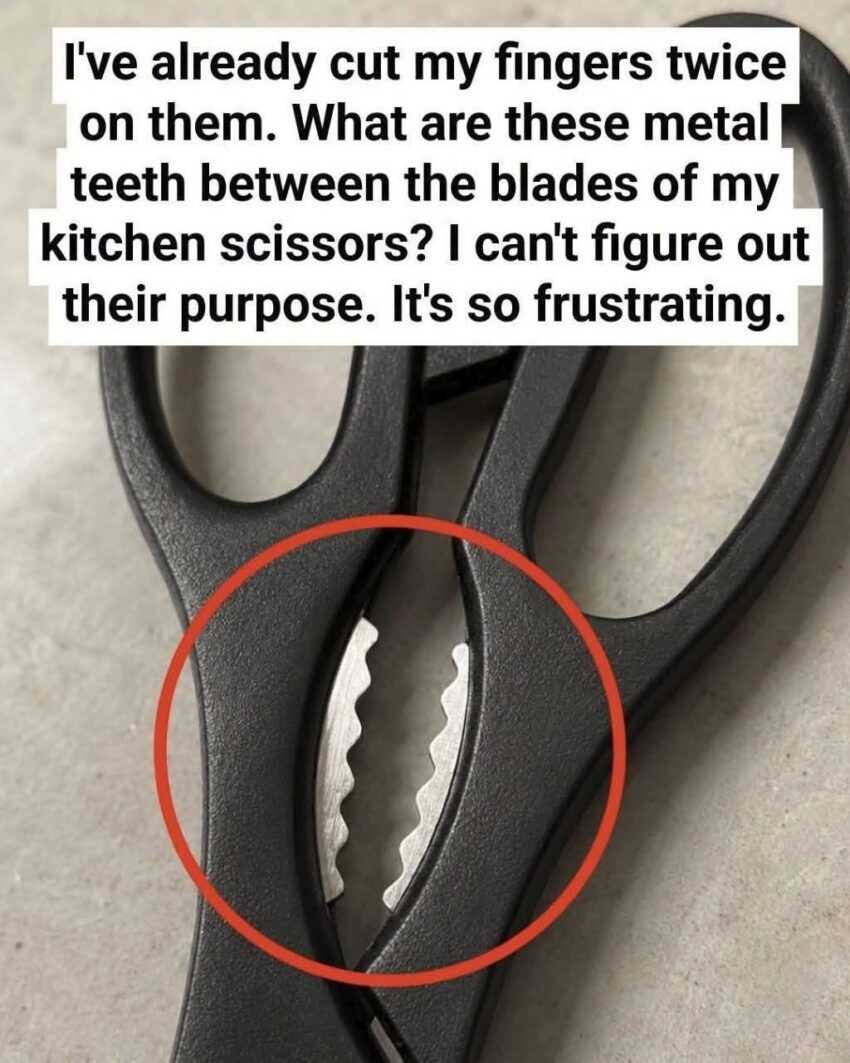
Discover what the toothed section on kitchen scissors is designed for and learn four clever ways to use this versatile kitchen tool for everyday tasks.
Have you ever looked closely at your kitchen scissors and wondered why they have a strange, ridged section between the handles? Most people use kitchen scissors to cut herbs, open food packages, or trim meat, but that unusual toothed part often goes unnoticed.
It turns out that this small feature can be surprisingly useful. On many kitchen scissors, the ridged section is designed to grip objects firmly, helping you perform certain kitchen tasks with less slipping.
Let’s explore what it does and four practical ways you might use it.
What Is the Toothed Part on Kitchen Scissors For?
<text> </text>
The toothed section is often a gripping tool for twisting or holding objects. Depending on the scissor design, it may help you grip jar lids, crack certain nuts, or hold slippery items securely.
Not every pair of kitchen scissors has the same features, so the exact purpose depends on the model. Some are designed specifically for cracking nuts or opening bottle caps, while others include a simple gripping surface.
1. Open Stubborn Jar Lids
A tightly closed jar can be frustrating, especially when your hands are wet or the lid is slippery.
If your scissors have a suitable gripping notch, position the lid securely in the toothed section and apply gentle pressure while turning. Make sure the scissors are fully closed and designed for this purpose.
Safety tip: Don’t force the scissors or use the sharp blades to pry the lid open. A dedicated jar opener is safer for stubborn lids.
2. Crack Certain Nuts
Some kitchen shears have a reinforced, ridged section that can help crack hard-shelled nuts.
Place an appropriate nut in the designated gripping area and squeeze gently, keeping your fingers away from the blades. Use this only if the manufacturer says the scissors are suitable for cracking nuts.
Avoid trying this with extremely hard shells, which could damage ordinary scissors or cause pieces to fly.
3. Grip Slippery Objects
The teeth can help provide extra friction when holding certain small objects during food preparation.
For example, a purpose-designed gripping section may help you hold a small, sturdy item while turning it. Always check that the object fits securely and that the scissors are intended for that task.
Never use the toothed section to grip hot cookware or anything that could cause burns.
4. Help With Bottle Caps or Similar Closures
Some multifunction kitchen scissors include a bottle-cap gripping feature. If yours has one, it may help loosen suitable caps without requiring much hand strength.
Check the manufacturer’s instructions first. Don’t use the blades as a lever, and never squeeze a glass bottle in a way that could break it.
Bonus: Keep Your Kitchen Scissors Clean
Kitchen scissors can collect grease and food particles around their hinge and teeth. To keep them hygienic:
- Wash them according to the manufacturer’s instructions.
- Open the blades carefully to clean accessible areas.
- Use a small brush to remove trapped food residue.
- Dry them thoroughly, especially around the hinge.
- If the blades separate, disassemble them only if the manufacturer permits it.
Because kitchen scissors often contact raw meat, wash and sanitize them appropriately before using them on ready-to-eat foods.
Final Thoughts
That unusual toothed section on kitchen scissors is not merely decorative. On many models, it serves as a gripping aid that can help with jar lids, certain nuts, and other small kitchen tasks.
However, the exact function varies from one design to another. Before trying any of these hacks, inspect your scissors or check the manufacturer’s instructions to make sure the feature is intended for that purpose.
Sometimes, the most useful kitchen tools are the ones we already own but haven’t fully explored!