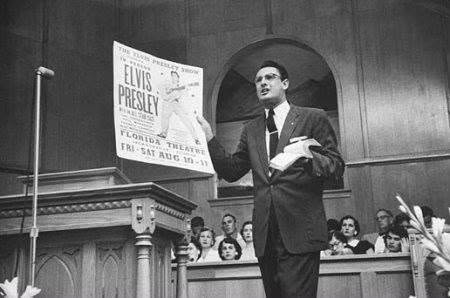
In August 1956, Baptist preacher Robert Gray condemned Elvis Presley in Jacksonville as the rock-and-roll star faced a growing backlash over his provocative performances and influence on teenagers.
Baptist Preacher Robert Gray Tried to Stop the Elvis Presley Show in Jacksonville
In the summer of 1956, Elvis Presley was becoming something far bigger than a young singer with a few hit records.
He was becoming a cultural phenomenon.
Teenagers adored him.
Parents didn’t always understand him.
Religious leaders worried about him.
And in Jacksonville, Florida, the controversy surrounding Elvis reached a remarkable level when Baptist preacher Robert Gray publicly denounced the young performer just before his appearances at the Florida Theatre.
Presley was only 21 years old, but his combination of rock-and-roll music, distinctive appearance, and provocative stage movements had already made him one of the most controversial entertainers in America.
His Jacksonville performances would become one of the clearest examples of the cultural battle surrounding early rock and roll.
Elvis Arrives in Jacksonville
Elvis arrived in Jacksonville on August 10, 1956, during a pivotal period in his rapidly developing career.
Earlier that year, he had scored major hits including “Heartbreak Hotel” and “I Want You, I Need You, I Love You.” His version of “Hound Dog” and “Don’t Be Cruel” was also dominating the attention of young music fans.
The Florida Theatre was scheduled to host six performances over August 10 and 11.
The demand was enormous.
Thousands of young fans turned out for the shows, with contemporary reporting describing packed performances and large crowds of excited teenagers.
But not everyone was celebrating Elvis’s arrival.
Some Jacksonville adults believed his performances were dangerous for young people.
Among his most outspoken critics was Reverend Robert Gray, pastor of Trinity Baptist Church.
Robert Gray’s Condemnation
Gray didn’t simply dislike Elvis’s music.
He viewed the singer’s influence as a moral and spiritual threat.
Before the Jacksonville performances, Gray told his congregation that Presley had reached what he described as “a new low in spiritual degeneracy.”
At Trinity Baptist Church, Gray led a prayer gathering in which teenagers were encouraged to pray for Elvis’s salvation.
The episode was subsequently covered nationally, including in LIFE magazine, helping turn the Jacksonville controversy into part of the larger national debate surrounding Presley.
To modern audiences, the reaction can seem extraordinary.
But in 1956, Elvis represented something new.
Rock and roll wasn’t merely another musical style to many adults.
It was associated with changing attitudes toward youth, dancing, sexuality, race, and social behavior.
Elvis seemed to embody all of those changes at once.
The Judge Gets Involved
The preacher wasn’t the only person concerned about what Elvis might do onstage.
Jacksonville Juvenile Court Judge Marion Gooding became involved as well.
Before the performances, Gooding warned Presley about his movements and threatened legal action if the singer’s performance crossed the line into what authorities considered inappropriate behavior toward minors.
The judge was prepared to have Presley arrested for allegedly impairing the morals of minors if he ignored the restrictions.
Elvis was reportedly confused and frustrated by the situation.
He had difficulty understanding what exactly he was doing wrong.
After all, from his perspective, the movements were simply part of his performance.
Elvis Changes His Performance
The restrictions didn’t stop Elvis from performing.
Instead, he adapted.
During the Jacksonville shows, Presley dramatically reduced the movements that authorities considered too provocative.
Rather than performing his famous full-body movements, he incorporated smaller gestures—including a memorable movement of his little finger.
It sounds almost comical today.
But the tiny gesture was enough to send the audience into a frenzy.
The young fans knew exactly what Elvis was doing.
And the controversy arguably made the performances even more memorable.
The Florida Historical Society notes that Judge Gooding ultimately watched Elvis perform and was apparently satisfied enough with the modified show that he allowed his own daughters to attend.
The Audience Was Still Wild
Even with restrictions, Elvis remained Elvis.
The crowd was enormous.
Contemporary LIFE coverage described thousands of Jacksonville teenagers attending each of the six shows, with police positioned in the orchestra pit to prevent the audience from rushing the stage during performances such as “Hound Dog.”
That image captures something important about Elvis’s early appeal.
His popularity wasn’t simply about the songs.
It was the experience.
Teenagers weren’t just listening to him.
They were screaming, copying his hairstyle, imitating his movements, buying his records, and turning him into a symbol of youth culture.
Adults watching from the outside often saw the same behavior and interpreted it very differently.
Elvis Was Hurt by Gray’s Words
The controversy affected Elvis personally.
He later recalled being particularly hurt by Reverend Gray’s criticism.
According to accounts of his comments, Presley felt that Gray had judged him without actually knowing him.
That criticism probably struck Elvis especially deeply because he had grown up around church music and had a strong religious background.
Presley pointed out that he had attended church from childhood and rejected the idea that his music automatically made him immoral.
That detail is easy to overlook when looking back at Elvis decades later.
The young man being condemned in Jacksonville wasn’t yet the legendary figure people associate with Las Vegas, Graceland, or the later years of his career.
He was a 21-year-old performer suddenly discovering what it meant to become famous on a national scale.
A Battle Bigger Than Elvis
The Jacksonville controversy wasn’t really just about one singer.
It represented a much larger conflict.
America was changing rapidly.
Teenagers were becoming an increasingly important cultural force.
Music was changing.
Fashion was changing.
Movies were changing.
And young people were increasingly willing to challenge the expectations of their parents.
Rock and roll became one of the most visible symbols of that transformation.
Elvis happened to stand at the center of it.
His critics saw him as evidence that traditional values were disappearing.
His fans saw him as exciting, rebellious, and different.
And the more adults tried to control him, the more fascinating he became to many teenagers.
The Controversy Didn’t Stop Elvis
If the goal was to make Elvis disappear, Jacksonville didn’t accomplish it.
His career continued to accelerate.
The Florida performances became part of the mythology surrounding his rise, and the national attention only increased interest in the young singer.
Within months, Elvis would make his famous national television appearances that helped cement his status as one of America’s biggest entertainers.
The young singer whom some authorities considered a threat would soon become one of the most recognizable figures in popular culture.
Why the Jacksonville Story Still Matters
Looking back nearly seven decades later, the incident can seem almost unbelievable.
A preacher condemned a young singer.
A judge threatened legal consequences over his stage movements.
Police surrounded the performance area.
Thousands of teenagers screamed for the performer anyway.
And Elvis stood onstage, restricted but still determined to entertain.
But that’s precisely why the story remains fascinating.
It shows how threatening new forms of popular culture can appear when they first emerge.
Elvis wasn’t simply selling records.
He was challenging ideas about what young people were allowed to enjoy, how performers were expected to behave, and how much control adults should have over youth culture.
The Lasting Image
One of the most memorable aspects of the Jacksonville episode is the contrast.
Inside the theater were thousands of teenagers desperate to see Elvis.
Outside and around the performances were adults, authorities, and religious leaders trying to control what they believed was a dangerous influence.
And in the middle stood a young Elvis Presley.
He couldn’t move exactly as he wanted.
But he could still sing.
He could still perform.
And he could still make an audience lose its mind with the smallest gesture.
The attempt to restrain Elvis ultimately became another chapter in his rise to fame.
Final Thoughts
Robert Gray’s campaign against Elvis Presley was part of a much broader reaction to the arrival of rock and roll in 1950s America.
Gray saw Elvis as a moral danger and publicly condemned him from the pulpit. Judge Marion Gooding separately imposed restrictions on Presley’s movements during the Jacksonville performances.
But Elvis didn’t disappear.
He modified his performance, took the stage, and continued entertaining thousands of screaming fans.
The Jacksonville shows became a snapshot of a country caught between two generations.
One wanted the old rules preserved.
The other wanted something new.
And Elvis Presley, standing under the lights at the Florida Theatre in August 1956, became one of the most visible faces of that change.