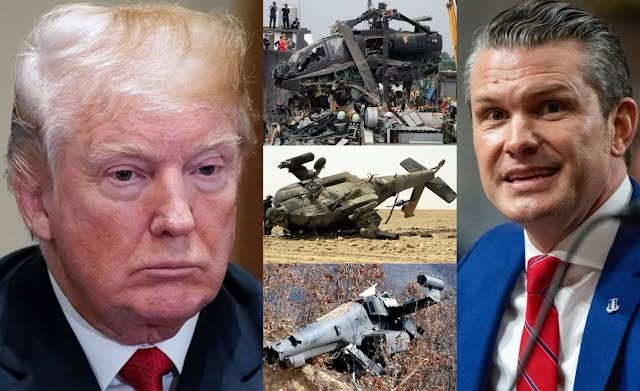
A troubling series of U.S. Army AH-64 Apache crashes has raised fresh questions about aviation safety, training, and operational pressures under the Trump administration and Defense Secretary Pete Hegseth.
A troubling pattern is drawing renewed attention to the safety of the U.S. Army’s AH-64 Apache attack helicopters.
Recent reporting indicates that the Apache has experienced an unusually high number of serious accidents. In fact, the Army’s latest fatal Apache crash near Fort Hood, Texas, prompted officials to temporarily suspend Apache training flights while the incident was reviewed. Two soldiers were killed in the August 12, 2026 crash.
The Numbers Are Raising Eyebrows
The concern isn’t based on a single accident.
Earlier data showed that the Apache already had a significantly higher serious-incident rate than the Army’s UH-60 Black Hawk. From 2020 through 2024, the Apache recorded 17 serious incidents at a rate of about 4.41 incidents per 100,000 flight hours, compared with 1.23 for the Black Hawk.
A recent report circulating about the Army’s Apache fleet says fiscal year 2026 is on track to become the second-worst year for Apache flight accidents since the current AH-64 model was introduced in 2011.
A Series of Crashes
The latest Texas accident comes after several other major Apache incidents.
The Army has faced crashes involving Apaches during both training and operational missions. In 2026, an Apache also went down near the Strait of Hormuz during the conflict involving Iran; the two pilots survived.
The accumulation of incidents has naturally raised questions about aircraft condition, training, maintenance, operational tempo, and other possible contributing factors.
Does This Prove Trump’s Policies Caused the Crashes?
Not by itself.
The elevated accident rate is a legitimate safety concern, but the available evidence does not establish that President Donald Trump or Defense Secretary Pete Hegseth personally caused the crashes.
Military aviation accidents can have numerous causes, including mechanical problems, weather, human factors, maintenance issues, training conditions, and operational circumstances. Individual investigations are necessary before assigning responsibility.
The broader political debate, however, is likely to continue as the Army deals with the unusually high number of Apache accidents.
The Army Is Taking Action
Following the deadly Fort Hood crash, the Army temporarily paused Apache training operations. The suspension was lifted after a safety and operational review, allowing training missions to resume.
That doesn’t mean the underlying questions have disappeared.
Why are so many Apache accidents occurring? Are there common factors connecting them? And what changes are needed to prevent the next one?
Those questions will depend heavily on the findings of individual crash investigations.
The Bigger Picture
The Apache remains one of the Army’s most important attack helicopters, designed for missions ranging from close air support to anti-armor operations. Its demanding mission profile can expose crews and aircraft to challenging conditions.
But when accidents begin occurring at an unusually high rate, every incident becomes part of a larger safety picture.
For now, the most accurate takeaway is this:
The Apache’s accident record in 2026 is serious and deserves scrutiny—but claims that the crashes are directly the result of Trump or Hegseth’s policies should be treated as an allegation unless supported by the ongoing investigations.