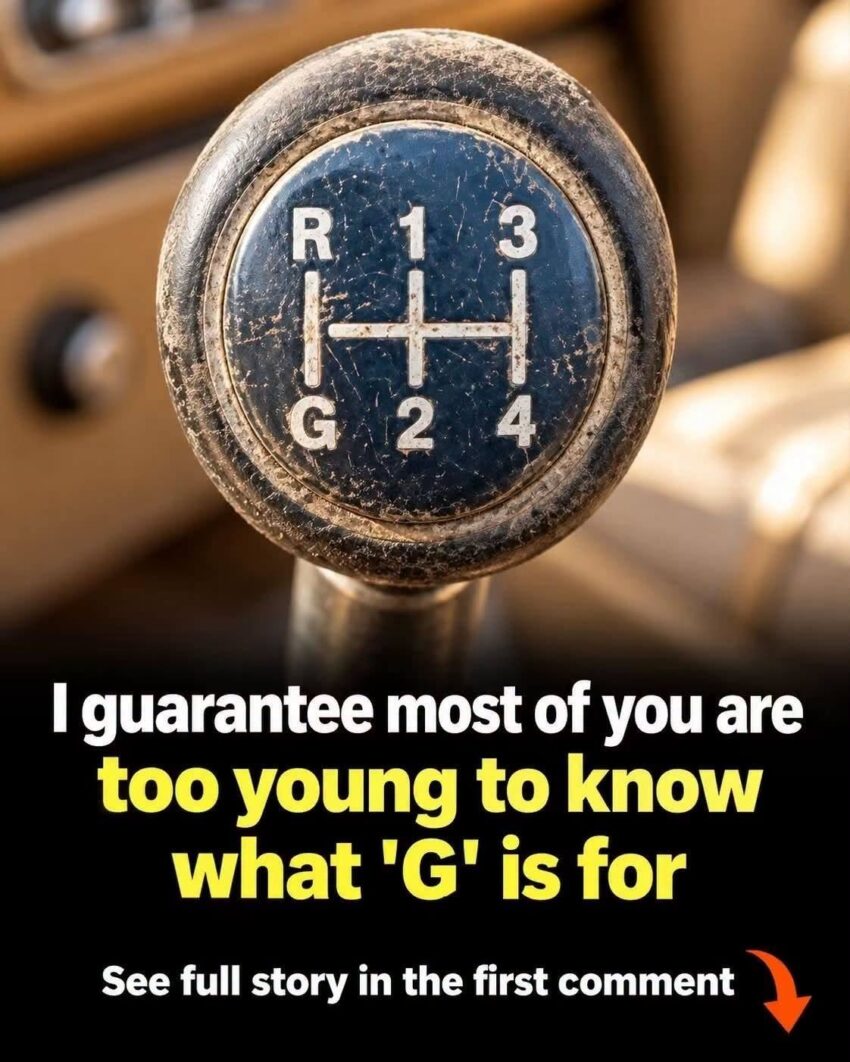
Ever wondered what the “G” on a manual gear stick means? Learn why some vehicles have a G gear position and how it differs from ordinary driving gears.
If you’ve ever climbed into an older manual vehicle and noticed a mysterious “G” marked on the gear lever, you might have wondered what it meant.
For drivers accustomed to the familiar 1-2-3-4-5 or 1-2-3-4-5-6 pattern, the letter can look completely out of place.
So, what exactly is G?
The surprising answer is that it usually isn’t simply another ordinary road-driving gear.
What Does “G” Mean?
On some manual vehicles, particularly certain older off-road vehicles, G refers to a special low-range or Gelände (German for “terrain”) gear system.
The exact meaning depends on the vehicle and transmission design.
In vehicles equipped with a separate low-range gearbox, the system is designed to provide extra-low gearing for situations where the vehicle needs more controlled torque and slower movement.
That can be useful when driving over difficult terrain.
Why Would a Vehicle Need It?
Imagine driving slowly over a steep, rocky trail.
You don’t necessarily want the vehicle moving quickly. Instead, you want the engine to provide strong pulling power while the wheels turn slowly and predictably.
Low gearing can help achieve this.
It can be useful for situations such as:
- Steep climbs
- Steep descents
- Muddy or loose surfaces
- Rocky trails
- Heavy loads
- Difficult off-road conditions
The exact operation varies by vehicle, so drivers should always check the owner’s manual before using a special transmission setting.
Is G the Same as First Gear?
No—not necessarily.
This is where the confusion often begins.
A low-range gear can dramatically change the relationship between engine speed and wheel speed. It is intended for situations where controlled, slow movement and increased torque at the wheels are more important than normal road speed.
Some vehicles use a separate transfer case with markings such as 2H, 4H, and 4L, while others may use different labeling.
That means you shouldn’t assume that every “G” position works in exactly the same way.
Why Don’t Modern Cars Usually Have It?
Modern vehicles have increasingly sophisticated transmissions and electronic driving systems.
Automatic transmissions, electronically controlled four-wheel-drive systems, and modern off-road technology can provide capabilities that older mechanical systems required drivers to manage themselves.
As a result, unusual gear markings that were once familiar to specialist drivers can seem mysterious today.
One Important Warning
Don’t move a vehicle into a special low-range or off-road setting simply because you see a “G” on the selector.
Using the wrong transmission mode at the wrong speed can potentially damage the drivetrain or affect vehicle handling.
The safest approach is simple:
Check the vehicle’s owner’s manual before using an unfamiliar gear position.
The Takeaway
That mysterious “G” isn’t necessarily a secret extra gear for everyday driving.
On vehicles that use the designation for a special low-range or terrain-oriented transmission setting, it is there to help the driver control the vehicle in demanding conditions.
And that’s what makes these old-fashioned gear selectors so interesting: a single letter can reveal that the vehicle was designed for far more than simply driving from one place to another