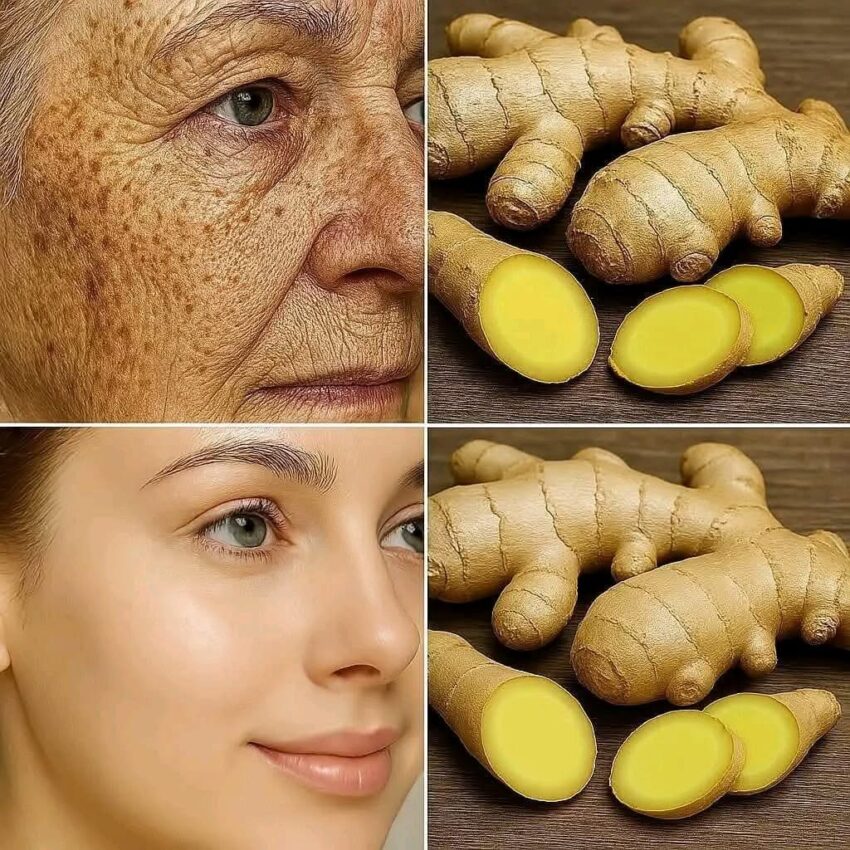
Ginger is often promoted as a natural remedy for wrinkles, freckles, and dark spots. Learn what ginger may actually do for skin and why it should not be considered a replacement for proven treatments.
The internet is full of beauty remedies promising dramatic results with ingredients already sitting in your kitchen.
One of the latest claims suggests that ginger is “100 times more powerful than Botox” for removing deep wrinkles, freckles, and dark spots.
The comparison sounds impressive—but it isn’t supported by reliable clinical evidence.
Ginger does contain naturally occurring compounds with antioxidant and anti-inflammatory properties, which is one reason it has attracted interest in skincare. However, there is no good evidence that rubbing ginger on the skin can work like Botox or permanently erase deep wrinkles and pigmentation.
Still, that doesn’t mean ginger is completely uninteresting when it comes to skin health.
Why Is Ginger Associated With Skin Benefits?
Ginger contains bioactive compounds such as gingerols and shogaols.
These compounds have antioxidant and anti-inflammatory properties that researchers have studied in laboratory and experimental settings.
Oxidative stress and inflammation can contribute to skin damage, so scientists are interested in whether plant-derived compounds could eventually have useful cosmetic applications.
But laboratory findings don’t automatically translate into a proven home treatment.
Can Ginger Remove Deep Wrinkles?
Deep wrinkles develop through a combination of factors, including natural aging, repeated facial movements, loss of collagen and elastin, and long-term exposure to ultraviolet radiation.
A kitchen ingredient cannot realistically be expected to reverse all of these processes.
Botulinum toxin treatments work through a very specific mechanism that temporarily reduces activity of certain facial muscles. Ginger does not work in the same way.
So the claim that ginger is “100 times more powerful than Botox” should be treated as a viral beauty claim rather than an established medical fact.
What About Dark Spots?
Dark spots can have many causes.
They may develop following acne or skin inflammation, from sun exposure, hormonal changes, or certain medications and skin conditions.
Ginger has antioxidant compounds, but there isn’t sufficient clinical evidence to conclude that applying raw ginger to dark spots will reliably remove them.
In fact, putting concentrated ginger juice directly onto the skin can cause irritation in some people.
Irritation itself can sometimes make pigmentation worse, particularly in people who are prone to post-inflammatory hyperpigmentation.
Can Ginger Remove Freckles?
Freckles are largely influenced by genetics and sun exposure.
They can become darker after ultraviolet exposure.
Rather than trying to burn or scrub freckles away with strong kitchen ingredients, protecting the skin from sunlight is much more important.
A broad-spectrum sunscreen used consistently can help prevent freckles and other pigmentation from becoming darker.
If You Still Want to Try Ginger
If you’re interested in ginger as part of a skincare routine, don’t apply undiluted ginger juice aggressively to your face.
A safer approach is to use a properly formulated skincare product that contains ginger extract rather than experimenting with concentrated kitchen preparations.
Before using any new product on your face, perform a small patch test on an inconspicuous area.
Stop using it if you develop burning, redness, itching, swelling, or significant irritation.
What Actually Helps With Wrinkles?
For evidence-based wrinkle prevention and treatment, several approaches have much stronger support than kitchen remedies.
Sun Protection
Daily sun protection is one of the most important things you can do for your skin.
Ultraviolet radiation contributes significantly to premature skin aging and pigmentation.
Moisturizer
Keeping the skin hydrated can temporarily make fine lines look less noticeable and can support the skin barrier.
Retinoids
Retinoid products have substantial evidence for improving certain signs of photoaging.
However, they aren’t appropriate for everyone. People who are pregnant should not use topical retinoids unless specifically advised by their healthcare professional.
Professional Treatments
Depending on the type and depth of wrinkles, dermatologists may offer treatments such as chemical peels, laser procedures, microneedling, botulinum toxin, or other options.
The appropriate treatment depends on the individual skin condition.
A Simple Truth About “Miracle” Ingredients
The idea of replacing expensive cosmetic treatments with something from the kitchen is understandably appealing.
But skin is complex, and dramatic claims deserve careful consideration.
An ingredient can have antioxidant properties without being capable of removing deep wrinkles or permanently eliminating pigmentation.
That’s why it’s better to ask “What does the evidence show?” rather than assuming that a viral beauty recipe must work.
The Bottom Line
Ginger contains interesting natural compounds and can certainly be part of a healthy diet. But there is no credible evidence that ginger is 100 times more powerful than Botox or that applying it to the face can erase deep wrinkles, freckles, and dark spots.
If your goal is younger-looking, more even skin, focus on proven basics: sun protection, gentle skincare, adequate moisturization, and appropriate dermatological treatments when needed.
And before putting a strong kitchen ingredient directly on your face, remember that natural doesn’t automatically mean irritation-free.