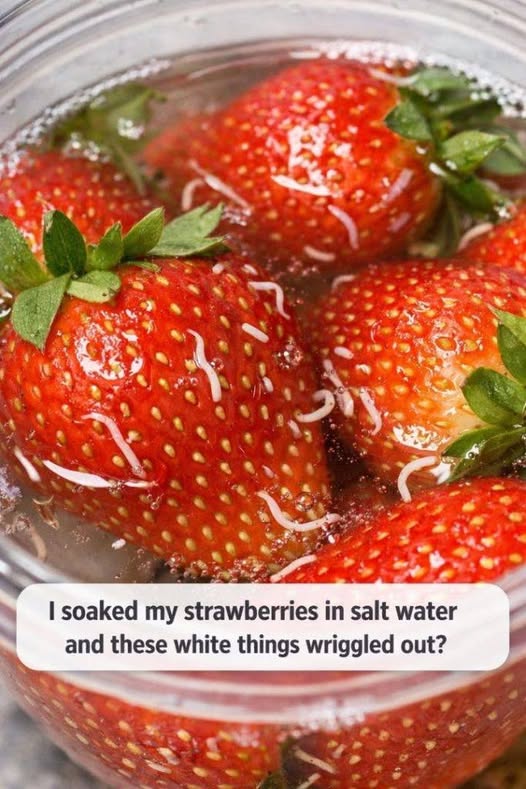
Soaked strawberries in salt water and noticed tiny white things moving around? Here’s what may be happening, whether they’re harmful, and how to wash strawberries safely before eating.
I Soaked My Strawberries in Salt Water and These White Things Wriggled Out—What Are They?
You buy a fresh container of strawberries, bring them home, and decide to give them a quick soak in salt water before eating.
A few minutes later, you notice something you definitely weren’t expecting.
Tiny white or pale objects appear to be moving in the water.
Suddenly, those innocent-looking strawberries don’t seem quite so appetizing.
Videos showing this phenomenon have become popular online, often accompanied by claims that strawberries are “full of worms” or that salt water is pulling dangerous parasites out of the fruit.
The reality is more complicated.
What you see may be tiny insects or other organisms that were already present on the fruit, but a video or a few moving particles isn’t enough to identify exactly what they are.
Here’s what you should know.
Why Can Tiny Things Come Out of Strawberries?
Strawberries grow close to the ground and have a textured surface with many tiny seeds, crevices, and folds.
Because of their growing environment, small insects or insect larvae can occasionally be present on fresh produce.
A salt-water soak can disturb tiny organisms hiding in cracks or around the surface, making them easier to notice.
That doesn’t necessarily mean the strawberries were unusually dirty or dangerous.
Fresh produce can sometimes contain small insects even after being harvested and packaged.
Are They Actually Worms?
Not necessarily.
One of the biggest problems with viral strawberry videos is that people often identify anything tiny and moving as a “worm.”
Without close examination, it’s difficult to determine whether a moving object is an insect larva, another small organism, plant material being disturbed, or something else entirely.
The white appearance can also be misleading.
Tiny organisms can look dramatically different when viewed through a phone camera or magnified in water.
So it’s better not to make a definite identification based solely on appearance in a viral video.
Does Salt Water Kill Everything?
No.
Salt water is sometimes used as a household produce-washing trick, but it shouldn’t be considered a reliable disinfectant.
A salt solution may cause some small insects or larvae to leave the fruit, but it doesn’t make contaminated produce automatically safe.
It also doesn’t replace proper washing.
If you’re concerned about foodborne pathogens, simply soaking fruit in salt water isn’t a guaranteed solution.
Should You Throw Away the Strawberries?
Not necessarily.
If the strawberries are otherwise fresh and in good condition, discovering a tiny insect isn’t automatically a reason to panic.
However, you should discard strawberries that show obvious signs of spoilage, such as:
- Extensive mold
- Strong unpleasant odors
- Significant sliminess
- Severe deterioration
- Unusual discoloration associated with spoilage
If many berries are visibly contaminated or badly damaged, you may reasonably decide not to eat them.
When in doubt about questionable produce, throwing it away is the safest option.
How Should You Wash Strawberries?
A simple approach is often best.
Before eating strawberries:
- Wash your hands with soap and water.
- Place the strawberries under cool, clean running water.
- Gently rub the surface with your fingers.
- Remove damaged or spoiled berries.
- Drain and dry them with a clean towel or paper towel.
Avoid washing strawberries long before you plan to eat them unless you can dry and store them properly, because excess moisture can encourage spoilage.
Should You Use Soap?
No.
Household soaps and detergents aren’t intended for washing fruit and can leave residues that shouldn’t be consumed.
You don’t need dish soap to clean strawberries.
Clean running water and gentle handling are the better choice for routine produce washing.
What About Vinegar?
Vinegar is another popular home remedy for cleaning berries.
Some people use diluted vinegar solutions to reduce surface contamination or extend the shelf life of berries, but it isn’t necessary for ordinary washing and doesn’t guarantee that all harmful microorganisms will be removed.
If you use any produce-washing method, remember that washing cannot eliminate every possible pathogen.
Proper food handling and refrigeration are still important.
Why Are Strawberries Especially Easy to Contaminate?
Strawberries have a soft, delicate surface.
Unlike fruits with thick peels, you generally eat the entire strawberry.
Their uneven surface can also trap dirt and tiny particles.
That’s why washing them shortly before eating is a useful habit.
It’s also important to purchase berries from reputable sources and avoid fruit that already looks damaged or spoiled.
Don’t Let Viral Videos Make You Afraid of Fruit
The internet has turned the strawberry salt-water experiment into a surprisingly dramatic trend.
Seeing tiny organisms moving in water can certainly be unpleasant.
But it doesn’t mean strawberries are inherently unsafe.
Fresh fruits and vegetables can occasionally carry tiny insects or other natural contaminants because they are agricultural products.
The goal isn’t to make produce completely free of every microscopic organism.
The goal is to handle and wash food appropriately and recognize obvious signs of spoilage.
What If You Already Ate the Strawberries?
If you ate strawberries before noticing something unusual during washing, don’t automatically assume you’ve been poisoned or infected.
Accidentally consuming a tiny insect isn’t generally the same thing as consuming a dangerous pathogen.
If you develop significant or persistent symptoms after eating contaminated food, seek medical advice, particularly if symptoms are severe.
But don’t panic simply because you saw something unusual in the washing water.
A Better Way to Think About It
Instead of asking:
“Are my strawberries full of worms?”
Ask:
“Are these strawberries fresh, properly washed, and free from obvious spoilage?”
That’s a much more useful food-safety question.
The occasional presence of a tiny insect doesn’t mean the entire container is dangerous.
Final Thoughts
Seeing tiny white things wriggling in the water after soaking strawberries can be disturbing, especially if you’ve never encountered it before.
Salt water may encourage some small organisms hiding on the fruit to move, but you can’t reliably identify them from a viral video or casual observation alone.
The best approach is simple: inspect your strawberries, discard berries that are moldy or spoiled, wash fresh berries thoroughly under clean running water, and store them properly.
And the next time you see a dramatic strawberry-cleaning video online, remember that what looks frightening on camera may have a much less dramatic explanation.
A little caution is sensible. Panic isn’t necessary.