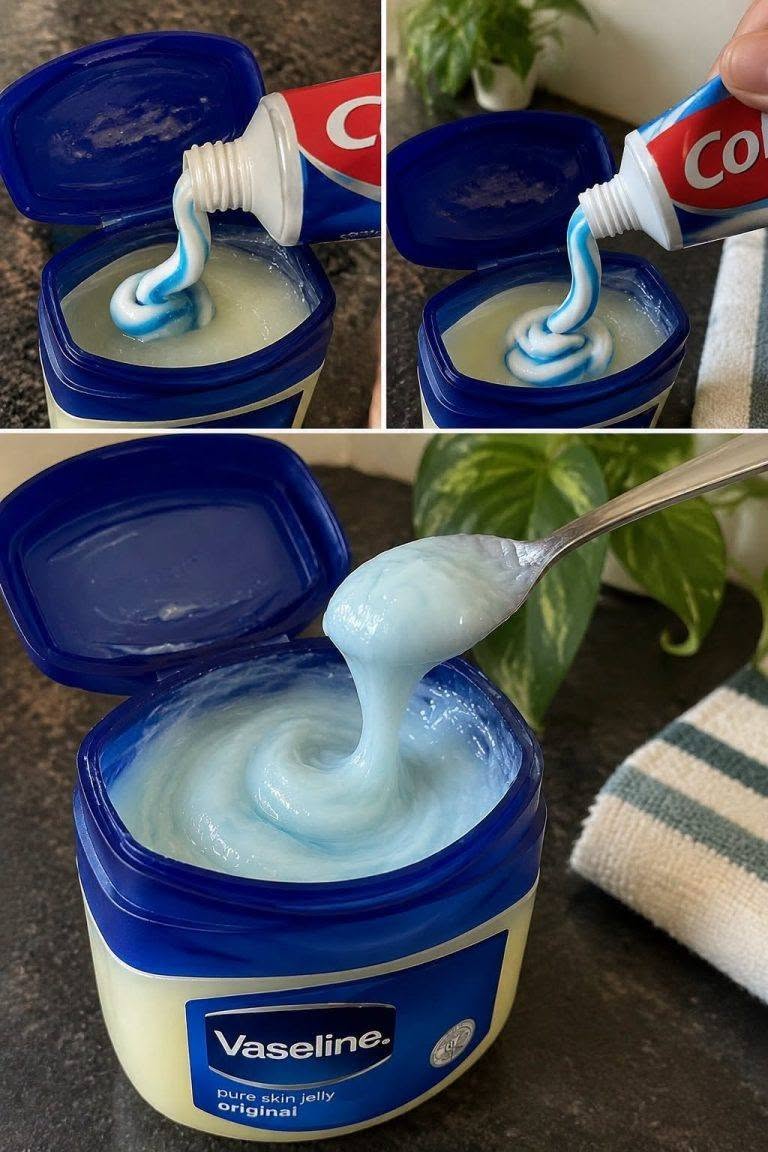
Mixing toothpaste and Vaseline is a popular home-remedy idea, but does it really work? Learn what this combination may do, what to avoid, and safer alternatives for your skin.
Mix Toothpaste and Vaseline, I Didn’t Expect It to Be So Effective
Home remedies often become popular because they are simple, inexpensive, and made from products already sitting in the bathroom cabinet.
One combination that frequently appears online is toothpaste mixed with Vaseline. Videos and social-media posts sometimes claim that this mixture can brighten skin, remove dark spots, smooth rough areas, reduce pimples, or even make certain skin problems disappear quickly.
But before putting the mixture on your face or body, it is important to understand what these two products are actually designed to do.
The surprising truth is that Vaseline can be useful for protecting dry skin, while toothpaste is generally not a skincare product at all.
What Is Vaseline Actually Doing?
Vaseline is a petroleum jelly. Its main benefit is its ability to form an occlusive layer over the skin.
This layer helps reduce water loss from the skin’s surface and can make dry, rough areas feel softer.
That is why petroleum jelly is commonly used for:
- Very dry skin
- Dry lips
- Rough patches
- Protecting irritated skin from further friction
- Supporting the skin barrier
Its effect isn’t that it magically removes damaged skin. Instead, it helps the skin retain moisture.
So Why Do People Add Toothpaste?
Toothpaste contains ingredients designed for cleaning teeth, not treating facial skin.
Depending on the product, toothpaste may contain ingredients such as detergents, flavoring agents, abrasives, fluoride, and other compounds.
Some people assume that the cooling or tingling sensation from toothpaste means it is working on a pimple or dark spot.
However, a tingling sensation does not necessarily mean that a skincare treatment is effective.
In fact, toothpaste can irritate sensitive skin.
Can Toothpaste and Vaseline Remove Dark Spots?
This is one of the biggest claims surrounding the mixture.
There is no good reason to expect toothpaste mixed with petroleum jelly to safely erase pigmentation.
Dark spots can have many causes, including acne marks, sun exposure, hormonal changes, irritation, and certain skin conditions.
Applying an irritating product can sometimes make pigmentation look worse rather than better, particularly in people whose skin develops dark marks after inflammation.
What About Pimples?
You may have seen people recommending toothpaste as an overnight acne treatment.
This is another popular home remedy that dermatologists generally advise against.
Toothpaste isn’t formulated to treat acne. Its ingredients may irritate the skin and cause dryness, redness, burning, or peeling.
Vaseline itself is different. It can be useful as a protective moisturizer for many people, but applying a thick occlusive layer over acne-prone skin isn’t necessarily the right treatment for active breakouts.
For acne, products specifically formulated with ingredients such as benzoyl peroxide or salicylic acid are generally more appropriate.
Could the Mixture Make Skin Feel Smooth?
Possibly—but that doesn’t mean the toothpaste is improving the skin.
Petroleum jelly can make dry skin feel smoother because it reduces moisture loss and creates a protective layer.
If someone applies toothpaste and Vaseline together and notices softer skin afterward, the moisturizing effect is more likely to come from the petroleum jelly rather than toothpaste.
There is no need to add an irritating ingredient simply to obtain the moisturizing benefit.
What Happens If You Apply Toothpaste to Sensitive Skin?
Some people may experience:
- Burning
- Redness
- Itching
- Dryness
- Peeling
- Irritation
- Increased sensitivity
The risk may be higher around delicate areas such as the lips, eyes, and nose.
If a product causes burning or significant irritation, wash it off rather than leaving it on overnight.
A Safer Alternative for Dry Skin
If your goal is simply to make dry skin softer, you can use petroleum jelly by itself.
Apply a small amount to clean, slightly damp skin.
For facial skin, use a thin layer rather than coating the entire face heavily.
You can also use a fragrance-free moisturizer underneath if your skin needs additional hydration.
A Better Approach for Dark Spots
If you’re trying to reduce pigmentation, focus on proven skincare rather than harsh kitchen or bathroom mixtures.
A basic routine can include:
Morning
- Gentle cleanser
- Moisturizer
- Broad-spectrum sunscreen
Night
- Gentle cleanser
- Appropriate pigmentation treatment
- Moisturizer
Sunscreen is particularly important because ultraviolet exposure can make many forms of pigmentation more noticeable.
Don’t Test Viral Remedies on Your Whole Face
If you still decide to try an unfamiliar skincare mixture, don’t immediately apply it over your entire face.
A small patch test can help you identify obvious irritation, although even a patch test cannot guarantee that a product is suitable for everyone.
Never apply toothpaste around the eyes or to broken, scratched, or already irritated skin.
The Bottom Line
The combination of toothpaste and Vaseline may sound like a clever beauty hack, but there is little reason to combine them.
Vaseline has a legitimate role in protecting and moisturizing dry skin. Toothpaste, however, is designed for teeth—not facial skincare.
If your goal is softer skin, use petroleum jelly or a suitable moisturizer. If you’re dealing with acne, pigmentation, persistent itching, or another skin problem, choose a treatment designed specifically for that condition.
Sometimes the most effective “hack” is simply leaving the toothpaste on your toothbrush and keeping your skincare products on your skin.