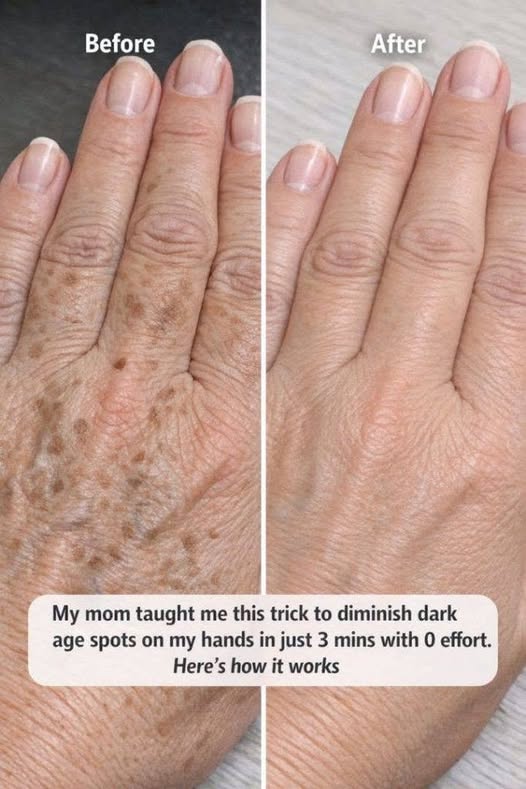
Dark age spots on the hands are common with aging and sun exposure. Learn a gentle, realistic approach that may help improve their appearance over time, plus why a “3-minute miracle” should be viewed cautiously.
My Mom Taught Me This Trick to Diminish Dark Age Spots on My Hands in Just 3 Minutes—Here’s How It Works
Dark spots on the backs of the hands are extremely common as we get older. Often called age spots, sun spots, or solar lentigines, they develop after years of exposure to ultraviolet (UV) radiation.
You may see them as small brown, tan, or darker patches that gradually become more noticeable.
But here’s the important part: there isn’t a safe home remedy that can permanently remove a true age spot in just three minutes. Some simple tricks can temporarily make the skin look smoother or brighter, while proven treatments generally take weeks or months to make a noticeable difference.
The 3-Minute Trick: Moisturize and Protect
If you’re looking for an easy routine that takes only a few minutes, start with something simple:
Step 1: Wash Your Hands Gently
Use lukewarm water and a mild cleanser. Avoid aggressively scrubbing dark spots because irritation can make pigmentation more noticeable.
Pat your hands dry rather than rubbing them harshly.
Step 2: Apply a Moisturizer
Massage a fragrance-free hand cream or moisturizer into the backs of your hands and around your fingers.
This won’t erase pigmentation, but hydrated skin can immediately look smoother, softer, and healthier.
Step 3: Apply Sunscreen
This is the most important step.
Apply a broad-spectrum SPF 30 or higher sunscreen to the backs of your hands and other exposed skin. Reapply when appropriate, especially after washing your hands frequently or spending extended time outdoors.
Without sun protection, existing pigmentation can become darker and new spots can develop.
What About Lemon Juice or Baking Soda?
You may have seen viral recipes recommending lemon juice, baking soda, toothpaste, or other household ingredients for dark spots.
It’s better to avoid these remedies.
Lemon juice can irritate skin and increase sensitivity to sunlight, while abrasive substances such as baking soda can damage the skin barrier. Irritation can sometimes make pigmentation worse rather than better.
What Actually Helps Fade Age Spots?
If you want more significant improvement, a dermatologist can determine whether the spots are truly age spots and discuss appropriate treatments.
Depending on the individual, options may include:
- Prescription or dermatologist-recommended lightening treatments
- Retinoid products
- Certain chemical peels
- Cryotherapy
- Laser or light-based treatments
These treatments should be selected based on your skin type and the appearance of the pigmentation.
Don’t Assume Every Dark Spot Is an Age Spot
This is especially important.
A new or changing dark spot should not automatically be treated at home. Skin cancer can sometimes resemble an age spot.
Have a dermatologist examine a spot if it:
- Changes in size, shape, or color
- Has an irregular border
- Contains several different colors
- Bleeds or crusts
- Becomes painful or persistently itchy
- Looks noticeably different from your other spots
The Bottom Line
The “3-minute trick” isn’t a magic way to erase age spots instantly. But a quick routine of gentle cleansing, moisturizing, and daily sun protection can help your hands look healthier and can prevent sun-related pigmentation from becoming more pronounced.
For persistent dark spots, professional evaluation is the safest way to determine what they are and which treatment is appropriate.