I knew I hadn’t made the team before the coach even finished speaking.
She didn’t say the words you’re rejected.
She didn’t have to.
She looked at me for a few uncomfortable seconds, glanced down at the clipboard in her hands, and then offered the kind of smile adults use when they’re trying to make an unpleasant decision sound reasonable.
“You have potential,” she said.
I waited.
Then came the sentence I would remember for years.
“But you’re not quite the image the team is looking for.”
I stood there silently.
Around me, girls who had made the squad were laughing and hugging each other. Some were already talking about uniforms and upcoming competitions.
I looked down at myself.
Nothing was wrong with my clothes.
Nothing was wrong with my hair.
Nothing was wrong with my body.
But suddenly, I felt as though there was something wrong with me.
I walked out of the gym trying not to cry.
I made it halfway down the hallway before the tears started.
The Comment I Couldn’t Forget
I kept replaying the coach’s words.
Not quite the image.
What did that even mean?
I had practiced for weeks.
I had learned the routines.
I had worked on my jumps until my legs hurt.
I wasn’t the most naturally flexible person in the room, but I had worked harder than almost anyone I knew.
So why hadn’t that mattered?
I sat on a bench near the side entrance, pretending to scroll through my phone.
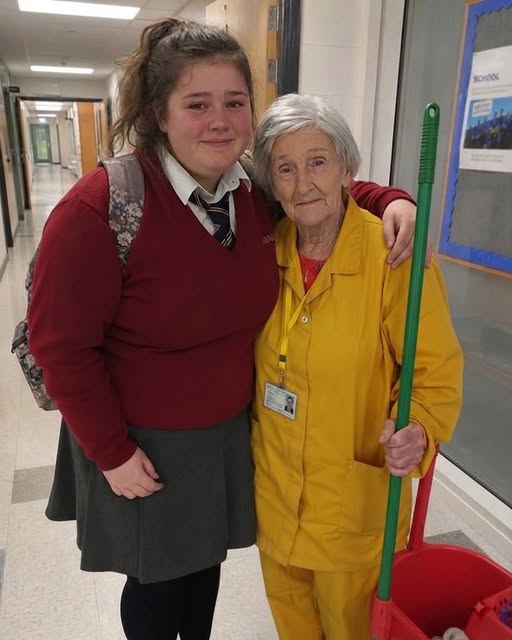
That’s when I noticed the school janitor.
She was pushing a cleaning cart down the hallway.
I’d seen her hundreds of times before.
Her name was Mrs. Alvarez.
She was one of those adults students barely noticed because she was always working quietly in the background.
But that afternoon, she stopped.
She looked at me.
Then she looked toward the gym.
“Did I hear what she said?” she asked softly.
I wiped my face.
“It’s nothing.”
Mrs. Alvarez shook her head.
“It isn’t nothing.”
I didn’t know what to say.
She leaned slightly closer.
Then she lowered her voice.
“Meet me behind the school tomorrow at six in the morning.”
I stared at her.
“Six?”
She nodded.
“Don’t tell anyone.”
Then she pushed her cart away.
I watched her disappear around the corner.
For the rest of the afternoon, I couldn’t stop wondering what she knew.
The Next Morning
My alarm went off at 5:15.
For several minutes, I seriously considered going back to sleep.
What could a school janitor possibly want to show me at six in the morning?
Maybe she’d misunderstood the conversation.
Maybe she was simply trying to make me feel better.
But curiosity won.
At 5:50, I quietly left the house.
The school was almost completely dark when I arrived.
Mrs. Alvarez was already waiting behind the gym.
Beside her was a battered cardboard box.
She smiled.
“You came.”
“What is this?” I asked.
She opened the box.
Inside were old photographs.
Hundreds of them.
Team photographs.
Competition programs.
Newspaper clippings.
And trophies.
I picked up one photograph.
It showed a cheerleading squad from nearly twenty years earlier.
Mrs. Alvarez pointed to a girl standing in the center.
“That was me.”
I looked at her.
“You were a cheerleader?”
She laughed.
“Before I became a janitor, yes.”
Then her expression changed.
“I was very good.”
She showed me another photograph.
Then another.
She had competed at regional and state levels.
She had won awards.
She had even received a scholarship offer.
“But I quit,” she said.
“Why?”
She looked toward the gym.
“Because someone told me I wasn’t the right image either.”
The Story She Had Never Told Anyone
Mrs. Alvarez sat on the concrete steps.
“When I was seventeen, my coach told me I was talented but didn’t fit what she wanted the team to look like.”
She paused.
“I believed her.”
She looked down at the photograph in her hands.
“I spent years thinking that one person’s opinion had accurately described my worth.”
I didn’t know what to say.
Then she handed me another photograph.
It showed her performing in front of a packed stadium.
“You know what I eventually realized?”
I shook my head.
“She wasn’t judging my ability.”
“She was judging what she thought I should look like.”
Those words hit me harder than I expected.
Because they sounded exactly like what had happened to me.
The Real Reason She Asked Me to Come
Mrs. Alvarez opened the cardboard box again.
At the bottom were several old notebooks.
“I started teaching myself everything I wished someone had taught me when I was your age.”
She opened one.
Inside were notes about conditioning, flexibility, strength training, balance, choreography, nutrition, and performance psychology.
“I don’t want you to quit because someone made you feel like you don’t belong.”
I stared at the notebooks.
“You want to train me?”
She smiled.
“No.”
She paused.
“I want to teach you how to train yourself.”
Six Months Changed Everything
The next six months were difficult.
There was no magical transformation.
No overnight success.
I practiced before school.
I stretched after classes.
I worked on strength, balance, timing, and technique.
Mrs. Alvarez corrected my form whenever she noticed something wrong.
Sometimes I was exhausted.
Sometimes I wanted to quit.
And sometimes I remembered the coach’s words.
Not quite the image.
But gradually, something changed.
I stopped practicing because I wanted the coach’s approval.
I started practicing because I wanted to become better.
That difference mattered.
The Unexpected Opportunity
Months later, the school announced an independent student performance competition.
Students could audition without being part of an official team.
I almost didn’t apply.
Mrs. Alvarez insisted.
“You have nothing to prove,” she told me.
“Then why should I go?”
“Because you deserve to see what you’re capable of.”
So I auditioned.
And I made it.
When the competition day arrived, the gym was packed.
Parents filled the seats.
Teachers stood along the walls.
Students crowded around the entrance.
And sitting near the front was the cheerleading coach.
I saw her before I stepped onto the floor.
For one second, I froze.
Then I remembered Mrs. Alvarez.
I remembered the dark morning behind the school.
I remembered the photographs.
And I performed.
Not perfectly.
Not flawlessly.
But confidently.
When I finished, the gym erupted in applause.
I looked toward the judges.
Then I looked at Mrs. Alvarez.
She was standing near the back of the room, smiling.
The Conversation Afterward
I didn’t win first place.
I came second.
And somehow, I didn’t care.
After the ceremony, the coach approached me.
“I owe you an apology,” she said.
I wasn’t expecting that.
She admitted that her comment months earlier had been unfair.
She said she’d focused too much on what she thought a team should look like instead of focusing on talent, discipline, and potential.
I listened.
Then I thanked her.
But I didn’t need her approval anymore.
Because the person who had helped me understand my worth wasn’t the coach.
It was the woman everyone walked past in the hallway every day.
The woman who pushed a cleaning cart while carrying decades of experience no one knew about.
The Woman Behind the Cleaning Cart
A few weeks later, I found out that Mrs. Alvarez had been asked to help with the school’s athletic programs.
The principal had learned about her background and discovered that she’d once competed at a very high level.
Students who had ignored her for years suddenly wanted her advice.
But she remained exactly the same.
Quiet.
Kind.
Hardworking.
One morning, I found her cleaning the hallway.
“Do you ever regret becoming a janitor?” I asked.
She smiled.
“Sometimes.”
Then she added:
“But I’ve met a lot of students in these hallways who needed someone to remind them that they matter.”
She handed me a cloth.
“Now stop talking and help me clean this window.”
I laughed.
And I did.
What I Learned
That experience taught me something I wish I’d understood earlier.
People will sometimes judge you based on appearances.
They may decide you don’t fit their idea of what success looks like.
They may use polite words to disguise unfair assumptions.
And sometimes, those words can hurt deeply.
But someone’s opinion about your appearance isn’t a measurement of your ability.
You don’t have to become someone else’s version of acceptable before you’re worthy of being given an opportunity.
Sometimes the person who changes your life won’t be the person standing in the spotlight.
Sometimes they’ll be the person quietly working in the background.
The person everyone overlooks.
The person who sees something in you that you haven’t learned to see in yourself yet.
For me, that person was Mrs. Alvarez.
And I’ll never forget the words she whispered that morning:
“Meet me behind the school tomorrow at 6 A.M. Don’t tell anyone.”
I thought she was going to show me a secret.
Instead, she showed me myself.