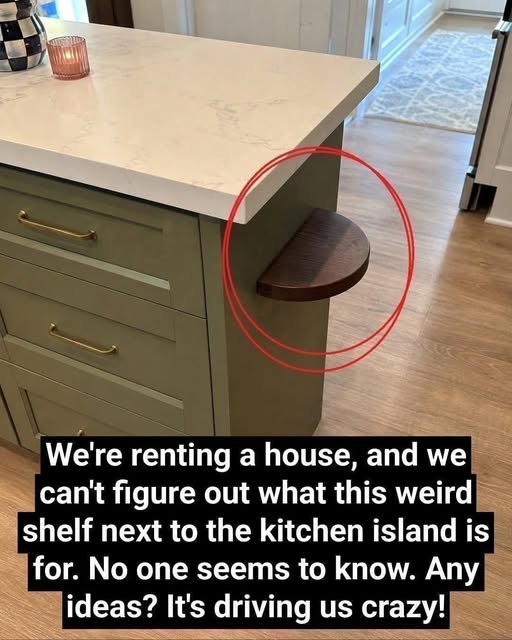
Renting a house with a strange shelf beside the kitchen island? Discover the surprising purposes these unusual built-in shelves may have served and how to identify what yours was designed for.
We’re Renting a House, and We Can’t Figure Out What This Weird Shelf Next to the Kitchen Island Is For
When you move into a rental home, you expect to find a few quirks. Maybe there’s an oddly placed light switch, an unusually narrow closet, or a cabinet that seems to have been designed for something very specific.
But sometimes you come across a feature that leaves you completely confused.
That’s exactly what happened to one renter who discovered a strange shelf built right next to the kitchen island. It looked intentional, yet nobody could explain what it was supposed to hold.
At first glance, it might seem like nothing more than an awkward piece of shelving. But its location and construction can provide some useful clues.
Why Would a Shelf Be Built Next to a Kitchen Island?
Kitchen storage is usually designed around convenience. Shelves and cabinets are placed where homeowners can easily reach the things they use most often.
A narrow shelf beside an island may therefore have been created for a very specific purpose.
Depending on its size, depth, and height, it could have been intended for anything from cookbooks and serving trays to bottles, cutting boards, or small kitchen appliances.
Older kitchens can be particularly puzzling because previous owners sometimes modified them to suit their own habits.
It Could Be a Cookbook Shelf
One of the simplest explanations is that it was designed to hold cookbooks.
Before smartphones and tablets became common kitchen companions, many people kept recipe books close to their food-preparation area.
A shallow vertical shelf next to an island would have been a convenient place to store:
- Cookbooks
- Recipe binders
- Cooking magazines
- Family recipe collections
- Small kitchen reference books
If the shelf is relatively narrow and doesn’t have much depth, this becomes an especially likely possibility.
Maybe It Was Designed for Cutting Boards
Another possibility is cutting-board storage.
Large wooden or plastic cutting boards can be awkward to store in ordinary cabinets. A narrow vertical compartment allows them to stand upright while remaining easy to grab.
Look at the spacing carefully. If the opening is tall but relatively narrow, it may have been intended for:
- Cutting boards
- Baking sheets
- Serving trays
- Pizza boards
- Cooling racks
This type of storage can be surprisingly useful because it keeps large flat objects from taking up valuable counter or cabinet space.
Could It Be a Bottle Rack?
The location beside a kitchen island also makes bottle storage a possibility.
If the shelf contains horizontal openings or several evenly spaced compartments, it may have originally been intended for wine bottles or other bottled beverages.
However, the exact design matters. A true bottle rack usually has compartments sized specifically to prevent bottles from rolling around.
What If It’s a Spice Shelf?
A very shallow shelf could have been designed for spices and cooking ingredients.
Spice shelves are often placed near food-preparation areas because they’re convenient when cooking. If the shelf is narrow enough that standard jars fit neatly inside, this could be its original purpose.
You might also find that the shelf’s height corresponds closely to common spice containers.
It Could Have Been Built for Trays and Baking Sheets
One of the most practical explanations is vertical baking-sheet storage.
Baking trays, roasting pans, muffin tins, and serving platters can quickly become difficult to organize in deep cabinets.
A narrow vertical shelf next to the island gives the homeowner somewhere to slide these items without stacking everything together.
If you notice several narrow vertical dividers, this possibility becomes even more convincing.
Sometimes the Answer Is Surprisingly Simple
Not every unusual kitchen feature has a mysterious historical purpose.
Sometimes a previous homeowner simply wanted extra storage and had a carpenter build something around an awkward space.
Kitchen islands frequently create small leftover areas that aren’t large enough for a conventional cabinet. Instead of leaving the space empty, someone may have turned it into a shelf.
That can make the feature look strange to the next person who moves in.
Look for These Clues
If you’re trying to solve your own kitchen-shelf mystery, examine a few details:
Depth:
A shallow shelf is more likely to hold books, spices, trays, or cutting boards.
Height:
A tall opening may indicate vertical storage for baking sheets or boards.
Width:
A very narrow compartment may have been designed for bottles or specialized kitchen items.
Dividers:
Multiple dividers can reveal what the original owner intended to store there.
Location:
A shelf beside the cooking area was probably designed for something that needed to be accessible while preparing food.
Wear marks:
Scratches, stains, or faded areas can sometimes reveal what was stored there previously.
The Best Part? You Don’t Have to Use It for Its Original Purpose
Even if you never discover exactly what the shelf was designed for, you can still make it useful.
Depending on its dimensions, you could use it for:
- Cookbooks
- Cutting boards
- Baking trays
- Serving platters
- Kitchen towels
- Decorative baskets
- Small plants
- Coffee-making supplies
- Storage containers
In a rental, unusual built-in storage can actually become one of the most useful features once you figure out how to work with it.
So, What Is the Mystery Shelf?
Without seeing the exact design, there’s no way to say with certainty what the shelf was originally intended for. But its dimensions, dividers, depth, and position next to the kitchen island can usually provide the answer.
And that’s what makes these strange little features so interesting: what looks like a completely pointless shelf may actually be a clever piece of storage whose original purpose has simply been forgotten.