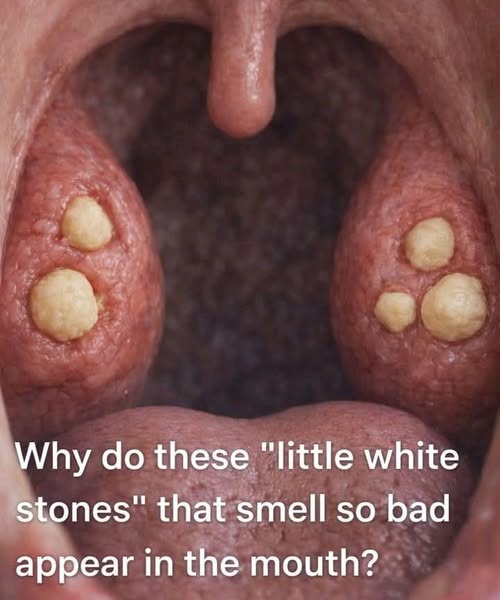
Small white or yellow stones in the mouth may be tonsil stones. Learn why they form, why they can smell so bad, common symptoms, and safe ways to prevent and manage them.
Why Do These Small White Stones Appear in the Mouth and Smell So Bad?
Have you ever noticed a tiny white or yellow lump near the back of your throat and wondered what it was?
If it is lodged inside one of the tonsils, it may be a tonsil stone, medically known as a tonsillolith.
These small, hard or soft formations are surprisingly common. Some people notice them when they look in the mirror, while others discover them after coughing up a tiny white lump with an unpleasant smell.
The smell can be particularly strong, but there is a simple reason for it.
What Exactly Are Tonsil Stones?
Tonsil stones form when material becomes trapped inside small folds, pits, and crevices on the tonsils.
The material can include:
- Food particles
- Mucus
- Dead cells
- Bacteria
- Saliva and other debris
Over time, this material can become compacted and may harden because of mineral deposits, creating a small white, yellowish, or sometimes grayish stone.
Some tonsil stones are barely visible, while others can become several millimeters in size.
Why Do They Smell So Bad?
The unpleasant odor is largely related to bacteria.
The trapped material inside a tonsil crypt can provide an environment where bacteria break down proteins and other organic material. This process can produce sulfur-containing compounds, which are associated with the characteristic foul odor of some tonsil stones.
That is why someone may notice a particularly unpleasant smell when a stone comes out.
Tonsil stones can therefore contribute to bad breath, especially when they are large, numerous, or repeatedly forming.
What Do Tonsil Stones Look Like?
They commonly appear as:
- Small white spots
- Cream-colored lumps
- Yellowish deposits
- Hard or crumbly particles
They are usually found in the tonsils at the back of the throat.
However, not every white spot in the throat is a tonsil stone. White patches can also occur with infections and other conditions, so persistent or unusual changes should be evaluated by a healthcare professional.
Common Symptoms of Tonsil Stones
Some people have tonsil stones without any symptoms at all.
Others may experience:
Bad Breath
This is one of the most common complaints associated with tonsil stones.
Something Stuck in the Throat
A larger stone may create the sensation that something is lodged at the back of the throat.
Sore or Irritated Throat
Tonsil stones can sometimes cause localized irritation.
Coughing
A person may cough when a stone becomes dislodged.
Difficulty Swallowing
Larger stones can occasionally make swallowing feel uncomfortable.
Ear Discomfort
Because the throat and ear share some nerve pathways, irritation around the tonsils can sometimes be felt as ear pain even when there is no ear infection.
Why Do Some People Get Tonsil Stones More Often?
Some people naturally have deeper tonsil crypts than others.
Deep crypts provide more places for food particles, mucus, and bacteria to become trapped.
People who frequently experience tonsil stones may also have a history of recurrent tonsil inflammation or enlarged tonsils.
Dry mouth and inadequate oral hygiene may contribute to the buildup of debris as well.
Are Tonsil Stones Dangerous?
Most tonsil stones are not dangerous.
Small stones often fall out on their own and may never cause significant problems.
The main issues are usually unpleasant breath, throat irritation, discomfort, or the recurring sensation of something being stuck in the throat.
However, symptoms that are severe, persistent, or associated with fever, significant swelling, difficulty breathing, or difficulty swallowing should not simply be blamed on tonsil stones.
Can You Get Rid of Tonsil Stones at Home?
Small tonsil stones may sometimes come out naturally when coughing, swallowing, or gargling.
Good oral hygiene can also help reduce the amount of debris available to accumulate.
Helpful habits include:
- Brush your teeth twice a day.
- Clean your tongue gently.
- Floss regularly.
- Drink enough water.
- Gargle with warm salt water if it feels soothing.
- Maintain regular dental checkups.
Avoid aggressively digging into the tonsils with sharp objects, fingernails, or other instruments. The tonsils are delicate and can bleed or become injured.
Does Gargling Help?
Warm salt-water gargling may help loosen debris and soothe throat irritation.
It does not guarantee that existing tonsil stones will disappear, but it can be a simple part of good oral and throat hygiene.
Some people also use alcohol-free mouthwash to improve overall oral hygiene.
What If Tonsil Stones Keep Coming Back?
Occasional tonsil stones usually don’t require specialized treatment.
But if they repeatedly return and cause significant bad breath, discomfort, or other problems, a doctor or ENT specialist can examine the tonsils and discuss treatment options.
In persistent cases, medical professionals may remove problematic stones or discuss other treatments depending on the person’s symptoms and history.
Tonsil removal is generally reserved for selected situations rather than being necessary for everyone who develops tonsil stones.
When Should You See a Doctor?
Seek medical advice if you have:
- Persistent or severe throat pain
- Difficulty breathing
- Significant difficulty swallowing
- Fever
- One-sided swelling
- Bleeding from the tonsils
- A persistent lump that doesn’t look like a typical tonsil stone
- Repeated tonsil infections
- Symptoms that keep returning despite good oral hygiene
These symptoms may indicate something other than a simple tonsil stone.
The Bottom Line
Those tiny white, foul-smelling lumps may be tonsil stones. They form when food particles, mucus, dead cells, bacteria, and other debris become trapped in the small crevices of the tonsils and gradually compact.
Their unpleasant smell is largely related to bacterial activity and sulfur-containing compounds.
For most people, tonsil stones are more annoying than dangerous. Good oral hygiene, adequate hydration, and gentle gargling may help reduce their occurrence. If they become frequent or cause significant symptoms, an ENT or dentist can help determine the best approach.