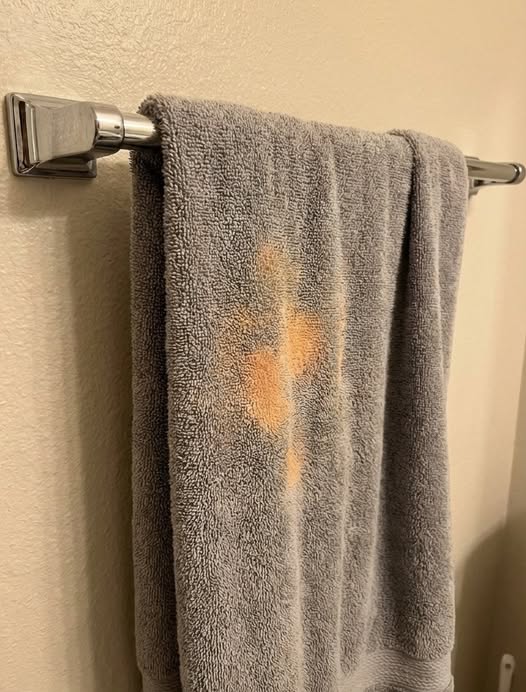
Have you ever pulled a clean towel out of the washing machine only to discover strange orange, rust-colored, or reddish stains that seem impossible to remove?
You’re not alone. Orange stains on towels are surprisingly common, and in many cases, they aren’t caused by dirt at all. Depending on where the stain comes from, ordinary detergent and repeated washing may do very little to remove it.
The good news is that once you identify the cause, you can usually prevent the stains from coming back—and sometimes remove them with a simple household treatment.
What Causes Orange Stains on Towels?
There are several possible reasons your towels may develop orange or rust-colored marks.
1. Rusty Water or Iron in the Water
One of the most common causes is iron in your household water.
If your water contains elevated levels of iron, it can react with oxygen and leave reddish-orange deposits on fabrics. This is especially noticeable on white or light-colored towels.
The problem may become worse if:
- Your home has old iron pipes
- You use well water
- Your water supply contains naturally occurring iron
- Your plumbing has corrosion
- A water heater or metal plumbing component is rusty
These stains often look like small orange spots, streaks, or patches.
Regular chlorine bleach can actually make iron stains worse because bleach can oxidize iron and make the discoloration more noticeable.
2. Rust From Your Washing Machine
Sometimes the water itself isn’t the problem.
A washing machine can develop rust around metal components, the drum, detergent dispenser, or other areas. Tiny amounts of rust can transfer onto towels during the wash cycle.
Check your machine carefully if you notice that the stains appear suddenly.
Look around:
- The detergent drawer
- The inside of the drum
- Metal edges
- The lid or door
- Areas underneath the rubber seal
If you find visible rust, simply treating the towels won’t completely solve the problem. The source needs to be addressed.
3. Skincare and Hair Products
Some orange or yellowish stains aren’t actually rust.
Certain skincare, haircare, and cosmetic products can discolor towels. Products containing ingredients such as benzoyl peroxide are particularly notorious for bleaching or discoloring colored fabrics.
Other products may contain oils, pigments, self-tanning ingredients, or other compounds that transfer onto towels.
If the stains appear mainly around the face, neck, or areas where you dry your skin, consider whether a personal-care product could be responsible.
4. Makeup and Self-Tanning Products
Foundation, bronzer, tinted moisturizers, and self-tanning products can leave yellow, orange, or brown marks.
These stains may become more difficult to remove after the towel goes through a hot dryer because heat can help set some stains into the fibers.
If you use these products, try rinsing the towel as soon as possible rather than immediately putting it into the dryer.
5. Certain Laundry Products
Occasionally, detergent, fabric softener, or other laundry additives can interact with minerals in water or residues already present in the fabric.
Using too much detergent can also leave buildup in towels.
Towels are particularly prone to buildup because their thick fibers can trap oils, detergent residue, and minerals.
Why Won’t Regular Washing Remove the Orange Stain?
The biggest mistake is assuming every stain is simply dirt.
Rust and iron stains are chemically different from ordinary food or body-oil stains. Washing detergent is designed primarily to remove oils, dirt, and other common soils—not necessarily mineral deposits.
Repeated washing may therefore leave the stain looking almost exactly the same.
And if you repeatedly dry the towel at high temperatures, you may make some organic stains more difficult to remove.
How to Remove Orange or Rust Stains From Towels
The treatment depends on the cause.
Method 1: Use a Rust Stain Remover
If you believe the stain is caused by iron or rust, look for a laundry-safe rust remover specifically designed for fabrics.
Follow the product’s label carefully and check that it is suitable for your towel’s material and color.
Never mix different cleaning chemicals together.
Method 2: Try Citric Acid for Mineral Deposits
For some mineral-related discoloration, a mild acidic treatment can help dissolve deposits.
Citric acid is commonly used to tackle mineral buildup. However, towels can contain dyes and finishes that may react differently, so test any treatment on an inconspicuous area first.
Rinse the towel thoroughly afterward.
Method 3: Treat Organic Stains Promptly
If the orange color comes from makeup, skincare, food, oils, or another organic substance, pretreat the affected area before washing.
Apply a suitable laundry stain treatment, gently work it into the fibers, and allow it to sit according to the product directions.
Then wash according to the towel’s care label.
Method 4: Avoid the Dryer Until the Stain Is Gone
This simple step can make a big difference.
After washing, inspect the towel before putting it into the dryer.
If the stain is still visible, treat it again.
Why?
Because high heat can make certain stains harder to remove. Air-drying while you’re working on the stain gives you another chance to treat it before the discoloration becomes more stubborn.
What About Vinegar?
White vinegar is often recommended online for almost every laundry problem.
It can be useful for certain types of residue and odors, but it isn’t a universal rust-stain remover.
If the orange mark is genuinely caused by iron or rust, vinegar may not be enough to completely remove it.
More importantly, never mix vinegar with chlorine bleach or other incompatible cleaning products.
When dealing with an unknown stain, it’s safer to identify the likely cause first.
Should You Use Bleach?
Be careful.
Chlorine bleach isn’t the best choice for rust or iron stains. It can oxidize iron and make orange or brown discoloration more pronounced.
If you regularly see rust-colored stains on white towels, don’t automatically reach for chlorine bleach.
Instead, determine whether you’re dealing with rust, mineral deposits, cosmetics, or another type of stain.
How to Prevent Orange Stains From Coming Back
Removing the stain is only half the solution.
Check Your Water
If multiple towels, sheets, or clothes develop reddish-orange marks, your water supply may contain excess iron.
A water-quality test can help determine whether iron or other minerals are present.
If you use well water, testing can be particularly useful.
Inspect Your Washing Machine
Look for rust or corrosion inside and around the machine.
Also clean the detergent dispenser and rubber seal regularly. Residue and moisture can accumulate in these areas.
Don’t Overload the Washer
Overloading prevents towels from moving freely through the wash.
That means detergent and water may not circulate properly, allowing residues to remain trapped in the thick fibers.
Give towels enough room to move during the wash cycle.
Use the Correct Amount of Detergent
More detergent doesn’t necessarily mean cleaner towels.
Excess detergent can build up in fabric, particularly when towels are washed repeatedly.
Follow the recommended amount for your detergent and water conditions.
Wash Towels Separately From Problem Items
If you use self-tanning products, heavy cosmetics, hair dyes, or other products that can transfer color, consider washing those towels separately.
This can help prevent stains from spreading to other laundry.
A Simple Way to Figure Out the Cause
If you’re unsure where the orange stain is coming from, look at the pattern.
Orange spots appearing randomly throughout several towels:
Iron or rust in the water could be responsible.
Stains appearing after washing but only on certain loads:
Check the washing machine and other items in the load.
Stains around the face or upper part of the towel:
Cosmetics or skincare products may be responsible.
Yellow-orange marks appearing after drying:
A heat-set organic stain or product residue may be involved.
The same stains appearing on many different fabrics:
Consider checking your water supply.
One Important Laundry Rule
Before trying any stain-removal method, check the towel’s care label and test the treatment on a hidden section.
And never mix cleaning chemicals simply because both products are individually considered safe.
In particular, avoid mixing chlorine bleach with acids such as vinegar or other household cleaners, as dangerous gases can be produced.
The Bottom Line
Those stubborn orange stains on your towels aren’t necessarily a sign that your towels aren’t clean.
They may be caused by iron-rich water, rust inside the washing machine, cosmetics, skincare products, self-tanning products, or laundry buildup.
The key is identifying the source before choosing a treatment.
If the stains keep returning despite washing, don’t keep scrubbing the towels harder. Look at the bigger picture: check your water, inspect your washing machine, review the products you use, and avoid drying stained towels until you’ve figured out the cause.
Once the source is fixed, keeping your towels fresh and stain-free becomes much easier.
Frequently Asked Questions
Are orange stains on towels caused by rust?
They can be. Iron in water or rust from plumbing and washing-machine components is one possible cause, but cosmetics and personal-care products can also create orange discoloration.
Does bleach remove orange rust stains?
Chlorine bleach is generally not recommended for rust stains and can make iron-related discoloration worse.
Why do my white towels turn orange?
Iron-rich water, rust, cosmetics, self-tanning products, and certain residues can cause orange or yellow discoloration.
Can a washing machine cause rust stains?
Yes. Corrosion or rust inside or around a washing machine can potentially transfer onto fabrics.
Why should I avoid drying the towel before removing the stain?
Heat can set certain types of stains, making them more difficult to remove later. It’s better to inspect the towel after washing and treat it again if necessary.
How can I stop orange stains from returning?
Identify the source first. If several fabrics are affected, investigate your water supply and washing machine. If only specific towels are affected, consider skincare, cosmetics, hair products, or other substances that contact the fabric.