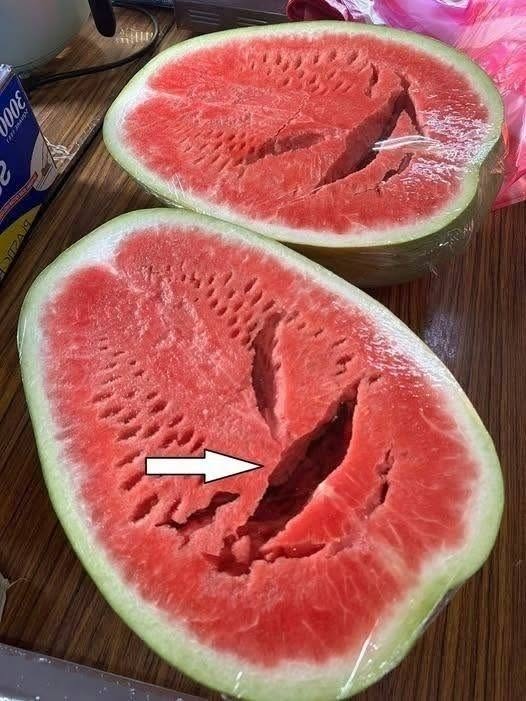
Found cracks inside your watermelon? Learn what those cracks can mean, when they may be harmless, and the warning signs that mean you should throw the watermelon away.
You Cut Open a Watermelon and Saw Cracks? Stop Eating It Immediately! Here’s What It Means
You cut open a watermelon expecting to see firm, juicy, bright-red flesh.
Instead, you notice something strange: cracks running through the inside.
Maybe the flesh has split in several places. Perhaps there are hollow-looking spaces, unusual lines, or sections that seem separated from the rest of the fruit.
Your first thought may be:
Is this watermelon safe to eat?
The good news is that cracks inside a watermelon do not automatically mean the fruit is dangerous. Some internal cracks can occur naturally as the fruit grows, while other changes can be signs that the watermelon is damaged, deteriorating, or no longer suitable to eat.
Knowing the difference is important.
Why Do Watermelons Develop Cracks?
Watermelons are mostly water, so changes in growing conditions can affect the way the fruit develops.
One possible cause is rapid growth.
When a watermelon absorbs water quickly or experiences changing growing conditions, the inside of the fruit can sometimes develop areas where the flesh separates or cracks.
This can happen even when the outside of the watermelon looks completely normal.
These internal cracks may affect texture and appearance without necessarily meaning that the fruit contains something toxic.
However, appearance alone isn’t enough to determine whether a watermelon is safe.
When Cracks May Not Be a Serious Problem
If you cut open a fresh watermelon and notice a few internal cracks, don’t automatically panic.
Look at the rest of the fruit.
If the watermelon:
- smells fresh,
- has normal-colored flesh,
- feels firm and juicy,
- has no visible mold,
- isn’t slimy,
- and has been stored properly,
the cracks may simply be a natural quality issue.
The watermelon may not have the ideal texture, but internal cracking by itself isn’t proof that it is spoiled.
When You Should Throw It Away
The situation changes if the cracks are accompanied by other signs of deterioration.
Do not eat the watermelon if you notice mold, an unpleasant or fermented smell, slimy flesh, significant discoloration, or obvious spoilage.
You should also be cautious if the fruit has been left at an unsafe temperature for an extended period or has been improperly stored.
A spoiled watermelon can contain harmful microorganisms even if only part of the fruit appears affected.
When in doubt, throwing it away is safer than taking a chance.
What About Hollow or Soft Areas?
Another condition people sometimes notice is a hollow or cracked appearance inside the watermelon.
The flesh may contain gaps, become less dense, or have an unusual texture.
This can be associated with growing conditions and isn’t necessarily a sign of contamination.
However, if the unusual texture comes with an unpleasant odor, excessive softness, discoloration, or other signs of spoilage, don’t eat it.
The important point is to look at the entire fruit rather than judging safety based on one characteristic alone.
Don’t Rely Only on the Color
A bright-red watermelon isn’t automatically safe, and a slightly unusual-looking watermelon isn’t automatically dangerous.
Food safety depends on several factors, including:
- freshness,
- storage temperature,
- handling,
- cleanliness,
- visible spoilage,
- and how long the fruit has been stored after cutting.
That’s why it’s better to evaluate multiple signs instead of relying on color or cracks alone.
How to Store Cut Watermelon Safely
Once you cut a watermelon, refrigeration becomes especially important.
Cut watermelon should be kept refrigerated rather than sitting at room temperature for long periods.
Use a clean knife and clean cutting surface when preparing it.
Store leftover pieces in a clean, covered container and keep the refrigerator cold.
If you aren’t sure how long the cut watermelon has been sitting out, it’s better to be cautious.
What You Should Check Before Eating It
Before taking another bite, give the watermelon a quick inspection.
Check the smell
Fresh watermelon should have a mild, pleasant smell.
A sour, fermented, alcoholic, or otherwise unpleasant odor is a warning sign.
Check the texture
The flesh should generally be firm and juicy.
If it feels unusually slimy, mushy, or sticky, don’t eat it.
Look for mold
Any visible mold is a reason to discard the fruit.
Don’t simply cut away a small moldy section and assume the rest is safe.
Consider how it was stored
Think about whether the watermelon was refrigerated appropriately after being cut.
Storage history matters just as much as appearance.
The Biggest Mistake Is Assuming Every Crack Means Poison
Sensational claims about watermelon often spread online because they sound alarming.
But an internal crack isn’t automatically evidence that a watermelon is poisonous or contaminated.
Some cracks are simply related to how the fruit developed.
The important thing is to recognize the difference between a harmless quality defect and actual spoilage.
Instead of asking only, “Does my watermelon have cracks?”, ask:
“Does it show other signs that it has gone bad?”
That question gives you a much better indication of whether you should eat it.
A Simple Rule to Remember
If your watermelon has a few internal cracks but otherwise looks, smells, and feels fresh, the cracks alone don’t necessarily mean you need to throw it away.
But if those cracks are accompanied by mold, foul odors, sliminess, unusual discoloration, or obvious deterioration, don’t take the risk.
When food looks or smells spoiled, the safest choice is to discard it.
Final Thoughts
Finding cracks inside a watermelon can certainly be surprising, especially when you expect the inside to look perfectly smooth.
But don’t let an alarming headline convince you that every cracked watermelon is dangerous.
Internal cracks can occur naturally and aren’t, by themselves, proof of contamination.
Instead, inspect the fruit carefully. Check its smell, texture, appearance, storage history, and overall freshness.
And remember the simplest food-safety rule:
When there are clear signs of spoilage, don’t taste it to find out whether it’s safe. Throw it away.