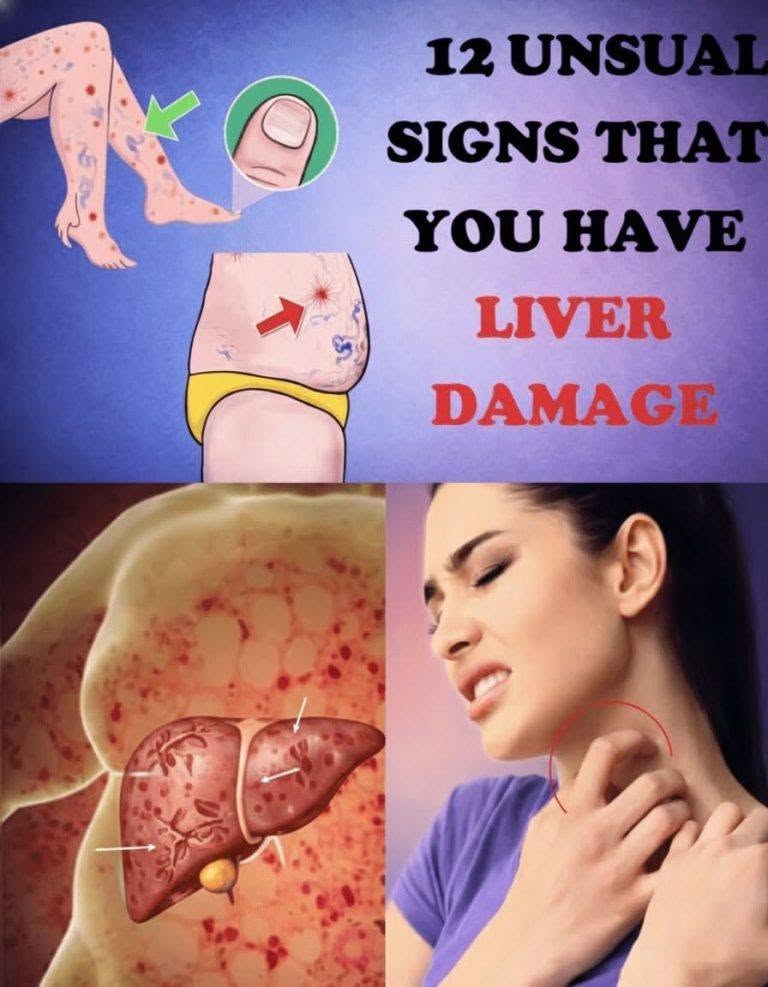
Discover 12 unusual warning signs that may be linked to liver problems, from persistent itching and unusual bruising to changes in urine, stool, and skin. Learn when these symptoms deserve medical attention.
12 Bizarre Red Flags Your Liver Is Screaming for Help — Seriously, Don’t Ignore Them
Your liver is one of the hardest-working organs in your body.
It helps process nutrients, produces important proteins, stores energy, supports digestion, and helps your body process substances it no longer needs.
The surprising part?
Liver problems don’t always begin with obvious pain.
In fact, some liver conditions can develop quietly, with symptoms that seem completely unrelated to the liver.
That is why unusual changes in your skin, digestion, energy levels, or bleeding patterns shouldn’t automatically be dismissed.
Here are 12 warning signs worth knowing.
1. Your Skin or Eyes Turn Yellow
One of the best-known warning signs of a liver problem is jaundice.
It can cause the whites of your eyes and your skin to develop a yellowish color.
This happens when bilirubin, a yellow substance produced when red blood cells break down, builds up in the body.
Jaundice can have several causes, including liver disease, gallbladder problems, and certain blood disorders.
Don’t ignore new or unexplained yellowing.
2. Your Urine Suddenly Becomes Very Dark
Dark urine can happen simply because you’re dehydrated.
But urine that remains unusually dark despite drinking enough fluids can sometimes occur when bilirubin is being excreted through the urine.
If dark urine appears together with yellow eyes, pale stools, abdominal symptoms, or significant fatigue, it deserves medical evaluation.
3. Your Stool Becomes Unusually Pale
Healthy stool is normally brown because of bile pigments.
If stools repeatedly become very pale, clay-colored, or grayish, it can indicate that bile isn’t reaching the intestine normally.
This can occur with problems involving the liver, bile ducts, or gallbladder.
One unusual bowel movement isn’t necessarily an emergency, but persistent pale stools should be discussed with a healthcare professional.
4. You Develop Persistent Itching With No Obvious Rash
Unexplained itching can have many causes.
Dry skin, allergies, medications, and dermatological conditions are common possibilities.
However, persistent itching without an obvious rash can sometimes occur with certain liver and bile-flow disorders.
If the itching is severe, widespread, or accompanied by jaundice or other unusual symptoms, don’t simply assume you need a stronger moisturizer.
5. You’re Bruising Much More Easily
Occasional bruises are normal.
But if you’re suddenly developing large bruises from minor bumps—or finding unexplained bruises frequently—it deserves attention.
Advanced liver disease can affect the body’s ability to produce proteins involved in blood clotting.
However, easy bruising can also be caused by medications, nutritional deficiencies, platelet disorders, and other conditions.
So the symptom shouldn’t automatically be blamed on the liver.
6. Your Energy Seems to Disappear
Feeling tired after a stressful week or poor night’s sleep is normal.
Persistent, unexplained fatigue is different.
People with liver disease may experience significant tiredness or weakness.
The problem is that fatigue is extremely nonspecific.
Anemia, thyroid problems, infections, sleep disorders, nutritional deficiencies, stress, and many other conditions can cause it.
That’s why ongoing fatigue should be evaluated rather than self-diagnosed.
7. Your Abdomen Starts Swelling
A progressively swollen abdomen can have many possible explanations.
But in advanced liver disease, fluid can accumulate inside the abdominal cavity. This condition is called ascites.
Ascites can make the abdomen feel unusually full, tight, or heavy.
New abdominal swelling—especially when it is persistent or rapidly worsening—should be medically assessed.
8. Your Legs or Ankles Become Swollen
Fluid retention can cause swelling around the ankles and lower legs.
In advanced liver disease, changes in blood proteins and circulation can contribute to fluid accumulation.
However, swollen legs are also associated with heart, kidney, vein, medication, and other medical problems.
Sudden swelling, particularly if one leg is painful, red, or warm, requires prompt medical attention because other conditions may be involved.
9. You Lose Your Appetite for No Clear Reason
A sudden or persistent decrease in appetite can be surprisingly important.
Liver disease may sometimes cause nausea, reduced appetite, or a feeling of fullness.
But appetite changes are common with infections, digestive conditions, medications, stress, and many other illnesses.
If poor appetite persists or is accompanied by unexplained weight loss, weakness, jaundice, or abdominal symptoms, speak with a healthcare professional.
10. Nausea Keeps Coming Back
Occasional nausea is common.
Persistent nausea or repeated episodes without an obvious explanation are different.
Liver dysfunction can sometimes contribute to nausea, particularly when accompanied by other symptoms.
But nausea alone isn’t enough to identify a liver problem.
If it keeps returning, particularly with vomiting, abdominal pain, jaundice, or significant loss of appetite, it should be evaluated.
11. You Notice Confusion or Unusual Changes in Thinking
This is one of the more serious warning signs.
Severe liver dysfunction can contribute to a condition called hepatic encephalopathy, in which toxins that are normally processed by the liver affect brain function.
Symptoms can include confusion, unusual sleepiness, difficulty concentrating, personality or behavior changes, or problems with coordination.
Sudden confusion or a major change in consciousness requires urgent medical attention.
Don’t wait for it to resolve on its own.
12. Your Hands or Feet Develop Unusual Changes
Certain physical changes can occur in people with chronic liver disease.
Examples can include changes in the nails, redness of the palms, or small spider-like blood vessels appearing on the skin.
These findings are not automatically evidence of liver disease.
Many benign conditions can produce similar changes.
But if several unusual signs appear together, especially alongside jaundice, abdominal swelling, unexplained bruising, or persistent fatigue, a medical evaluation is worthwhile.
The Biggest Mistake: Waiting for Liver Pain
Many people assume that liver disease must cause obvious pain in the upper-right side of the abdomen.
That’s not necessarily true.
Some liver conditions can remain relatively silent until significant damage has occurred.
That’s why paying attention to clusters of symptoms can be more useful than waiting for severe pain.
For example:
Yellow eyes + dark urine + pale stools
or
abdominal swelling + leg swelling + unusual fatigue
deserve much more attention than a single nonspecific symptom.
When Should You See a Doctor?
Make an appointment if you have persistent or unexplained symptoms such as:
- Yellow skin or eyes
- Repeatedly dark urine
- Pale or clay-colored stools
- Persistent unexplained itching
- Unusual bruising or bleeding
- Ongoing fatigue
- Persistent abdominal swelling
- Unexplained weight loss
- Recurrent nausea
- Changes in concentration or behavior
A healthcare professional may review your medications, medical history, alcohol exposure, and other risk factors and may order blood tests or imaging when appropriate.
When Is It an Emergency?
Seek urgent medical attention for symptoms such as:
- Sudden confusion or difficulty staying awake
- Vomiting blood
- Black, tar-like stools
- Severe abdominal swelling or severe abdominal pain
- Yellowing accompanied by severe illness
- Significant unexplained bleeding
These symptoms can have causes other than liver disease, but they should not be ignored.
The Bottom Line
Your liver doesn’t always send an obvious warning signal.
Sometimes the first clues can look surprisingly ordinary: fatigue, itching, appetite changes, bruising, or changes in urine and stool.
That doesn’t mean every unusual symptom is a liver problem.
It means persistent, unexplained changes deserve attention rather than dismissal.
Your body doesn’t need to scream before you listen.
Sometimes, the earliest warning is simply a small change that doesn’t feel quite right.